Zacharias Frida, Svahn Tony Martin
Department of Imaging and Functional Medicine, Division Diagnostics, Hudiksvall Hospital, Region Gävleborg, SE 824 81 Hudiksvall, Sweden.
Centre for Research and Development, Uppsala University, Region Gävleborg, SE 801 88 Gävle, Sweden.
Tomography. 2024 Dec 19;10(12):2087-2099. doi: 10.3390/tomography10120148.
This study aimed to assess the interobserver variability of semi-automatic diameter and volumetric measurements versus manual diameter measurements for small lung nodules identified on computed tomography scans.
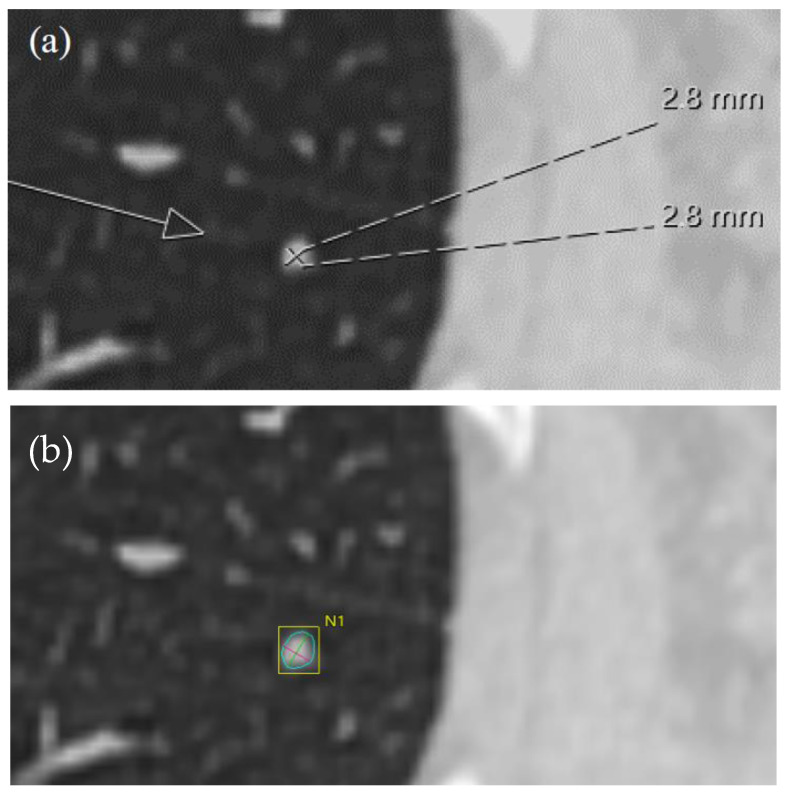
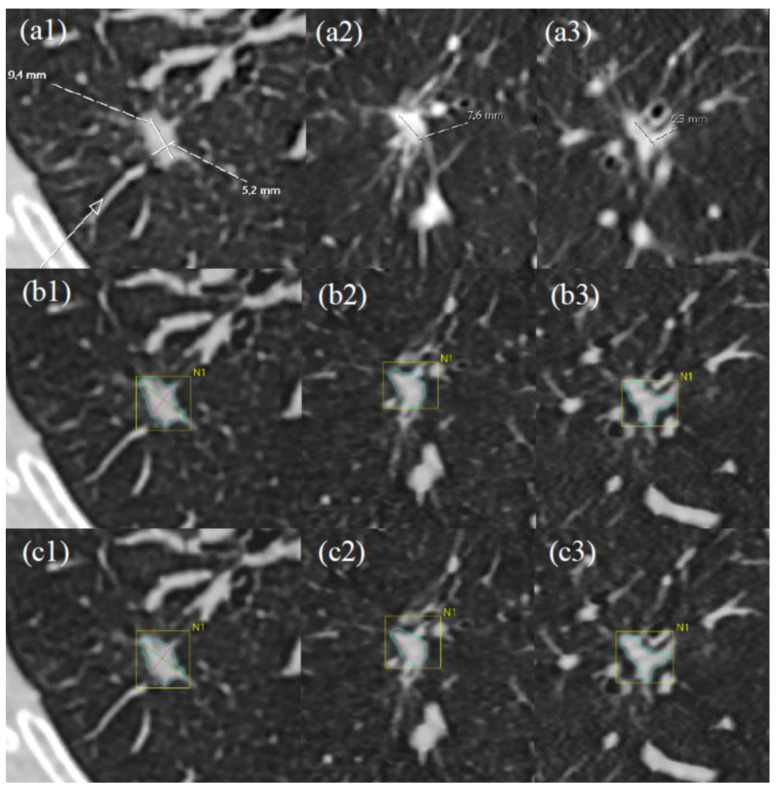
The radiological patient database was searched for CT thorax examinations with at least one noncalcified solid nodule (∼3-10 mm). Three radiologists with four to six years of experience evaluated each nodule in accordance with the Fleischner Society guidelines using standard diameter measurements, semi-automatic lesion diameter measurements, and volumetric assessments. Spearman's correlation coefficient measured intermeasurement agreement. We used descriptive Bland-Altman plots to visualize agreement in the measured data. Potential discrepancies were analyzed.
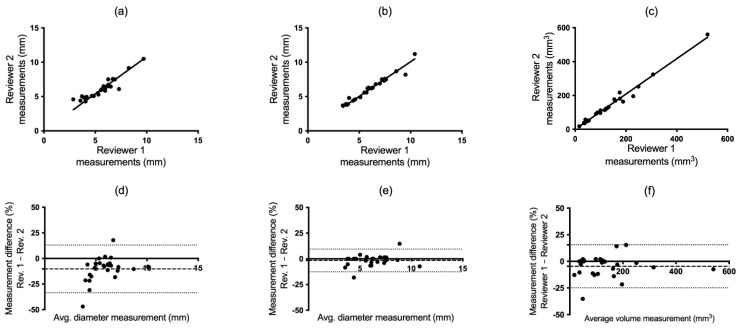
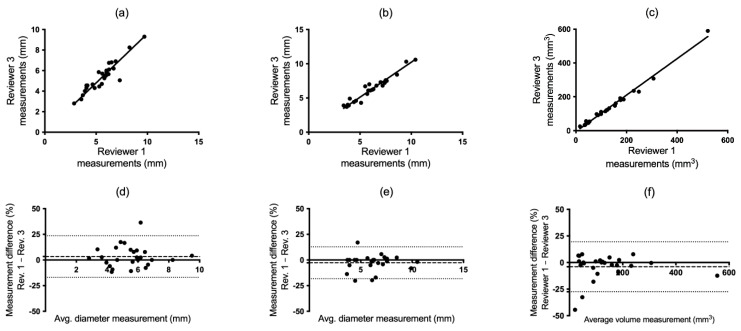
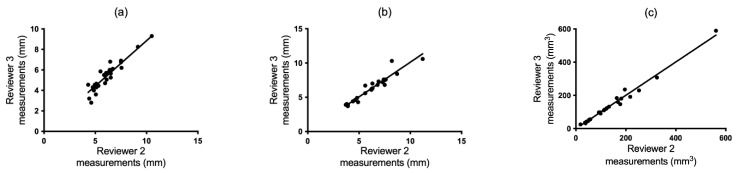
We studied a total of twenty-six nodules. Spearman's test showed that there was a much stronger relationship ( < 0.05) between reviewers for the semi-automatic diameter and volume measurements (avg. r = 0.97 ± 0.017 and 0.99 ± 0.005, respectively) than for the manual method (avg. r = 0.91 ± 0.017). In the Bland-Altman test, the semi-automatic diameter measure outperformed the manual method for all comparisons, while the volumetric method had better results in two out of three comparisons. The incidence of reviewers modifying the software's automatic outline varied between 62% and 92%.
Semi-automatic techniques significantly reduced interobserver variability for small solid nodules, which has important implications for diagnostic assessments and screening. Both the semi-automatic diameter and semi-automatic volume measurements showed improvements over the manual measurement approach. Training could further diminish observer variability, given the considerable diversity in the number of adjustments among reviewers.
本研究旨在评估计算机断层扫描中发现的小肺结节的半自动直径和体积测量与手动直径测量之间的观察者间变异性。
在放射学患者数据库中搜索至少有一个非钙化实性结节(约3 - 10毫米)的胸部CT检查。三位具有四至六年经验的放射科医生根据弗莱施纳学会指南,使用标准直径测量、半自动病变直径测量和体积评估对每个结节进行评估。Spearman相关系数用于测量测量间的一致性。我们使用描述性Bland - Altman图来直观显示测量数据中的一致性。分析了潜在的差异。
我们共研究了26个结节。Spearman检验表明,与手动方法(平均r = 0.91±0.017)相比,半自动直径和体积测量的审阅者之间的关系更强(<0.05)(平均r分别为0.97±0.017和0.99±0.005)。在Bland - Altman检验中,在所有比较中,半自动直径测量均优于手动方法,而体积测量方法在三次比较中的两次表现更好。审阅者修改软件自动轮廓的发生率在62%至92%之间。
半自动技术显著降低了小实性结节的观察者间变异性,这对诊断评估和筛查具有重要意义。半自动直径和半自动体积测量均比手动测量方法有所改进。鉴于审阅者之间调整数量存在相当大的差异,培训可能会进一步减少观察者变异性。