Park Jeongbin, Cook Seungho, Lee Dongjoo, Choi Jinyeong, Yoo Seongjin, Bae Sungwoo, Im Hyung-Jun, Lee Daeseung, Choi Hongyoon
Portrai, Inc., Dongsullagil, 78-18 Jongrogu, Seoul, Republic of Korea.
Portrai, Inc., Dongsullagil, 78-18 Jongrogu, Seoul, Republic of Korea; Department of Molecular Medicine and Biopharmaceutical Sciences, Graduate School of Convergence Science and Technology, Seoul National University, Seoul 08826, Republic of Korea; Department of Applied Bioengineering, Graduate School of Convergence Science and Technology, Seoul National University, Seoul 08826, Republic of Korea; Cancer Research Institute, Seoul National University, 03080 Seoul, Republic of Korea; Research Institute for Convergence Science, Seoul National University, 08826 Seoul, Republic of Korea.
Cell Rep Methods. 2025 Jan 27;5(1):100937. doi: 10.1016/j.crmeth.2024.100937. Epub 2024 Dec 26.
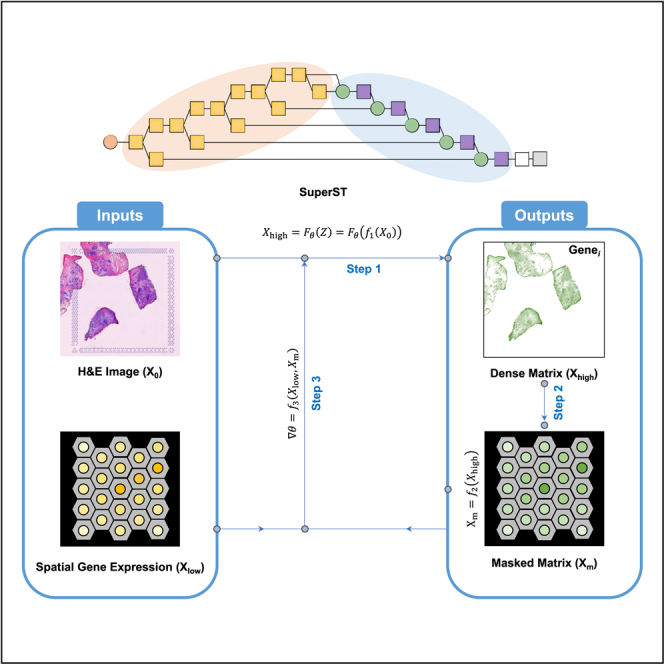
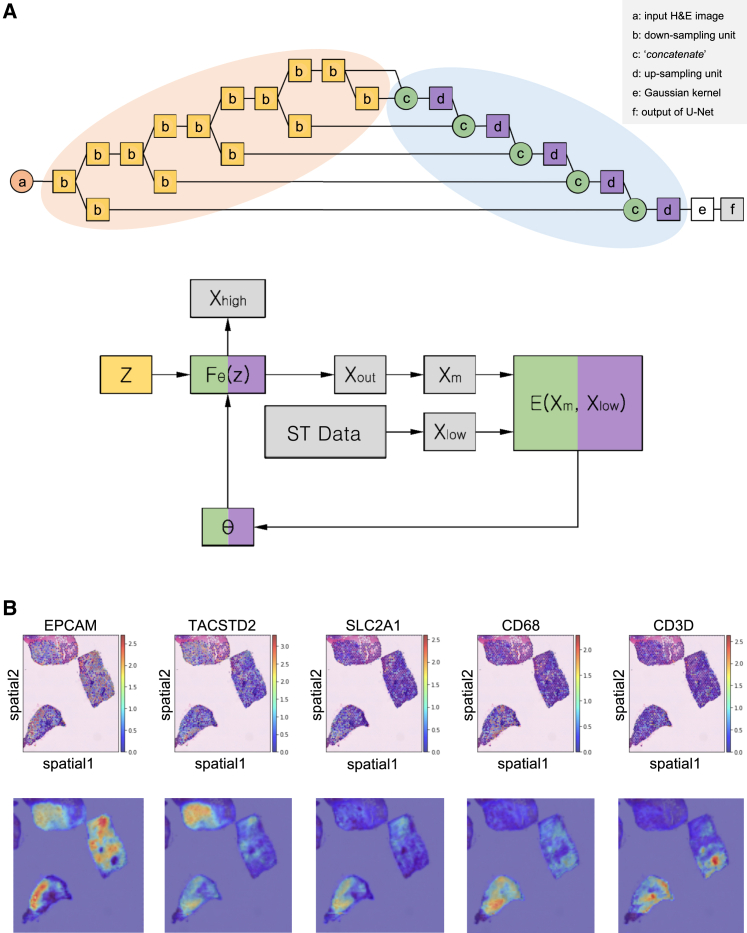
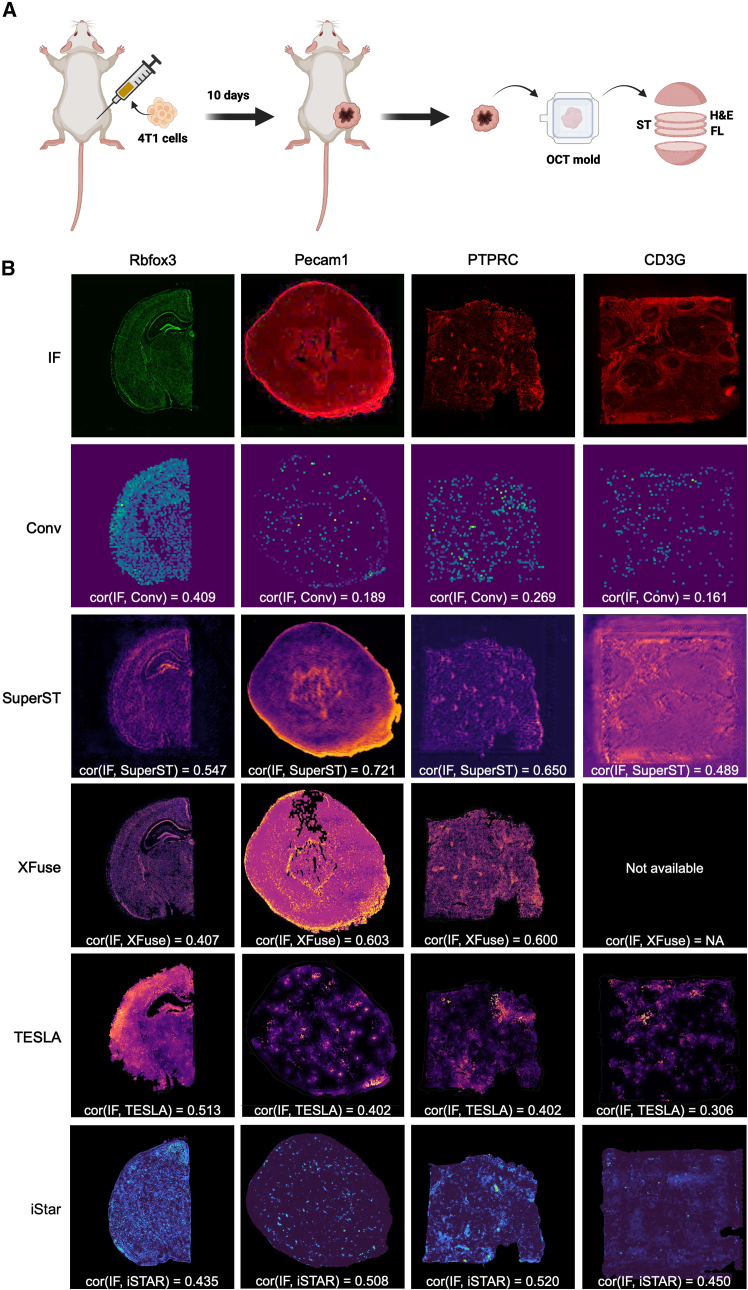
Spatially resolved transcriptomics (ST) has revolutionized the field of biology by providing a powerful tool for analyzing gene expression in situ. However, current ST methods, particularly barcode-based methods, have limitations in reconstructing high-resolution images from barcodes sparsely distributed in slides. Here, we present SuperST, an algorithm that enables the reconstruction of dense matrices (higher-resolution and non-zero-inflated matrices) from low-resolution ST libraries. SuperST is based on deep image prior, which reconstructs spatial gene expression patterns as image matrices. Compared with previous methods, SuperST generated output images that more closely resembled immunofluorescence images for given gene expression maps. Furthermore, we demonstrated how one can combine images created by SuperST with computer vision algorithms. In this context, we proposed a method for extracting features from the images, which can aid in spatial clustering of genes. By providing a dense matrix for each gene in situ, SuperST can successfully address the resolution and zero-inflation issue.
空间分辨转录组学(ST)通过提供一种用于原位分析基因表达的强大工具,彻底改变了生物学领域。然而,当前的ST方法,尤其是基于条形码的方法,在从稀疏分布在载玻片上的条形码重建高分辨率图像方面存在局限性。在此,我们提出了SuperST,一种能够从低分辨率ST文库重建密集矩阵(更高分辨率且非零膨胀矩阵)的算法。SuperST基于深度图像先验,将空间基因表达模式重建为图像矩阵。与先前的方法相比,对于给定的基因表达图谱,SuperST生成的输出图像与免疫荧光图像更为相似。此外,我们展示了如何将SuperST创建的图像与计算机视觉算法相结合。在此背景下,我们提出了一种从图像中提取特征的方法,这有助于基因的空间聚类。通过为每个基因原位提供一个密集矩阵,SuperST能够成功解决分辨率和零膨胀问题。