Nanyang Business School, Nanyang Technological University, Singapore, Singapore.
School of Business, Singapore University of Social Sciences, Singapore, Singapore.
Nat Commun. 2021 Jan 29;12(1):711. doi: 10.1038/s41467-021-20910-4.
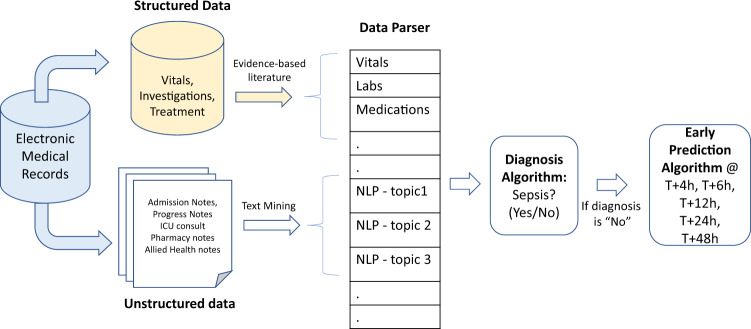
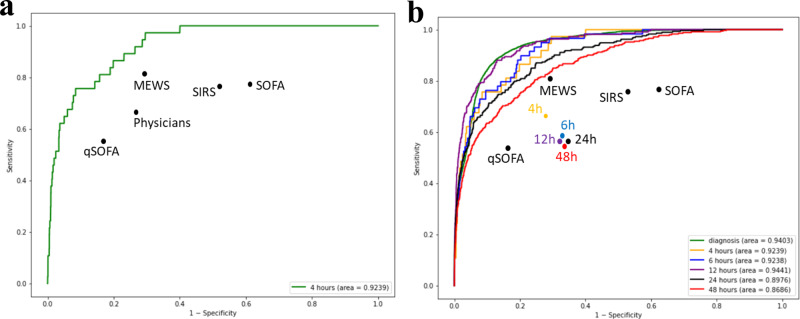
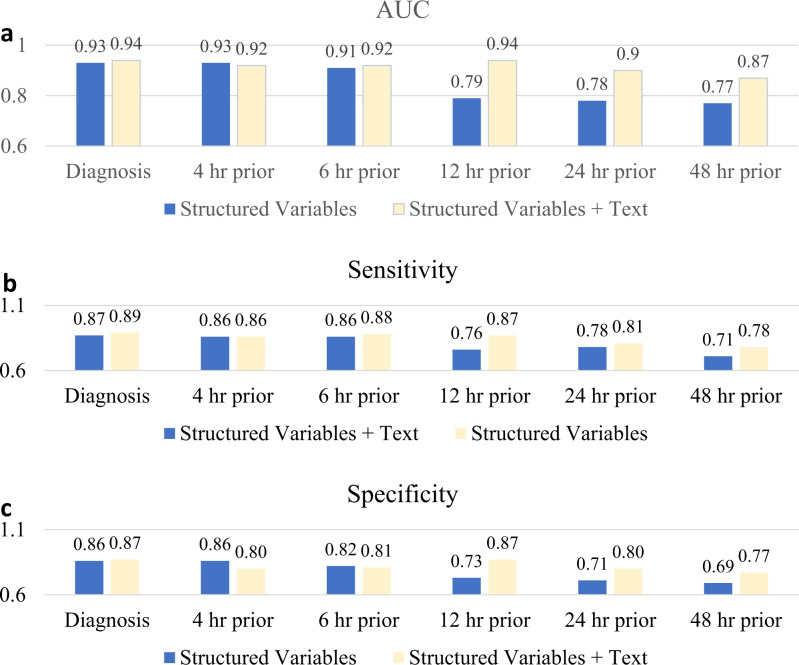
Sepsis is a leading cause of death in hospitals. Early prediction and diagnosis of sepsis, which is critical in reducing mortality, is challenging as many of its signs and symptoms are similar to other less critical conditions. We develop an artificial intelligence algorithm, SERA algorithm, which uses both structured data and unstructured clinical notes to predict and diagnose sepsis. We test this algorithm with independent, clinical notes and achieve high predictive accuracy 12 hours before the onset of sepsis (AUC 0.94, sensitivity 0.87 and specificity 0.87). We compare the SERA algorithm against physician predictions and show the algorithm's potential to increase the early detection of sepsis by up to 32% and reduce false positives by up to 17%. Mining unstructured clinical notes is shown to improve the algorithm's accuracy compared to using only clinical measures for early warning 12 to 48 hours before the onset of sepsis.
败血症是医院中主要的死亡原因。败血症的早期预测和诊断至关重要,可以降低死亡率,但败血症的许多迹象和症状与其他不太严重的病症相似,因此具有挑战性。我们开发了一种人工智能算法,即 SERA 算法,该算法同时使用结构化数据和非结构化临床记录来预测和诊断败血症。我们使用独立的临床记录来测试该算法,并在败血症发作前 12 小时达到了较高的预测准确性(AUC 为 0.94,灵敏度为 0.87,特异性为 0.87)。我们将 SERA 算法与医生的预测进行了比较,表明该算法有可能将败血症的早期检测提高多达 32%,并将假阳性减少多达 17%。与仅使用临床指标在败血症发作前 12 至 48 小时进行早期预警相比,挖掘非结构化临床记录显示可以提高算法的准确性。