Liu Lisha, Yi Jiaojiao, Xu Kun, Liu Zhen, Tang Mingmeng, Dai Le, Gao Xuan, Liu Yang, Wang Shuhao, Zhang Zhang, Shu Liang, Li Jing-Feng, Zhang Shujun, Wang Yaojin
School of Materials Science and Engineering, Nanjing University of Science and Technology, Nanjing, Nanjing, China.
Laboratory of Advanced Multicomponent Materials, School of Mechanical Engineering, Jiangsu University of Technology, Changzhou, China.
Nat Commun. 2024 Dec 30;15(1):10798. doi: 10.1038/s41467-024-54707-y.
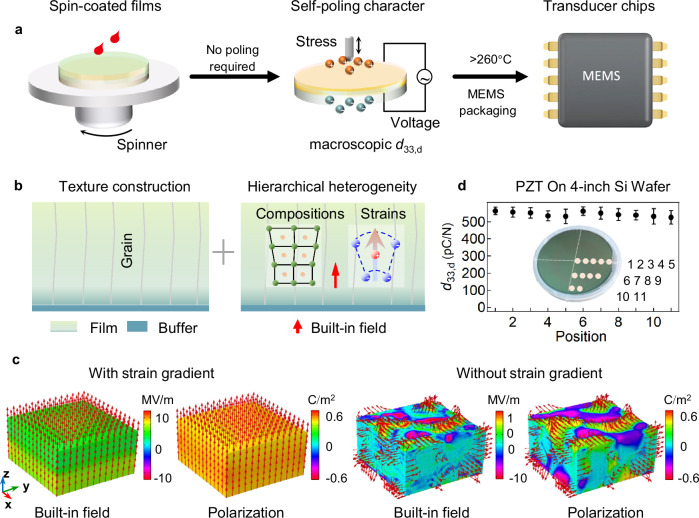
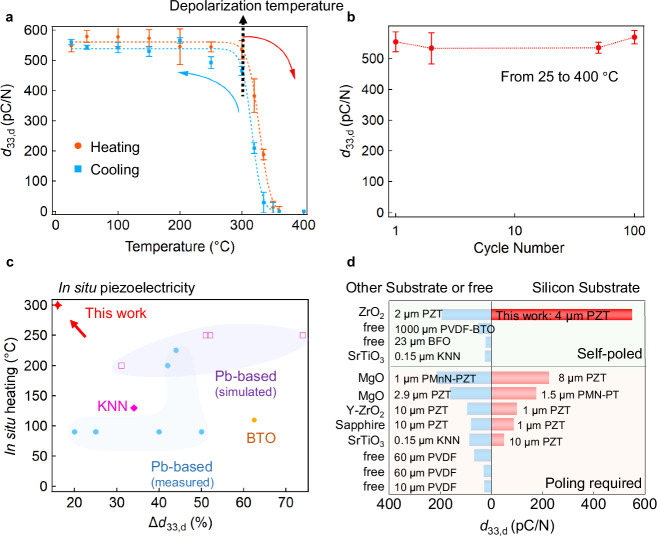
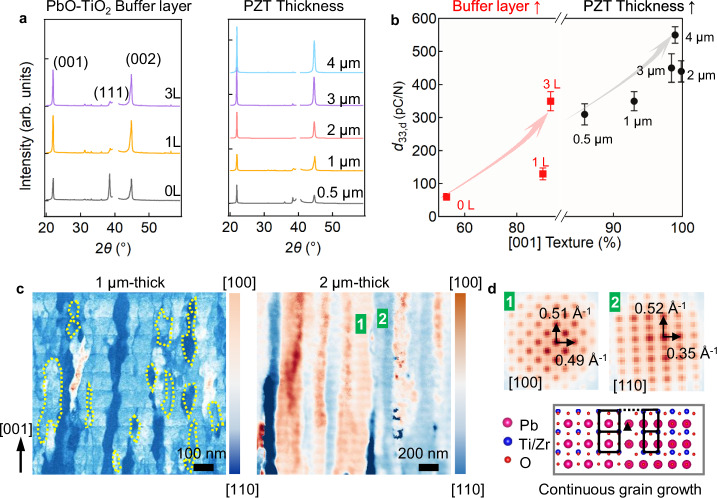
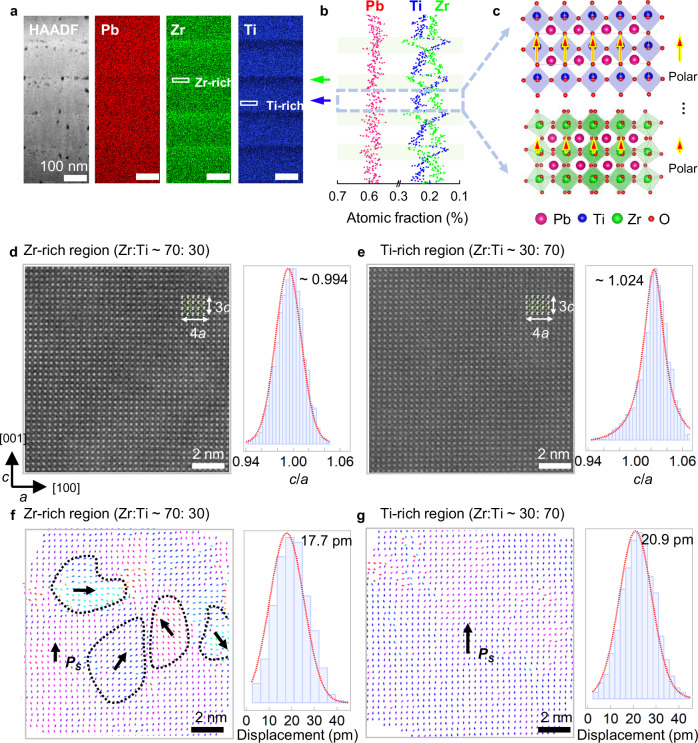
Ferroelectric films are highly sought-after in micro-electro-mechanical systems, particularly with the trend towards miniaturization. However, their tendency to depolarize and degradation in piezoelectric properties when exposed to packaging procedures at temperatures exceeding 260 °C remains a significant challenge. Here, we reveal the prerequisites for self-poling and leverage these insights to achieve unprecedented macroscopic performance through a two-step approach involving texture construction and hierarchical heterogeneity engineering. The significant [001] texture and fine Zr/Ti heterogeneity, facilitated by a PbO-TiO buffer, enable a piezoelectric charge coefficient of 550 pC/N in self-poled Pb(ZrTi)O film. This material demonstrates impressive resilience to elevated temperatures up to 300 °C, experiencing less than a 16% degradation in performance. Our approach can be extended to other ferroelectric systems, offering an innovative solution for high-temperature packaging and harsh environments in practical electro-mechanical applications.
铁电薄膜在微机电系统中备受青睐,尤其是在小型化趋势下。然而,当暴露于温度超过260°C的封装过程时,它们会出现去极化倾向以及压电性能退化,这仍然是一个重大挑战。在此,我们揭示了自极化的先决条件,并利用这些见解,通过一种涉及织构构建和分级异质性工程的两步法,实现了前所未有的宏观性能。由PbO-TiO缓冲层促成的显著的[001]织构和精细的Zr/Ti异质性,使得自极化的Pb(ZrTi)O薄膜的压电电荷系数达到550 pC/N。这种材料在高达300°C的高温下表现出令人印象深刻的稳定性,性能退化不到16%。我们的方法可以扩展到其他铁电系统,为实际机电应用中的高温封装和恶劣环境提供了一种创新解决方案。