Geeitha S, Prabha K P Rama, Cho Jaehyuk, Easwaramoorthy Sathishkumar Veerappampalayam
Department of Information Technology, M. Kumarasamy College of Engineering, Thalavapalayam, Karur, Tamil Nadu, India.
School of Computer Science and Engineering, Vellore Institute of Technology, Chennai, Tamil Nadu, India.
Sci Rep. 2024 Dec 30;14(1):31641. doi: 10.1038/s41598-024-80472-5.
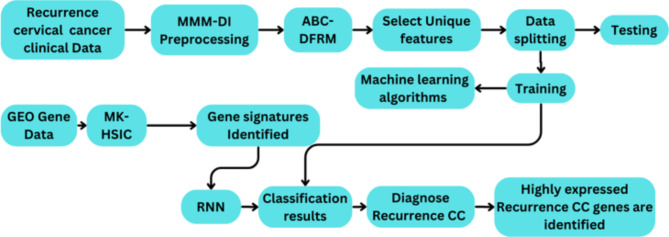
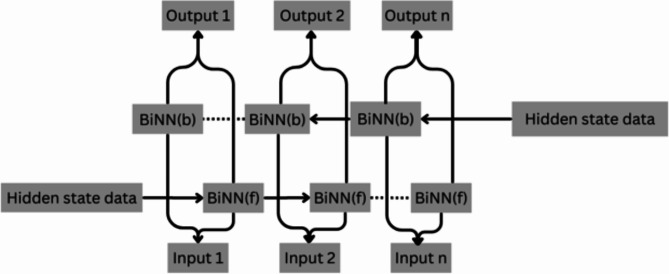
Cervical cancer is a deadly disease in women globally. There is a greater chance of getting rid of cervical cancer in case of earliest diagnosis. But for some patients, there is a chance of recurrence. The chances of treating the Recurrence of cervical carcinoma arelimited. The main objective of a research is to find the key features that will predict the cervical cancer recurrence and survival rates accurately by utilizing a neural network that is bidirectionally recurrent. The goal is to reduce risk factors of cervical cancer recurrence by identifying genes with positive coefficients and targeting them for preventive interventions. First step is identification of risk factors for cervical carcinoma recurrence by utilising clinical attributes. This research uses following Random forest, Logistic regression, Gradient boosting and support vector machine algorithms are applied for classification. Random forest offers the maximum precision of these four techniques at 91.2%. The second step is identifying long noncoding RNA (lnRNA) gene signatures among people with cervical carcinomaby implementingHSIC model. Intended to discover biomarkers in initial cervical carcinoma clinical data from people who experienced a distant repetition that could be connected to lnRNA gene signatures and utilized for forecasting survival rates using a bidirectional recurrent neural network(Bi-RNN). The results shows that Bi-RNN model effectively forecast the cervical cancer recurrence and survival.
宫颈癌是全球女性中的一种致命疾病。如果能最早诊断,摆脱宫颈癌的机会就更大。但对一些患者来说,存在复发的可能性。治疗宫颈癌复发的机会有限。一项研究的主要目标是通过利用双向递归神经网络,找到能够准确预测宫颈癌复发和生存率的关键特征。目标是通过识别具有正系数的基因并针对它们进行预防性干预,来降低宫颈癌复发的风险因素。第一步是利用临床属性确定宫颈癌复发的风险因素。本研究使用随机森林、逻辑回归、梯度提升和支持向量机算法进行分类。在这四种技术中,随机森林的精度最高,为91.2%。第二步是通过实施HSIC模型,在宫颈癌患者中识别长链非编码RNA(lnRNA)基因特征。旨在从经历远处复发的患者的初始宫颈癌临床数据中发现生物标志物,这些生物标志物可能与lnRNA基因特征相关,并用于使用双向递归神经网络(Bi-RNN)预测生存率。结果表明,Bi-RNN模型有效地预测了宫颈癌的复发和生存率。