Peng Junwei, Geng Xiaoyujie, Zhao Yiyue, Hou Zhijin, Tian Xin, Liu Xinyi, Xiao Yuanyuan, Liu Yang
Reproductive Medicine Department, Second Affiliated Hospital of Kunming Medical University, Kunming, China.
Division of Epidemiology and Health Statistics, School of Public Health, Kunming Medical University, Kunming, China.
Sci Rep. 2024 Dec 30;14(1):32083. doi: 10.1038/s41598-024-83781-x.
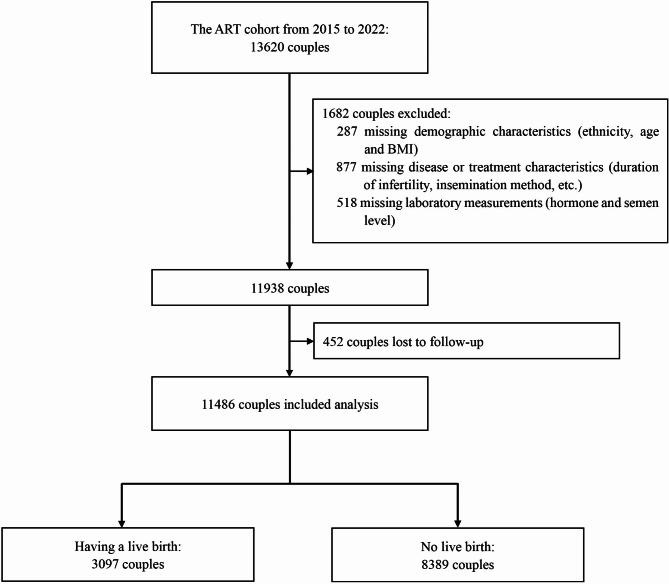
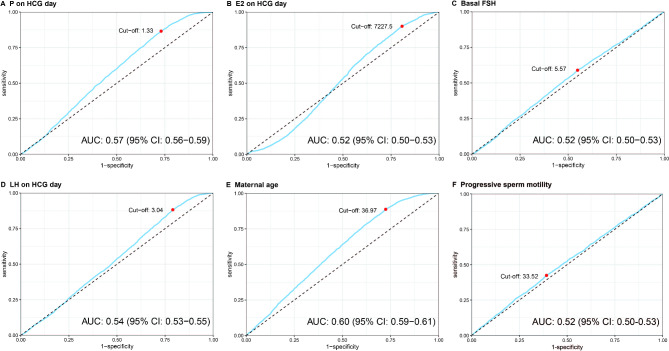
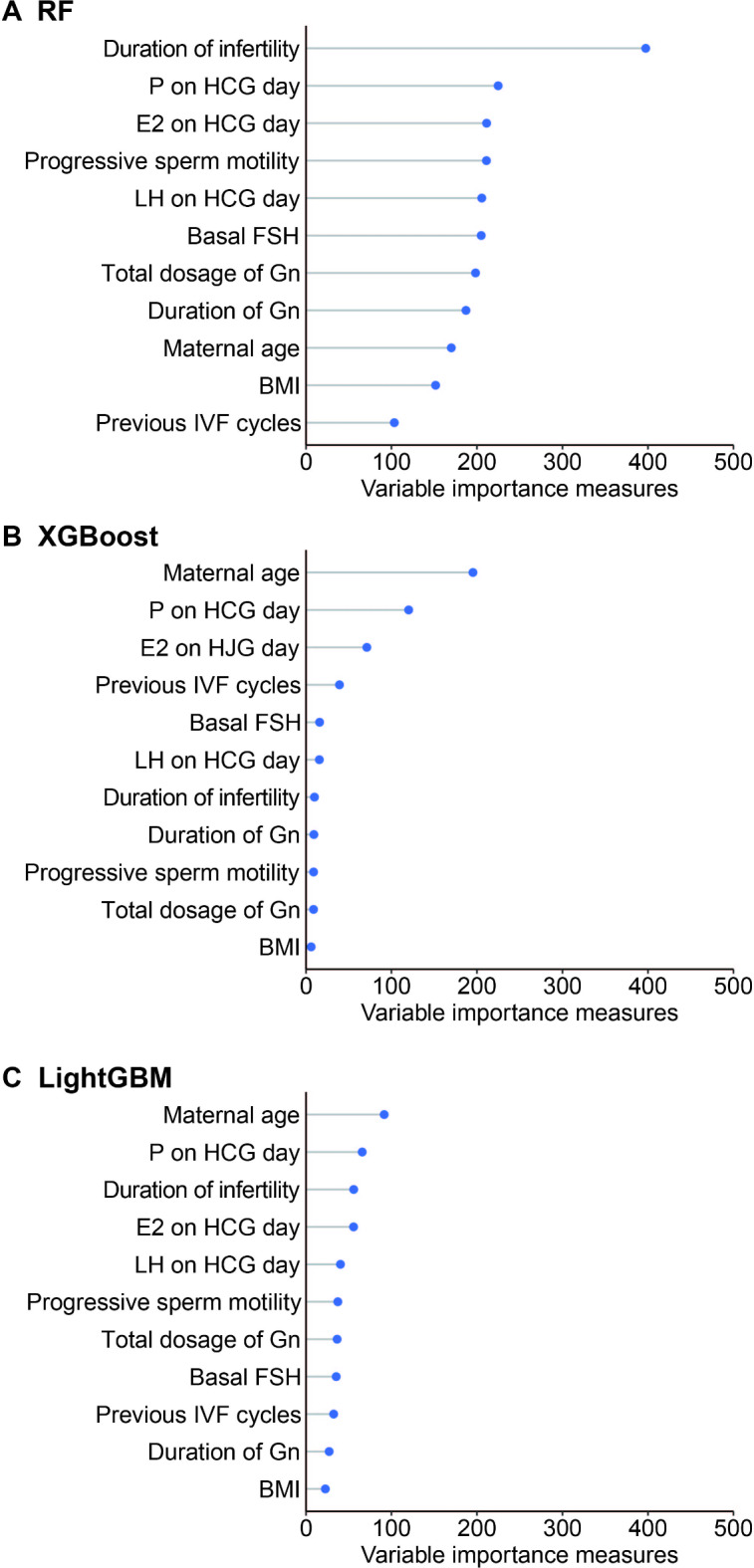
Currently applicable models for predicting live birth outcomes in patients who received assisted reproductive technology (ART) have methodological or study design limitations that greatly obstruct their dissemination and application. Models suitable for Chinese couples have not yet been identified. We conducted a retrospective study by using a database includes a total of 11,938 couples who underwent in vitro fertilization (IVF) treatment between January 2015 and December 2022 in a medical institution of southwest China Yunnan province. Multiple candidate predictors were screened out by using the importance scores. Four machine learning (ML) algorithms including random forest, extreme gradient boosting, light gradient boosting machine and binary logistic regression were used to construct prediction models. An initial assessment of the predictive performance was conducted and validated by using cross-validation and bootstrap methods. A total of seven predictors were identified, namely maternal age, duration of infertility, basal follicle-stimulating hormone (FSH), progressive sperm motility, progesterone (P) on HCG day, estradiol (E2) on HCG day, and luteinizing hormone (LH) on HCG day. Of the four predictive models, the random forest model and the logistic regression model were considered to have the optimal performance, with the areas under the receiver operating characteristic curve (AUROC) curves of 0.671 (95% CI 0.630-0.713) and 0.674 (95% CI 0.627-0.720). The Brier scores were 0.183 (95% CI 0.170-0.196) and 0.183 (95% CI 0.170-0.196), respectively. Considering the simplicity of model fitting, we recommend the logistic regression model as the best predictive model for live birth. Furthermore, maternal age, P on HCG day and E2 on HCG day were deemed to have the highest contribution to model prediction.
目前用于预测接受辅助生殖技术(ART)患者活产结局的模型存在方法学或研究设计方面的局限性,这极大地阻碍了它们的传播和应用。尚未确定适合中国夫妇的模型。我们进行了一项回顾性研究,使用了一个数据库,该数据库包含2015年1月至2022年12月在中国西南部云南省一家医疗机构接受体外受精(IVF)治疗的总共11938对夫妇。通过重要性得分筛选出多个候选预测因素。使用包括随机森林、极端梯度提升、轻梯度提升机和二元逻辑回归在内的四种机器学习(ML)算法构建预测模型。通过交叉验证和自助法对预测性能进行了初步评估和验证。总共确定了七个预测因素,即产妇年龄、不孕持续时间、基础卵泡刺激素(FSH)、精子前向运动率、HCG日的孕酮(P)、HCG日的雌二醇(E2)和HCG日的促黄体生成素(LH)。在这四个预测模型中,随机森林模型和逻辑回归模型被认为具有最佳性能,受试者操作特征曲线(AUROC)曲线下面积分别为0.671(95%CI 0.630-0.713)和0.674(95%CI 0.627-0.720)。Brier分数分别为0.183(95%CI 0.170-0.196)和0.183(95%CI 0.170-0.196)。考虑到模型拟合的简单性,我们推荐逻辑回归模型作为活产的最佳预测模型。此外,产妇年龄、HCG日的P和HCG日的E2被认为对模型预测的贡献最大。