Alqahtani Bashayr, Li Hanrui, Syed Abdul Momin, El-Atab Nazek
Electrical and Computer Engineering Program, Computer Electrical Mathematical Science and Engineering Division, King Abdullah University of Science and Technology (KAUST), Thuwal, Saudi Arabia.
Electrical Engineering Department, College of Engineering, Princess Nourah Bint Abdulrahman University (PNU), Riyadh, Saudi Arabia.
Light Sci Appl. 2025 Jan 3;14(1):30. doi: 10.1038/s41377-024-01698-6.
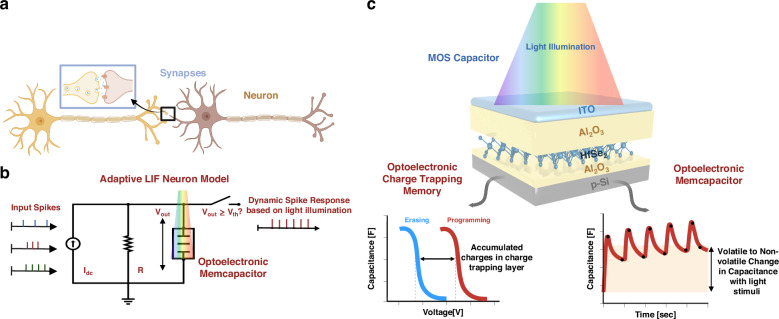
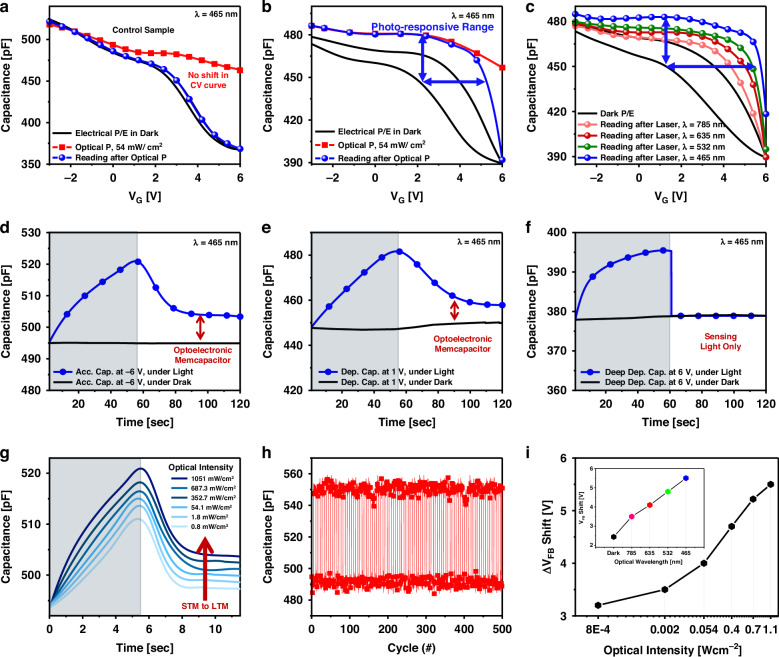
Advancements in neuromorphic computing have given an impetus to the development of systems with adaptive behavior, dynamic responses, and energy efficiency characteristics. Although charge-based or emerging memory technologies such as memristors have been developed to emulate synaptic plasticity, replicating the key functionality of neurons-integrating diverse presynaptic inputs to fire electrical impulses-has remained challenging. In this study, we developed reconfigurable metal-oxide-semiconductor capacitors (MOSCaps) based on hafnium diselenide (HfSe). The proposed devices exhibit (1) optoelectronic synaptic features and perform separate stimulus-associated learning, indicating considerable adaptive neuron emulation, (2) dual light-enabled charge-trapping and memcapacitive behavior within the same MOSCap device, whose threshold voltage and capacitance vary based on the light intensity across the visible spectrum, (3) memcapacitor volatility tuning based on the biasing conditions, enabling the transition from volatile light sensing to non-volatile optical data retention. The reconfigurability and multifunctionality of MOSCap were used to integrate the device into a leaky integrate-and-fire neuron model within a spiking neural network to dynamically adjust firing patterns based on light stimuli and detect exoplanets through variations in light intensity.
神经形态计算的进展推动了具有自适应行为、动态响应和能源效率特性的系统的发展。尽管已经开发出基于电荷或忆阻器等新兴存储技术来模拟突触可塑性,但复制神经元的关键功能——整合各种突触前输入以激发电脉冲——仍然具有挑战性。在本研究中,我们基于二硒化铪(HfSe)开发了可重构金属氧化物半导体电容器(MOSCap)。所提出的器件表现出:(1)光电突触特性并执行与刺激相关的单独学习,表明具有相当大的自适应神经元模拟能力;(2)在同一MOSCap器件内具有双光控电荷俘获和忆容行为,其阈值电压和电容会根据可见光谱范围内的光强度而变化;(3)基于偏置条件的忆容波动性调节,能够从易失性光传感转变为非易失性光学数据保留。MOSCap的可重构性和多功能性被用于将该器件集成到脉冲神经网络中的泄漏积分发放神经元模型中,以根据光刺激动态调整发放模式,并通过光强度变化检测系外行星。