Peng Yun, Wu Chunmiao, Sun Ke, Li Zihao, Xiong Liangxia, Sun Xiaoyu, Wan Min, Gong Lianggeng
Department of Radiology, The Second Affiliated Hospital, Jiangxi Medical College, Nanchang University, Nanchang, Jiangxi, China.
Jiangxi Provincial Key Laboratory of Intelligent Medical Imaging, Nanchang, China.
PLoS One. 2025 Jan 6;20(1):e0316642. doi: 10.1371/journal.pone.0316642. eCollection 2025.
This study aimed to assess the feasibility of the deep learning in generating T2 weighted (T2W) images from diffusion-weighted imaging b0 images.
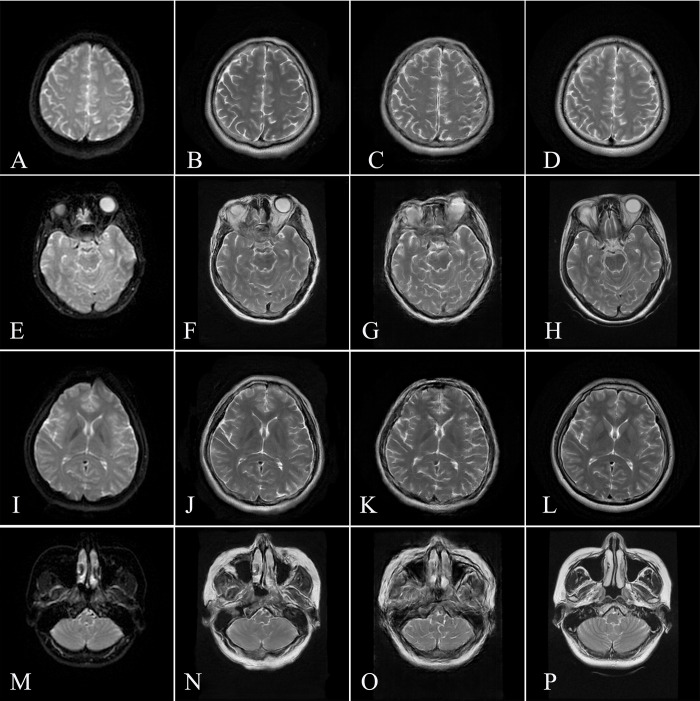
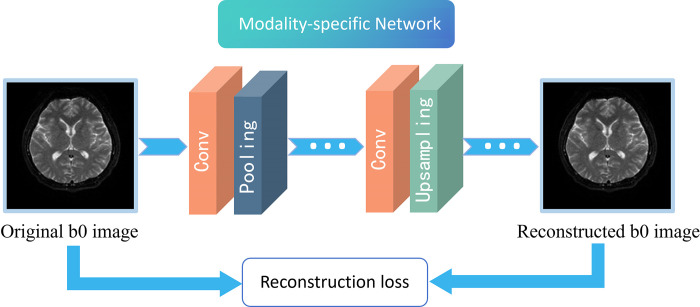
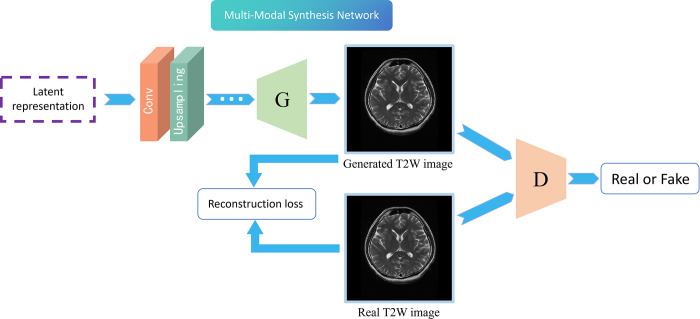
This retrospective study included 53 patients who underwent head magnetic resonance imaging between September 1 and September 4, 2023. Each b0 image was matched with a corresponding T2-weighted image. A total of 954 pairs of images were divided into a training set with 763 pairs and a test set with 191 pairs. The Hybrid-Fusion Network (Hi-Net) and pix2pix algorithms were employed to synthesize T2W (sT2W) images from b0 images. The quality of the sT2W images was evaluated using three quantitative indicators: Peak Signal-to-Noise Ratio (PSNR), Structural Similarity (SSIM), and Normalized Mean Squared Error (NMSE). Subsequently, two radiologists were required to determine the authenticity of (s)T2W images and further scored the visual quality of sT2W images in the test set using a five-point Likert scale. The overall quality score, anatomical sharpness, tissue contrast and homogeneity were used to reflect the quality of the images at the level of overall and focal parts.
The indicators of pix2pix algorithm in test set were as follows: PSNR, 20.549±1.916; SSIM, 0.702±0.0864; NMSE, 0.239±0.150. The indicators of Hi-Net algorithm were as follows: PSNR, 20.646 ± 2.194; SSIM, 0.722 ± 0.0955; NMSE, 0.469 ± 0.124. Hi-Net performs better than pix2pix, so the sT2W images obtained by Hi-Net were used for radiologist assessment. The two readers accurately identified the nature of the images at rates of 69.90% and 71.20%, respectively. The synthetic images were falsely identified as real at rates of 57.6% and 57.1%, respectively. The overall quality score, sharpness, tissue contrast, and image homogeneity of the sT2Ws images ranged between 1.63 ± 0.79 and 4.45 ± 0.88. Specifically, the quality of the brain parenchyma, skull and scalp, and middle ear region was superior, while the quality of the orbit and paranasal sinus region was not good enough.
The Hi-Net is able to generate sT2WIs from low-resolution b0 images, with a better performance than pix2pix. It can therefore help identify incidental lesion through providing additional information, and demonstrates the potential to shorten the acquisition time of brain MRI during acute ischemic stroke imaging.
本研究旨在评估深度学习从扩散加权成像b0图像生成T2加权(T2W)图像的可行性。
这项回顾性研究纳入了2023年9月1日至9月4日期间接受头部磁共振成像的53例患者。每个b0图像都与相应的T2加权图像匹配。总共954对图像被分为一个包含763对图像的训练集和一个包含191对图像的测试集。采用混合融合网络(Hi-Net)和pix2pix算法从b0图像合成T2W(sT2W)图像。使用三个定量指标评估sT2W图像的质量:峰值信噪比(PSNR)、结构相似性(SSIM)和归一化均方误差(NMSE)。随后,要求两名放射科医生确定(s)T2W图像的真实性,并使用五点李克特量表进一步对测试集中sT2W图像的视觉质量进行评分。总体质量得分、解剖清晰度、组织对比度和均匀性用于反映图像在整体和局部层面的质量。
pix2pix算法在测试集中的指标如下:PSNR为20.549±1.916;SSIM为0.702±0.0864;NMSE为0.239±0.150。Hi-Net算法的指标如下:PSNR为20.646±2.194;SSIM为0.722±0.0955;NMSE为0.469±0.124。Hi-Net的性能优于pix2pix,因此将Hi-Net获得的sT2W图像用于放射科医生评估。两位读者分别以69.90%和71.20%的准确率识别出图像的性质。合成图像被误判为真实图像的比例分别为57.6%和57.1%。sT2W图像的总体质量得分、清晰度、组织对比度和图像均匀性在1.63±0.79至4.45±0.88之间。具体而言,脑实质、颅骨和头皮以及中耳区域的质量较好,而眼眶和鼻旁窦区域的质量不够好。
Hi-Net能够从低分辨率b0图像生成sT2WIs,性能优于pix2pix。因此,它可以通过提供额外信息帮助识别偶然病变,并显示出在急性缺血性中风成像期间缩短脑部MRI采集时间的潜力。