
NeCA:通过神经隐式表示从两个二维投影重建三维冠状动脉树。
NeCA: 3D Coronary Artery Tree Reconstruction from Two 2D Projections via Neural Implicit Representation.
作者信息
Wang Yiying, Banerjee Abhirup, Grau Vicente
机构信息
Institute of Biomedical Engineering, Department of Engineering Science, University of Oxford, Oxford OX3 7DQ, UK.
Division of Cardiovascular Medicine, Radcliffe Department of Medicine, University of Oxford, Oxford OX3 9DU, UK.
出版信息
Bioengineering (Basel). 2024 Dec 4;11(12):1227. doi: 10.3390/bioengineering11121227.
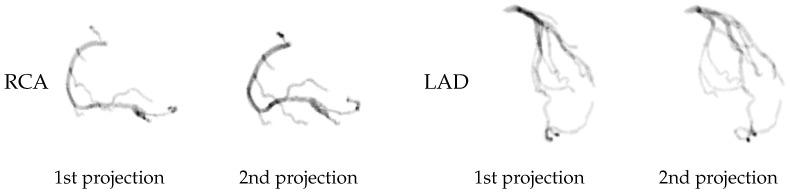
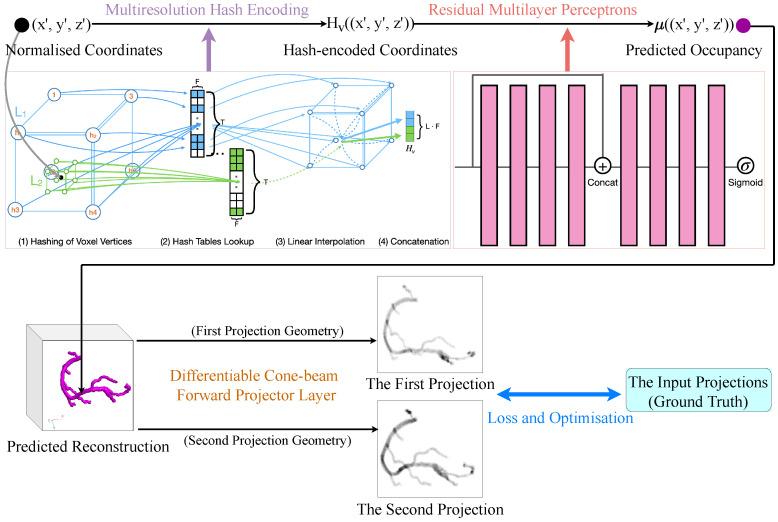
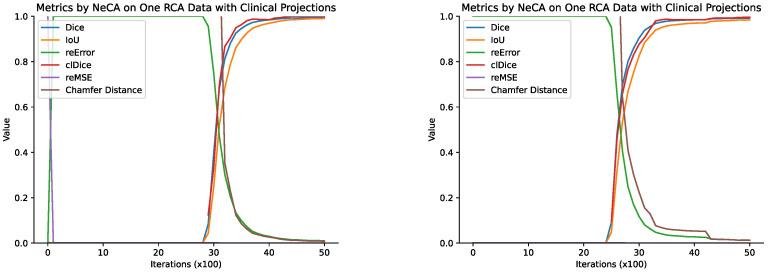
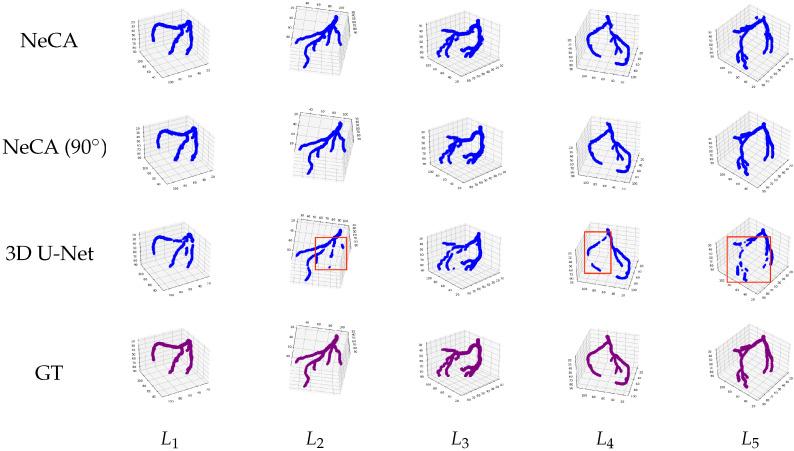
Cardiovascular diseases (CVDs) are the most common health threats worldwide. 2D X-ray invasive coronary angiography (ICA) remains the most widely adopted imaging modality for CVD assessment during real-time cardiac interventions. However, it is often difficult for the cardiologists to interpret the 3D geometry of coronary vessels based on 2D planes. Moreover, due to the radiation limit, often only two angiographic projections are acquired, providing limited information of the vessel geometry and necessitating 3D coronary tree reconstruction based only on two ICA projections. In this paper, we propose a self-supervised deep learning method called NeCA, which is based on neural implicit representation using the multiresolution hash encoder and differentiable cone-beam forward projector layer, in order to achieve 3D coronary artery tree reconstruction from two 2D projections. We validate our method using six different metrics on a dataset generated from coronary computed tomography angiography of right coronary artery and left anterior descending artery. The evaluation results demonstrate that our NeCA method, without requiring 3D ground truth for supervision or large datasets for training, achieves promising performance in both vessel topology and branch-connectivity preservation compared to the supervised deep learning model.
心血管疾病(CVDs)是全球最常见的健康威胁。二维X射线侵入性冠状动脉造影(ICA)仍然是实时心脏介入治疗期间用于心血管疾病评估的最广泛采用的成像方式。然而,心脏病专家通常很难基于二维平面来解读冠状动脉的三维几何结构。此外,由于辐射限制,通常仅获取两个血管造影投影,这提供的血管几何信息有限,因此需要仅基于两个ICA投影来重建三维冠状动脉树。在本文中,我们提出了一种名为NeCA的自监督深度学习方法,该方法基于使用多分辨率哈希编码器和可微锥束前向投影层的神经隐式表示,以便从两个二维投影实现三维冠状动脉树重建。我们在由右冠状动脉和左前降支冠状动脉的冠状动脉计算机断层扫描血管造影生成的数据集上使用六种不同的指标验证了我们的方法。评估结果表明,我们的NeCA方法无需三维地面真值进行监督或大型数据集进行训练,与监督深度学习模型相比,在血管拓扑和分支连通性保留方面均取得了有前景的性能。



 Zotero 插件