Department of Radiology, Union Hospital, Tongji Medical College, Huazhong University of Science and Technology, Wuhan 430022, China; Hubei Province Key Laboratory of Molecular Imaging, Wuhan 430022, China.
School of Electronic Information and Communications, Huazhong University of Science and Technology, Wuhan 430074, China.
Cell Rep Med. 2022 Oct 18;3(10):100775. doi: 10.1016/j.xcrm.2022.100775. Epub 2022 Oct 7.
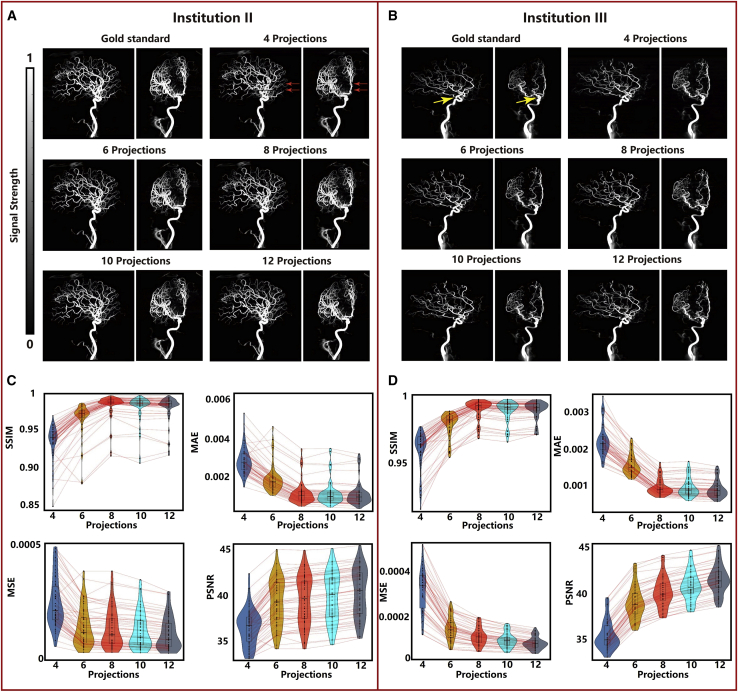
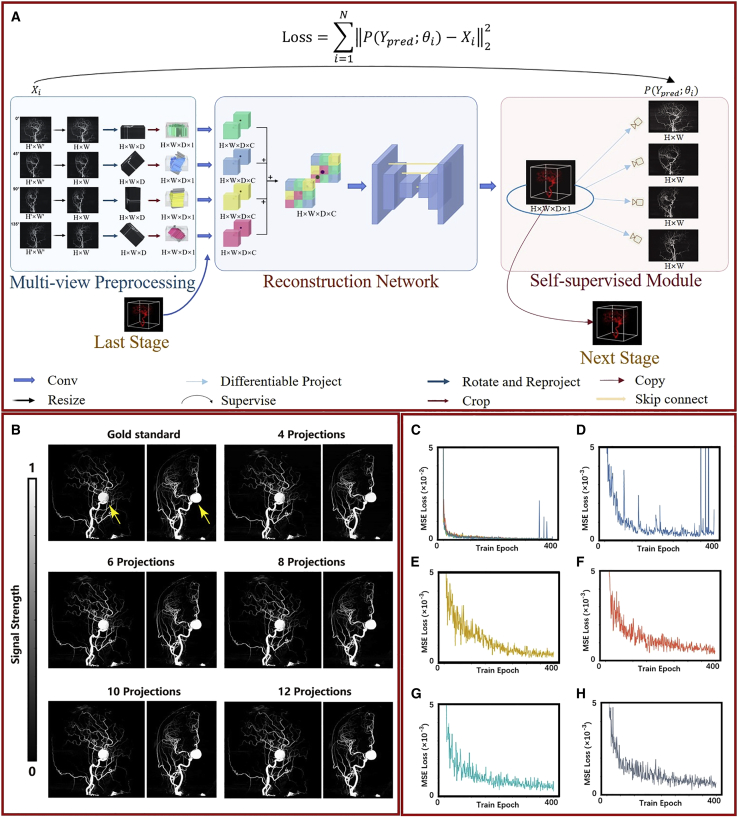
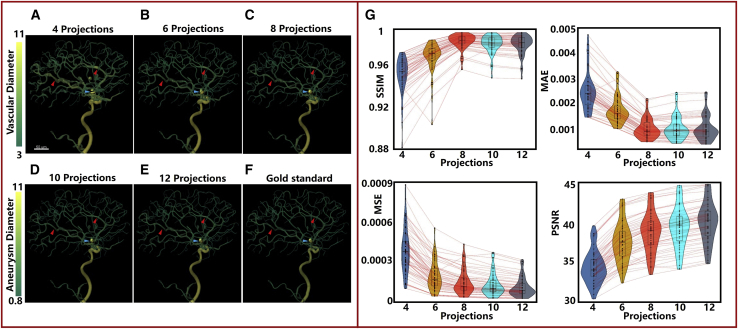
3D digital subtraction angiography (DSA) reconstruction from rotational 2D projection X-ray angiography is an important basis for diagnosis and treatment of intracranial aneurysms (IAs). The gold standard requires approximately 133 different projection views for 3D reconstruction. A method to significantly reduce the radiation dosage while ensuring the reconstruction quality is yet to be developed. We propose a self-supervised learning method to realize 3D-DSA reconstruction using ultra-sparse 2D projections. 202 cases (100 from one hospital for training and testing, 102 from two other hospitals for external validation) suspected to be suffering from IAs were conducted to analyze the reconstructed images. Two radiologists scored the reconstructed images from internal and external datasets using eight projections and identified all 82 lesions with high diagnostic confidence. The radiation dosages are approximately 1/16.7 compared with the gold standard method. Our proposed method can help develop a revolutionary 3D-DSA reconstruction method for use in clinic.
基于旋转二维投影 X 射线血管造影的三维数字减影血管造影(3D-DSA)重建是颅内动脉瘤(IAs)诊断和治疗的重要基础。金标准要求进行大约 133 次不同的投影视角的 3D 重建。目前仍需要开发一种能够在保证重建质量的同时显著降低辐射剂量的方法。我们提出了一种自监督学习方法,利用超稀疏二维投影来实现 3D-DSA 重建。对 202 例(100 例来自一家医院进行训练和测试,102 例来自另外两家医院进行外部验证)疑似患有 IAs 的患者进行了分析,以重建图像。两名放射科医生使用 8 次投影对内外部数据集的重建图像进行评分,并以高诊断置信度识别出所有 82 个病变。与金标准方法相比,辐射剂量约为其 1/16.7。我们提出的方法可以帮助开发一种革命性的 3D-DSA 重建方法,用于临床应用。