Fortuni Federico, Ciliberti Giuseppe, De Chiara Benedetta, Conte Edoardo, Franchin Luca, Musella Francesca, Vitale Enrica, Piroli Francesco, Cangemi Stefano, Cornara Stefano, Magnesa Michele, Spinelli Antonella, Geraci Giovanna, Nardi Federico, Gabrielli Domenico, Colivicchi Furio, Grimaldi Massimo, Oliva Fabrizio
Cardiology and Cardiovascular Pathophysiology, S. Maria Della Misericordia Hospital, University of Perugia, Piazzale Giorgio Menghini, 3, 06129 Perugia, Italy.
Cardiology Department, Marche University Hospital, Ancona, Italy.
Eur Heart J Imaging Methods Pract. 2024 Dec 14;2(4):qyae136. doi: 10.1093/ehjimp/qyae136. eCollection 2024 Oct.
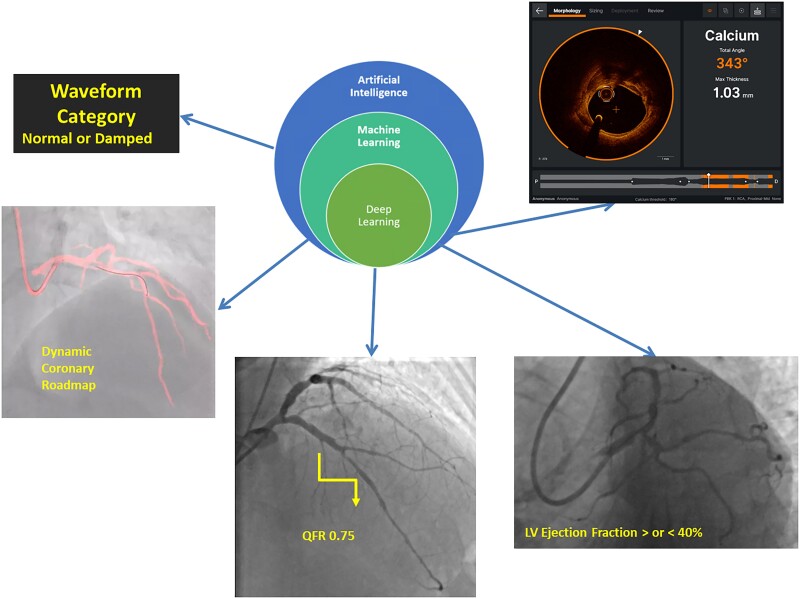
Artificial intelligence (AI) is transforming cardiovascular imaging by offering advancements across multiple modalities, including echocardiography, cardiac computed tomography (CCT), cardiovascular magnetic resonance (CMR), interventional cardiology, nuclear medicine, and electrophysiology. This review explores the clinical applications of AI within each of these areas, highlighting its ability to improve patient selection, reduce image acquisition time, enhance image optimization, facilitate the integration of data from different imaging modality and clinical sources, improve diagnosis and risk stratification. Moreover, we illustrate both the advantages and the limitations of AI across these modalities, acknowledging that while AI can significantly aid in diagnosis, risk stratification, and workflow efficiency, it cannot replace the expertise of cardiologists. Instead, AI serves as a powerful tool to streamline routine tasks, allowing clinicians to focus on complex cases where human judgement remains essential. By accelerating image interpretation and improving diagnostic accuracy, AI holds great potential to improve patient care and clinical decision-making in cardiovascular imaging.
人工智能(AI)正在通过在多种模式上取得进展来改变心血管成像,这些模式包括超声心动图、心脏计算机断层扫描(CCT)、心血管磁共振成像(CMR)、介入心脏病学、核医学和电生理学。本综述探讨了AI在这些领域中的临床应用,强调了其在改善患者选择、减少图像采集时间、增强图像优化、促进来自不同成像模式和临床来源的数据整合、改善诊断和风险分层方面的能力。此外,我们阐述了AI在这些模式中的优势和局限性,承认虽然AI可以显著辅助诊断、风险分层和工作流程效率,但它不能取代心脏病专家的专业知识。相反,AI是简化常规任务的强大工具,使临床医生能够专注于人类判断仍然至关重要的复杂病例。通过加快图像解读并提高诊断准确性,AI在改善心血管成像中的患者护理和临床决策方面具有巨大潜力。