Tesar Ondrej, Dosedel Martin, Kubena Ales Antonin, Mala-Ladova Katerina, Prokesova Radka, Brabcova Iva, Hajduchova Hana, Cerveny Martin, Chloubova Ivana, Vlcek Jiri, Tothova Valerie, Maly Josef
Department of Social and Clinical Pharmacy, Faculty of Pharmacy in Hradec Kralove, Charles University, Hradec Kralove, Czech Republic.
Institute of Humanities in Helping Professions, Faculty of Health and Social Sciences, University of South Bohemia in Ceske Budejovice, Ceske Budejovice, Czech Republic.
Nurs Open. 2025 Jan;12(1):e70139. doi: 10.1002/nop2.70139.
To explore all medication administration errors (MAEs) throughout the entire process of medication administration by nurses in the inpatient setting, to describe their prevalence, and to analyse associated factors, including deviation from the good practice standards.
Worldwide, MAEs are very common and regarded as a serious risk factor to inpatient safety. Nurses assume an essential role in the hospital setting during the administration of medications.
The prospective observational study was carried out in accordance with the STROBE guidance.
This study was conducted in four regional hospitals from June to August 2021. MAEs were collected when nurses administered medications to the adult inpatients during the morning, noon, and evening medication rounds at the internal, surgical, and follow-up care departments in each hospital over three consecutive days. Direct observation by the multidisciplinary team was employed. MAEs were classified as major MAEs (from the potentially most serious and common to all drug forms), specific MAEs (specific to a drug form), and procedural MAEs (e.g., patient identification, hygiene standards, or generic drug substitution). Predictors of either major MAE or specific MAE frequency were analysed using the generalised linear model and the decision tree model.
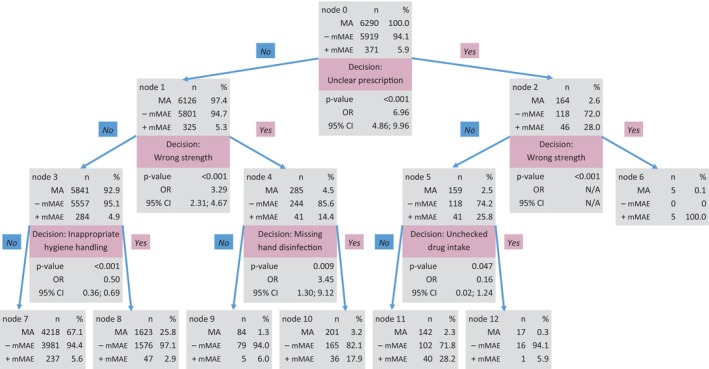
Overall, 58 nurses administering medication to 331 inpatients at 12 departments were observed. In total, 6356 medication administrations were observed, of which 461 comprised major MAEs, 1497 specific MAEs, and 12,045 procedural MAEs. The predictors of the occurrence of major MAEs and specific MAEs were the specific hospital, the nurse's length of practice (less than 2 years), and two procedural MAEs (the unclear prescription and the wrong strength).
Non-adherence to the standard processes in healthcare facilities for prescribing and administering drugs increased the prevalence of severe MAEs. Determinants of MAE occurrence such as incorrect prescriptions or limited experience of nurses should be considered.
The identified determinants of MAE should be considered by hospital stakeholders in their support programs to reduce the level of burden for nurses during medication administration.
Neither patients nor public was not involved in the design, data collection, or dissemination plans of this study. The researchers observed nurse care delivery at medical departments acting as passive participants.
探讨住院环境中护士在整个给药过程中的所有给药错误(MAE),描述其发生率,并分析相关因素,包括偏离良好实践标准的情况。
在全球范围内,给药错误非常普遍,被视为住院患者安全的严重风险因素。护士在医院给药过程中起着至关重要的作用。
前瞻性观察性研究按照STROBE指南进行。
本研究于2021年6月至8月在四家地区医院开展。在每家医院的内科、外科和后续护理科室,护士在连续三天的早、中、晚给药查房期间为成年住院患者给药时收集给药错误。采用多学科团队直接观察的方法。给药错误分为重大给药错误(从所有剂型中潜在最严重和最常见的错误)、特定给药错误(特定于某种剂型)和程序性给药错误(如患者识别、卫生标准或通用名药物替代)。使用广义线性模型和决策树模型分析重大给药错误或特定给药错误发生率的预测因素。
总体而言,观察了在12个科室为331名住院患者给药 的58名护士。总共观察了6356次给药,其中461次为重大给药错误,1497次为特定给药错误,12045次为程序性给药错误。重大给药错误和特定给药错误发生的预测因素是特定医院、护士执业年限(少于2年)以及两项程序性给药错误(处方不清晰和剂量错误)。
医疗机构在开药和给药方面不遵守标准流程会增加严重给药错误的发生率。应考虑给药错误发生的决定因素,如处方错误或护士经验有限。
医院利益相关者在其支持计划中应考虑已确定的给药错误决定因素,以减轻护士在给药过程中的负担。
患者和公众均未参与本研究的设计、数据收集或传播计划。研究人员在医疗科室观察护士的护理工作,他们是被动参与者。