Ajala Adewole Adetoro, Adeoye Oluwatosin Lawrence, Salami Olawale Moshood, Jimoh Ayoola Yusuf
Centre of Excellence for Data Science Artificial Intelligence & Modelling (DAIM), University of Hull, HU6 7RX, Hull, United Kingdom.
Research Division, Stalwart Ventures LLC, 5719 Cedonia Avenue, Suite F, Baltimore, MD, 21206, USA.
Environ Sci Pollut Res Int. 2025 Jan;32(5):2510-2535. doi: 10.1007/s11356-024-35764-8. Epub 2025 Jan 13.
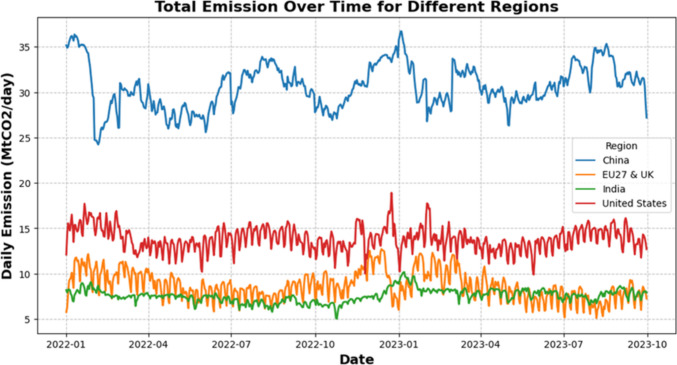
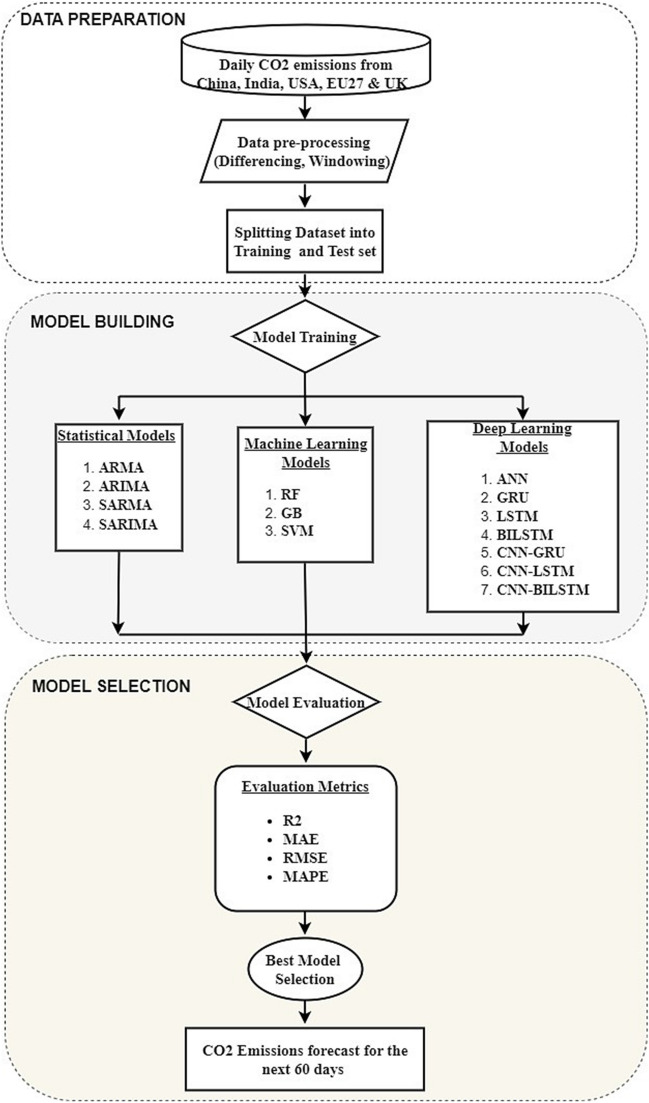
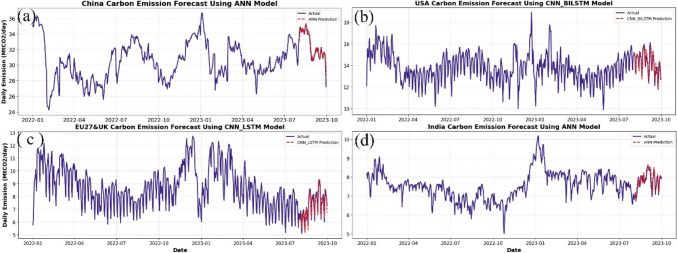
Human-induced global warming, primarily attributed to the rise in atmospheric CO, poses a substantial risk to the survival of humanity. While most research focuses on predicting annual CO emissions, which are crucial for setting long-term emission mitigation targets, the precise prediction of daily CO emissions is equally vital for setting short-term targets. This study examines the performance of 14 models in predicting daily CO emissions data from 1/1/2022 to 30/9/2023 across the top four polluting regions (China, India, the USA, and the EU27&UK). The 14 models used in the study include four statistical models (ARMA, ARIMA, SARMA, and SARIMA), three machine learning models (support vector machine (SVM), random forest (RF), and gradient boosting (GB)), and seven deep learning models (artificial neural network (ANN), recurrent neural network variations such as gated recurrent unit (GRU), long short-term memory (LSTM), bidirectional-LSTM (BILSTM), and three hybrid combinations of CNN-RNN). Performance evaluation employs four metrics (R, MAE, RMSE, and MAPE). The results show that the machine learning (ML) and deep learning (DL) models, with higher R (0.714-0.932) and lower RMSE (0.480-0.247) values, respectively, outperformed the statistical model, which had R (- 0.060-0.719) and RMSE (1.695-0.537) values, in predicting daily CO emissions across all four regions. The performance of the ML and DL models was further enhanced by differencing, a technique that improves accuracy by ensuring stationarity and creating additional features and patterns from which the model can learn. Additionally, applying ensemble techniques such as bagging and voting improved the performance of the ML models by approximately 9.6%, whereas hybrid combinations of CNN-RNN enhanced the performance of the RNN models. In summary, the performance of both the ML and DL models was relatively similar. However, due to the high computational requirements associated with DL models, the recommended models for daily CO emission prediction are ML models using the ensemble technique of voting and bagging. This model can assist in accurately forecasting daily emissions, aiding authorities in setting targets for CO emission reduction.
人为导致的全球变暖主要归因于大气中二氧化碳的增加,这对人类的生存构成了重大风险。虽然大多数研究集中在预测年度二氧化碳排放量上,这对于设定长期减排目标至关重要,但精确预测每日二氧化碳排放量对于设定短期目标同样至关重要。本研究考察了14种模型在预测2022年1月1日至2023年9月30日期间前四大污染地区(中国、印度、美国以及欧盟27国和英国)每日二氧化碳排放数据方面的表现。该研究中使用的14种模型包括四种统计模型(自回归滑动平均模型(ARMA)、自回归积分滑动平均模型(ARIMA)、季节性自回归滑动平均模型(SARMA)和季节性自回归积分滑动平均模型(SARIMA))、三种机器学习模型(支持向量机(SVM)、随机森林(RF)和梯度提升(GB))以及七种深度学习模型(人工神经网络(ANN)、门控循环单元(GRU)、长短期记忆网络(LSTM)、双向长短期记忆网络(BILSTM)等循环神经网络变体,以及卷积神经网络-循环神经网络(CNN-RNN)的三种混合组合)。性能评估采用四个指标(相关系数R、平均绝对误差MAE、均方根误差RMSE和平均绝对百分比误差MAPE)。结果表明,机器学习(ML)和深度学习(DL)模型在预测所有四个地区的每日二氧化碳排放量方面表现优于统计模型,它们的R值较高(0.714 - 0.932),RMSE值较低(0.480 - 0.247),而统计模型的R值为(-0.060 - 0.719),RMSE值为(1.695 - 0.537)。差分技术进一步提高了ML和DL模型的性能,该技术通过确保平稳性并创建模型可以从中学习的额外特征和模式来提高准确性。此外,应用诸如装袋和投票等集成技术使ML模型的性能提高了约9.6%,而CNN-RNN的混合组合提高了循环神经网络模型的性能。总之,ML和DL模型的性能相对相似。然而,由于DL模型的高计算要求,推荐用于每日二氧化碳排放预测的模型是使用投票和装袋集成技术的ML模型。该模型可以帮助准确预测每日排放量,协助当局设定二氧化碳减排目标。