Chen Anjing, Chang Xinyue, Bian Xueling, Zhang Fangxia, Ma Shasha, Chen Xiaolin
College of Nursing, Binzhou Medical University, Shandong, 256600, People's Republic of China.
Vascular Surgery Department, Shandong Provincial Hospital, Binzhou, Shandong, 250001, People's Republic of China.
Int J Gen Med. 2025 Jan 6;18:11-20. doi: 10.2147/IJGM.S497416. eCollection 2025.
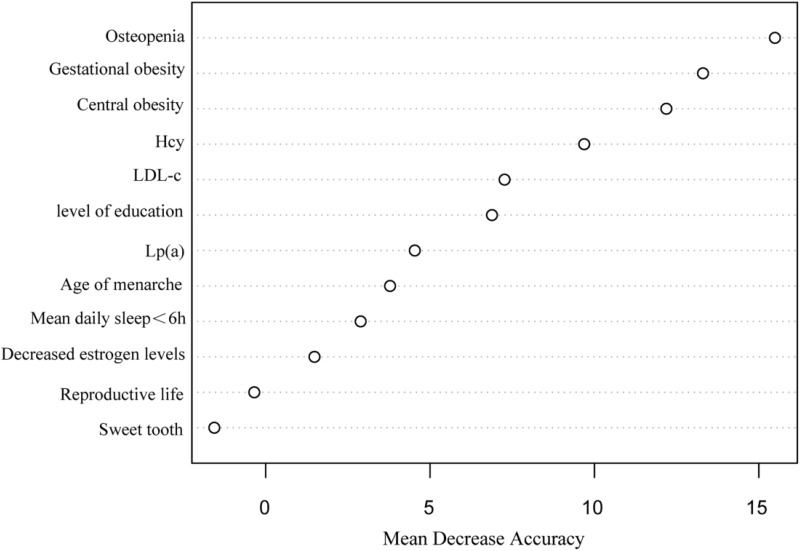
Perimenopausal period is a period of physiological changes in women with signs of ovarian failure, including menopausal transition period and 1 year after menopause. Ovarian function declines in perimenopausal women and lower estrogen levels lead to changes in the function of various organs, which may lead to cardiovascular disease. Major adverse cardiovascular events (MACE) are the combination of clinical events including heart failure, myocardial infarction and other cardiovascular diseases. Therefore, this study explores the factors influencing the occurrence of MACE in perimenopausal women and establishes a prediction model for MACE risk factors using three algorithms, comparing their predictive performance.
A total of 411 perimenopausal women diagnosed with MACE at the Binzhou Medical University Hospital were randomly divided into a training set and a test set following a 7:3 ratio. According to the principle of 10 events per Variable, the training set sample size was sufficient. In the training set, Random Forest (RF) algorithm, backpropagation neural network (BPNN) and Logistic Regression (LR) were used to construct a MACE risk prediction model for perimenopausal women, and the test set was used to verify the model. The prediction performance of the model was evaluated in terms of accuracy, sensitivity, specificity, and area under the subject operating characteristic curve (AUC).
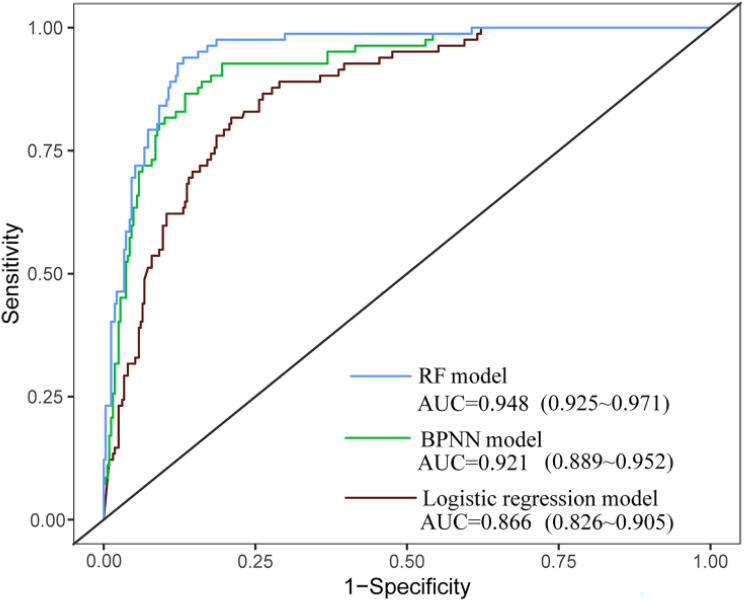
A total of twenty-six candidate variables were included. The area under ROC curve of the RF model, BPNN model, and logistic regression model was 0.948, 0.921, and 0.866. Comparison of ROC curve AUC between logistic regression and RF model for predicting MACE risk showed a statistically significant difference (Z=2.278, =0.023).
The RF model showed good performance in predicting the risk of MACE in perimenopausal women providing a reference for the early identification of high-risk patients and the development of targeted intervention strategies.
围绝经期是女性生理发生变化且伴有卵巢功能衰竭迹象的时期,包括绝经过渡期及绝经后1年。围绝经期女性卵巢功能衰退,雌激素水平降低导致各器官功能改变,可能引发心血管疾病。主要不良心血管事件(MACE)是包括心力衰竭、心肌梗死等心血管疾病在内的临床事件组合。因此,本研究探讨围绝经期女性发生MACE的影响因素,并使用三种算法建立MACE危险因素预测模型,比较它们的预测性能。
滨州医学院附属医院共纳入411例诊断为MACE的围绝经期女性,按照7:3的比例随机分为训练集和测试集。按照每个变量10个事件的原则,训练集样本量充足。在训练集中,使用随机森林(RF)算法、反向传播神经网络(BPNN)和逻辑回归(LR)构建围绝经期女性MACE风险预测模型,并使用测试集对模型进行验证。从准确性、敏感性、特异性和受试者工作特征曲线下面积(AUC)方面评估模型的预测性能。
共纳入26个候选变量。RF模型、BPNN模型和逻辑回归模型的ROC曲线下面积分别为0.948、0.921和0.866。逻辑回归模型与RF模型预测MACE风险的ROC曲线AUC比较,差异有统计学意义(Z=2.278,P=0.023)。
RF模型在预测围绝经期女性MACE风险方面表现良好,为早期识别高危患者及制定针对性干预策略提供参考。