Janek Sarah E, Matos Lisvel A, Hatoum Sandy, Mulawa Marta I, Ledbetter Leila, Relf Michael V
School of Nursing, Duke University, Durham, NC, United States of America.
Global Health Institute, Duke University, Durham, NC, United States of America.
PLoS One. 2025 Jan 16;20(1):e0316532. doi: 10.1371/journal.pone.0316532. eCollection 2025.
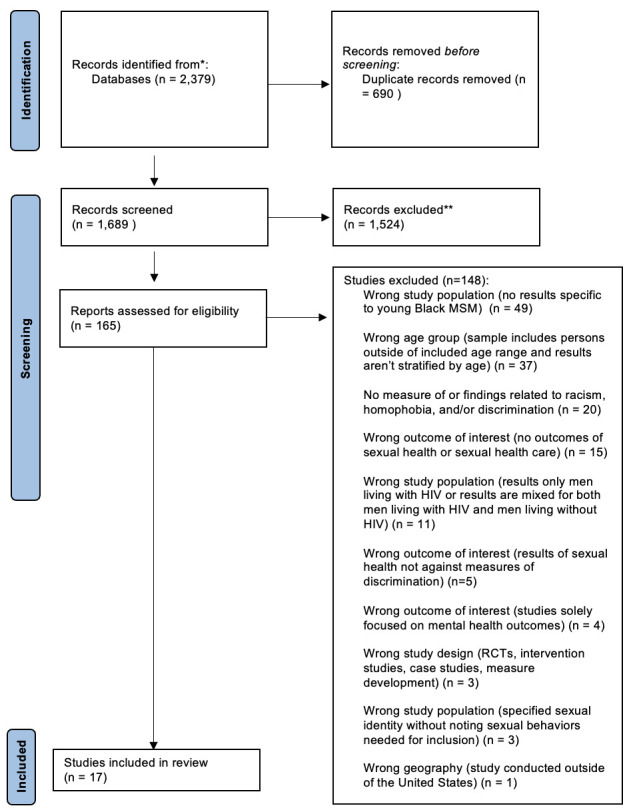
Black gay, bisexual, and other men who have sex with men (BMSM) experience the highest rates of HIV acquisition annually out of any population in the United States, and young BMSM (YBMSM) are heavily impacted by this inequity as they enter adulthood. Despite a high annual HIV incidence, extant literature has found BMSM to engage in fewer sexual risk behaviors than White and Hispanic/Latino men who have sex with men, resulting in a gap between risk behaviors and the inequity of HIV infection. Structural factors, such as racism and homophobia, are thus being examined in order to understand this disconnect between behavior and HIV incidence. The purpose of this systematic review was to examine the discrimination experiences of YBMSM due to racism and homophobia in the United States and to evaluate the effect of these experiences on their sexual health. Four databases (MEDLINE, CINAHL Complete, APA PsycINFO, and Sociology Source Ultimate) were searched to examine the available qualitative, quantitative, and mixed method studies relevant to the research question. Out of 17 included studies, the majority were qualitative in design and were conducted in urban settings. Racism and homophobia affected YBMSM's sense of belonging, sexual identity, and sexual partnership choices. Often, masculinity would interact with these two constructs to impact how YBMSM engaged in sexual behavior, such as condomless sex, as well as their likelihood to seek sexual health care. Future research is needed to fully understand the relationships between discrimination and sexual health to develop effective structurally responsive interventions that will help decrease the inequities experienced by YBMSM.
黑人男同性恋者、双性恋者以及其他与男性发生性行为的男性(BMSM)在美国所有人群中每年感染艾滋病毒的比例最高,年轻的BMSM(YBMSM)在步入成年时深受这种不平等现象的影响。尽管艾滋病毒年发病率很高,但现有文献发现,与白人及西班牙裔/拉丁裔男同性恋者相比,BMSM的性风险行为较少,这导致了风险行为与艾滋病毒感染不平等之间的差距。因此,人们正在研究种族主义和恐同症等结构性因素,以了解行为与艾滋病毒发病率之间的这种脱节现象。本系统评价的目的是研究美国YBMSM因种族主义和恐同症而遭受的歧视经历,并评估这些经历对其性健康的影响。检索了四个数据库(MEDLINE、CINAHL Complete、APA PsycINFO和Sociology Source Ultimate),以审查与该研究问题相关的现有定性、定量和混合方法研究。在纳入的17项研究中,大多数研究设计为定性研究,且在城市环境中进行。种族主义和恐同症影响了YBMSM的归属感、性身份和性伴侣选择。通常,男子气概会与这两种观念相互作用,影响YBMSM的性行为方式,如无保护措施的性行为,以及他们寻求性健康护理的可能性。需要开展进一步研究,以全面了解歧视与性健康之间的关系,从而制定有效的结构性应对干预措施,帮助减少YBMSM所经历的不平等现象。