Obregon-Gutierrez Pau, Mahmmod Yasser, Barba-Vidal Emili, Sibila Marina, Correa-Fiz Florencia, Aragón Virginia
Unitat Mixta d'Investigació IRTA-UAB en Sanitat Animal, Centre de Recerca en Sanitat Animal (CReSA), Campus de la Universitat Autònoma de Barcelona (UAB), 08193, Bellaterra, Barcelona, Spain.
Institut de Recerca I Tecnologia Agroalimentàries, Programa de Sanitat Animal, Centre de Recerca en Sanitat Animal (CReSA), Campus de la Universitat Autònoma de Barcelona (UAB), 08193, Bellaterra, Barcelona, Spain.
Sci Rep. 2025 Jan 17;15(1):2347. doi: 10.1038/s41598-025-85867-6.
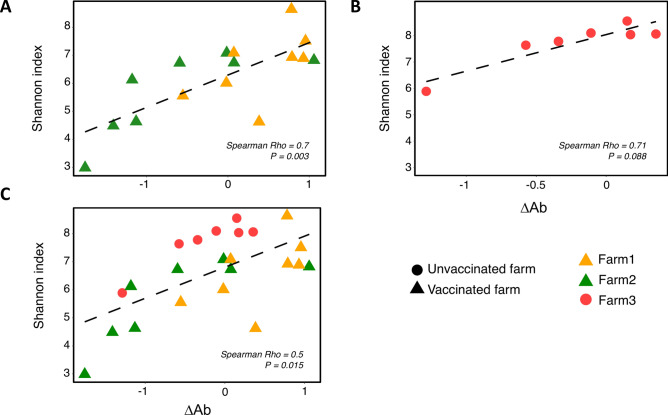
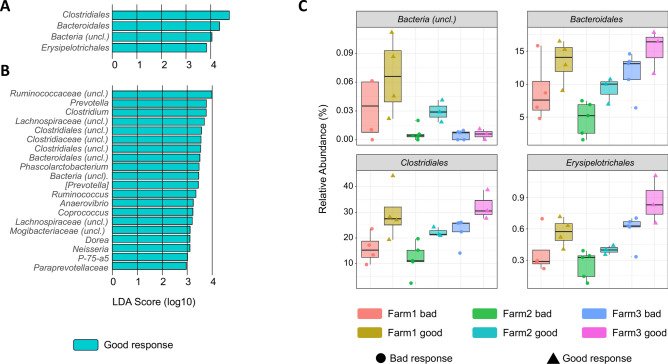
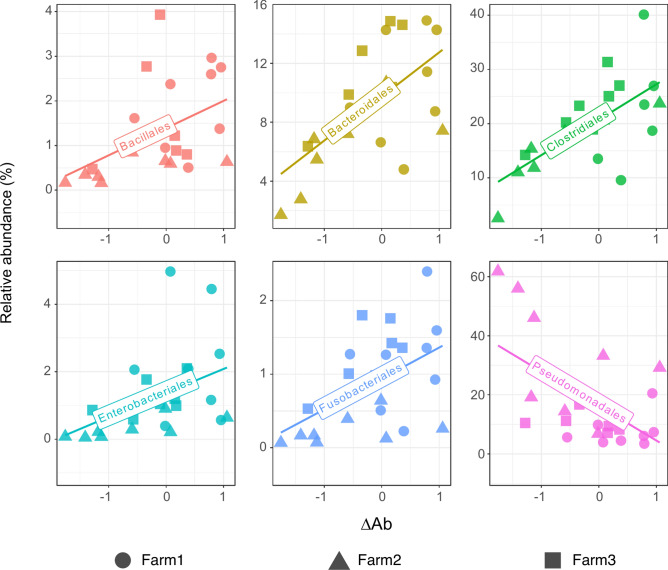
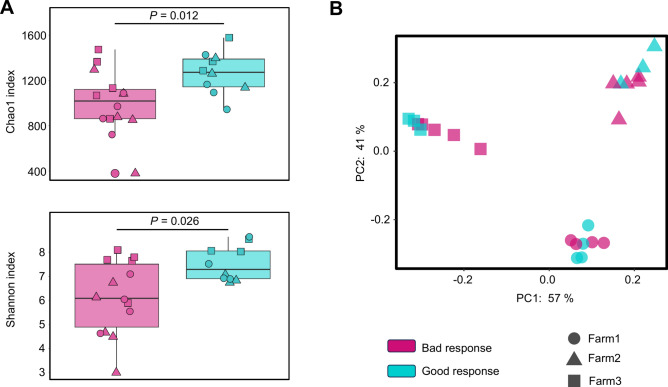
Vaccination stands as one of the most sustainable and promising strategies to control infectious diseases in animal production. Nevertheless, the causes for antibody response variation among individuals are poorly understood. The animal microbiota has been shown to be involved in the correct development and function of the host immunity, including the antibody response. Here, we studied the nasal and rectal microbiota composition in association with the antibody response against the pathobiont Glaesserella parasuis. The nasal and rectal microbiotas of 24 piglets were sampled in two farms before vaccination and in one unvaccinated farm (naturally exposed to the pathobiont) at similar time. Microbiota composition was inferred by V3V4 16S rRNA gene sequencing and bioinformatics analysis, and the antibody response was quantified using the variation between the levels before and after vaccination (normalized per farm). Piglets with higher antibody responses showed more diverse nasal and rectal microbial communities compared to piglets with lower responses. Moreover, swine nasal core microbiota colonizers were associated with higher antibody levels, such as several members from Bacteroidales and Clostridiales orders and genera including Moraxella, Staphylococcus, Fusobacterium and Neisseria. Regarding taxa found in the rectal microbiota, associations with antibody responses were detected only at order level, pointing towards a positive role for Clostridiales while negative for Enterobacteriales. Altogether, these results suggest that the microbiota is associated with the antibody response to G. parasuis (and probably to other pathogens) and serves as starting point to understand the factors that contribute to immunization in pigs.
疫苗接种是动物生产中控制传染病最具可持续性和前景的策略之一。然而,个体间抗体反应差异的原因尚不清楚。动物微生物群已被证明参与宿主免疫的正确发育和功能,包括抗体反应。在此,我们研究了与针对致病性副猪嗜血杆菌的抗体反应相关的鼻腔和直肠微生物群组成。在两个农场的24头仔猪接种疫苗前以及在一个未接种疫苗的农场(自然暴露于该致病性细菌)于相似时间采集鼻腔和直肠微生物群样本。通过V3V4 16S rRNA基因测序和生物信息学分析推断微生物群组成,并使用接种疫苗前后水平之间的差异(按农场标准化)来量化抗体反应。与抗体反应较低的仔猪相比,抗体反应较高的仔猪鼻腔和直肠微生物群落更多样化。此外,猪鼻腔核心微生物群定殖菌与较高的抗体水平相关,例如拟杆菌目和梭菌目的几个成员以及包括莫拉克斯氏菌属、葡萄球菌属、梭杆菌属和奈瑟菌属在内的属。关于在直肠微生物群中发现的分类群,仅在目水平检测到与抗体反应的关联,表明梭菌目起积极作用而肠杆菌目起消极作用。总之,这些结果表明微生物群与针对副猪嗜血杆菌(可能还有其他病原体)的抗体反应相关,并作为了解影响猪免疫的因素的起点。