
实时预测以监测2022年纽约市疫情期间的猴痘实时趋势:使用按种族或族裔分层的法定报告疾病数据进行评估
Nowcasting to Monitor Real-Time Mpox Trends During the 2022 Outbreak in New York City: Evaluation Using Reportable Disease Data Stratified by Race or Ethnicity.
作者信息
Rohrer Rebecca, Wilson Allegra, Baumgartner Jennifer, Burton Nicole, Ortiz Ray R, Dorsinville Alan, Jones Lucretia E, Greene Sharon K
机构信息
Bureau of Communicable Disease, New York City Department of Health and Mental Hygiene, Long Island City, NY, United States.
出版信息
Online J Public Health Inform. 2025 Jan 14;17:e56495. doi: 10.2196/56495.
BACKGROUND
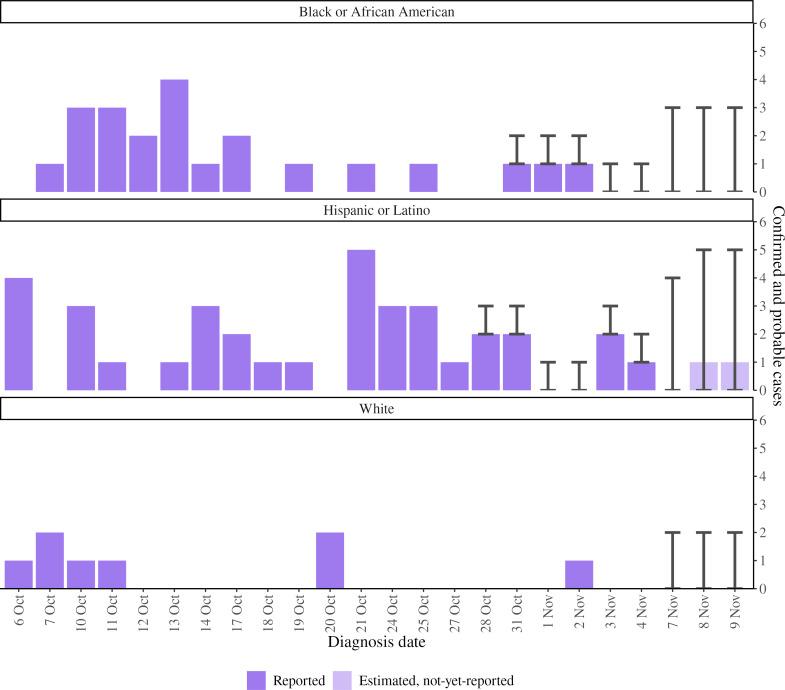
Applying nowcasting methods to partially accrued reportable disease data can help policymakers interpret recent epidemic trends despite data lags and quickly identify and remediate health inequities. During the 2022 mpox outbreak in New York City, we applied Nowcasting by Bayesian Smoothing (NobBS) to estimate recent cases, citywide and stratified by race or ethnicity (Black or African American, Hispanic or Latino, and White). However, in real time, it was unclear if the estimates were accurate.
OBJECTIVE
We evaluated the accuracy of estimated mpox case counts across a range of NobBS implementation options.
METHODS
We evaluated NobBS performance for New York City residents with a confirmed or probable mpox diagnosis or illness onset from July 8 through September 30, 2022, as compared with fully accrued cases. We used the exponentiated average log score (average score) to compare moving window lengths, stratifying or not by race or ethnicity, diagnosis and onset dates, and daily and weekly aggregation.
RESULTS
During the study period, 3305 New York City residents were diagnosed with mpox (median 4, IQR 3-5 days from diagnosis to diagnosis report). Of these, 812 (25%) had missing onset dates, and of these, 230 (28%) had unknown race or ethnicity. The median lag in days from onset to onset report was 10 (IQR 7-14). For daily hindcasts by diagnosis date, the average score was 0.27 for the 14-day moving window used in real time. Average scores improved (increased) with longer moving windows (maximum: 0.47 for 49-day window). Stratifying by race or ethnicity improved performance, with an overall average score of 0.38 for the 14-day moving window (maximum: 0.57 for 49 day-window). Hindcasts for White patients performed best, with average scores of 0.45 for the 14-day window and 0.75 for the 49-day window. For unstratified, daily hindcasts by onset date, the average score ranged from 0.16 for the 42-day window to 0.30 for the 14-day window. Performance was not improved by weekly aggregation. Hindcasts underestimated diagnoses in early August after the epidemic peaked, then overestimated diagnoses in late August as the epidemic waned. Estimates were most accurate during September when cases were low and stable.
CONCLUSIONS
Performance was better when hindcasting by diagnosis date than by onset date, consistent with shorter lags and higher completeness for diagnoses. For daily hindcasts by diagnosis date, longer moving windows performed better, but direct comparisons are limited because longer windows could only be assessed after case counts in this outbreak had stabilized. Stratification by race or ethnicity improved performance and identified differences in epidemic trends across patient groups. Contributors to differences in performance across strata might include differences in case volume, epidemic trends, delay distributions, and interview success rates. Health departments need reliable nowcasting and rapid evaluation tools, particularly to promote health equity by ensuring accurate estimates within all strata.
背景
将现况预测方法应用于部分累积的应报告疾病数据,有助于政策制定者解读近期的流行趋势,尽管存在数据滞后问题,且能快速识别并纠正健康不平等现象。在2022年纽约市猴痘疫情期间,我们应用贝叶斯平滑现况预测法(NobBS)来估计近期病例数,涵盖全市范围,并按种族或族裔(黑人或非裔美国人、西班牙裔或拉丁裔、白人)进行分层。然而,在实时情况下,尚不清楚这些估计是否准确。
目的
我们评估了一系列NobBS实施选项下猴痘病例数估计的准确性。
方法
我们评估了NobBS对2022年7月8日至9月30日期间确诊或可能患有猴痘的纽约市居民的表现,并与完全累积的病例进行比较。我们使用指数化平均对数得分(平均得分)来比较移动窗口长度,是否按种族或族裔、诊断和发病日期以及每日和每周汇总进行分层。
结果
在研究期间,3305名纽约市居民被诊断出患有猴痘(从诊断到诊断报告的中位数为4天,四分位间距为3 - 5天)。其中,812人(25%)发病日期缺失,其中230人(28%)种族或族裔未知。从发病到发病报告的天数中位数为10天(四分位间距为7 - 14天)。对于按诊断日期进行的每日事后预测,实时使用的14天移动窗口的平均得分为0.27。随着移动窗口变长,平均得分有所改善(提高)(最大值:49天窗口为0.47)。按种族或族裔分层可提高性能,14天移动窗口的总体平均得分为0.38(最大值:49天窗口为0.57)。白人患者的事后预测表现最佳,14天窗口的平均得分为0.45,49天窗口为0.75。对于按发病日期进行的未分层每日事后预测,平均得分范围从42天窗口的0.16到14天窗口的0.30。每周汇总并未提高性能。疫情高峰后的8月初,事后预测低估了诊断数,而在8月下旬疫情减弱时则高估了诊断数。9月病例数较低且稳定时,估计最为准确。
结论
按诊断日期进行事后预测的表现优于按发病日期,这与诊断的滞后时间较短和完整性较高一致。对于按诊断日期进行的每日事后预测,较长的移动窗口表现更好,但直接比较有限,因为只有在此次疫情的病例数稳定后才能评估更长的窗口。按种族或族裔分层可提高性能,并识别不同患者群体的流行趋势差异。各层表现差异的因素可能包括病例数量、流行趋势、延迟分布和访谈成功率的差异。卫生部门需要可靠的现况预测和快速评估工具,特别是通过确保所有层内的准确估计来促进健康公平。


 Zotero 插件