Ribbons Karen, Payne Kristy, Ditton Elizabeth, Johnson Sarah, Wills Adrian, Walker Frederick Rohan, Pollack Michael, Nilsson Michael
Centre for Rehab Innovations, University of Newcastle, Callaghan, NSW, Australia.
Hunter Medical Research Institute, New Lambton Heights, NSW, Australia.
PLoS One. 2025 Jan 24;20(1):e0317205. doi: 10.1371/journal.pone.0317205. eCollection 2025.
Dissatisfaction with Total Knee Arthroplasty (TKA) surgical outcomes remains between 10-20% and is associated with higher levels of societal costs. Expectations regarding post-surgical outcomes is considered as one of the major factors influencing satisfaction, however, there are no standardised methods for assessing patient's expectations regarding activities to be achieved following surgery.
The aims of this study were to identify patient expectations relating to activities of importance following TKA and to describe goal fulfillment at 3 months post-TKA. We hypothesised that activity expectation fulfillment would be associated with overall satisfaction with TKA outcomes.
This study comprised secondary data analysis of findings from the SuPeR Knee study. Using conventional content analysis, a classification system of activities specific to our TKA patient cohort was created. At 3 months following TKA, patients rated satisfaction with fulfilling activity goals and pain attenuation. The average level of satisfaction achieved was used as our measure of goal fulfillment. Overall satisfaction of the outcomes of surgery was rated using a 5-point Likert scale and the association between goal fulfillment and overall surgery satisfaction was compared by Spearman's rank correlation.
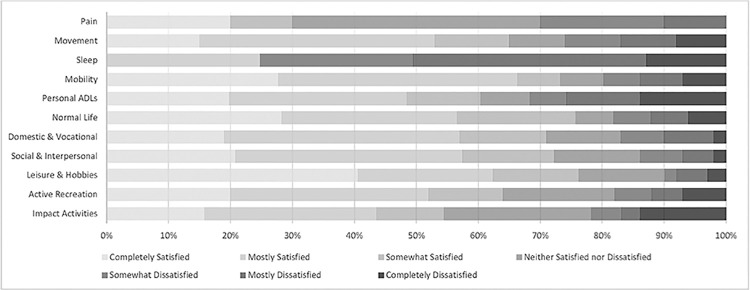
Data were collected from 861 TKA patients. Recreation and sporting pursuits were found to be important activity types (43% of all activities). At 3 months after surgery, less impactful activities were more commonly satisfied (67%), including domestic and vocational activities, low impact hobbies and leisure activities. Goal fulfillment and improvement in knee pain were both significantly positively correlated to, and significant predictors of, overall patient satisfaction (p≤0.001).
Our Australian cohort of TKA patients have a range of expectations for undertaking high-impact activities after surgery. However, at 3 months after surgery, higher rates of satisfaction were attained for lower-impact activities. Our findings support the importance of identifying activity expectations for each patient and that fulfillment of these goals contributes to overall satisfaction with the outcomes of TKA.
全膝关节置换术(TKA)手术效果的不满意率仍在10%-20%之间,且与更高的社会成本相关。对手术效果的期望被认为是影响满意度的主要因素之一,然而,目前尚无标准化方法来评估患者对术后预期实现活动的期望。
本研究旨在确定TKA术后患者对重要活动的期望,并描述TKA术后3个月时目标达成情况。我们假设活动期望的达成与对TKA手术效果的总体满意度相关。
本研究包括对SuPeR Knee研究结果的二次数据分析。采用传统内容分析法,创建了针对我们TKA患者队列的特定活动分类系统。在TKA术后3个月,患者对实现活动目标和疼痛减轻的满意度进行评分。将达到的平均满意度水平作为我们衡量目标达成的指标。使用5点李克特量表对手术效果的总体满意度进行评分,并通过Spearman等级相关性比较目标达成与总体手术满意度之间的关联。
收集了861例TKA患者的数据。发现娱乐和体育活动是重要的活动类型(占所有活动的43%)。术后3个月,影响较小的活动更常得到满足(67%),包括家庭和职业活动、低强度爱好和休闲活动。目标达成和膝关节疼痛改善均与患者总体满意度显著正相关,且是总体满意度的显著预测因素(p≤0.001)。
我们澳大利亚的TKA患者队列对术后进行高强度活动有一系列期望。然而,术后3个月时,低强度活动的满意度更高。我们的研究结果支持了为每位患者确定活动期望的重要性,并且这些目标的达成有助于提高对TKA手术效果的总体满意度。