Vineis Paolo, Dagnino Sonia
MRC Centre for Environment and Health, School of Public Health, Imperial College, London, UK.
Université Cote d'Azur, Polytech Nice Sophia, Institut Frédéric Joliot-UMR E 4320 TIRO-MATOs-SNC 5050 CNRS - 28, Nice, France.
Exposome. 2024 Dec 4;4(1):osae008. doi: 10.1093/exposome/osae008. eCollection 2024 Feb 9.
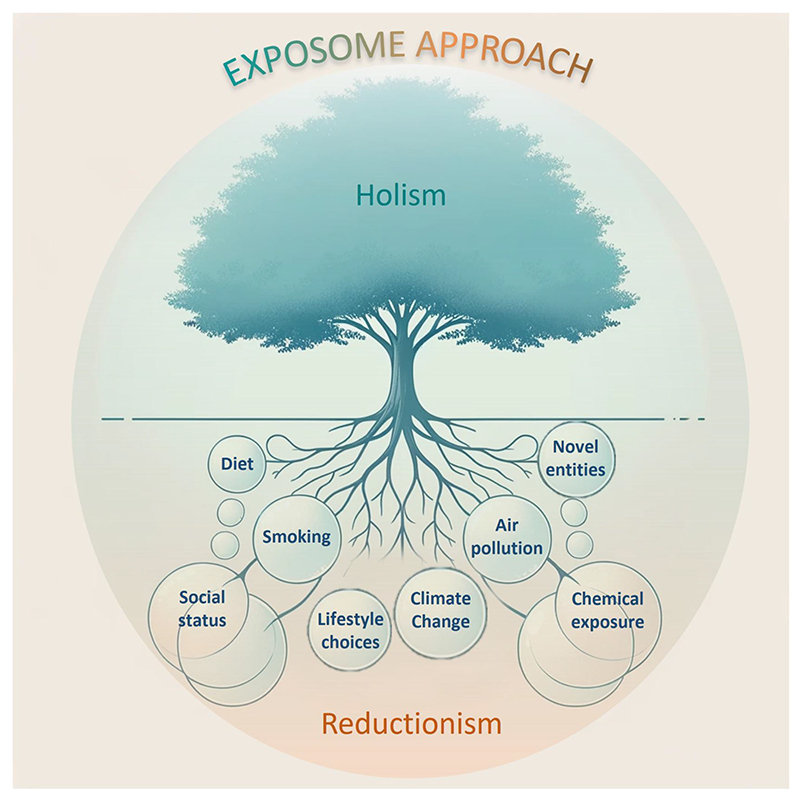
The exposome was proposed following the realization that most human diseases have an environmental rather than a genetic (hereditary) origin. Non-communicable diseases are, in fact, the consequence of multiple exposures that activate a sequence of stages in a multistage process that already starts in early life. This attracted attention to both the multiplicity (in fact, potentially the totality) of exposures humans are exposed to since conception and to the life-long perspective of disease causation. In this paper, we examine an extension of the exposome concept that incorporates a Darwinian approach based on the concept of phenotypic plasticity. One of the theses is that interpreting exposome science as "precision environmental research" is only a partial interpretation, largely focused on chemical exposures, while a broadening of the perspective is needed, also in light of the planetary crisis. Such broadening involves the incorporation of basic concepts from evolutionary biology and medicine, including the ability of organisms to adapt to rapidly changing environments. We refer in particular to cancer and "Darwinian carcinogenesis."
大多数人类疾病起源于环境而非遗传(世袭)因素。事实上,非传染性疾病是多种暴露的结果,这些暴露在一个多阶段过程中激活一系列阶段,而这个过程在生命早期就已开始。这使得人们关注自受孕以来人类所接触的暴露因素的多样性(实际上可能是全部)以及疾病因果关系的终身视角。在本文中,我们探讨了暴露组概念的一种扩展,它纳入了基于表型可塑性概念的达尔文主义方法。其中一个论点是,将暴露组科学解释为“精准环境研究”只是一种部分解释,主要侧重于化学暴露,而鉴于地球危机,还需要拓宽视角。这种拓宽涉及纳入进化生物学和医学的基本概念,包括生物体适应快速变化环境的能力。我们特别提及癌症和“达尔文式致癌作用”。