Ament-Velásquez S Lorena, Furneaux Brendan, Dheur Sonia, Granger-Farbos Alexandra, Stelkens Rike, Johannesson Hanna, Saupe Sven J
Department of Zoology, Stockholm University, 106 91 Stockholm, Sweden.
Department of Biological and Environmental Science, University of Jyväskylä, Jyväskylä 40014, Finland.
bioRxiv. 2025 Jan 15:2025.01.13.632504. doi: 10.1101/2025.01.13.632504.
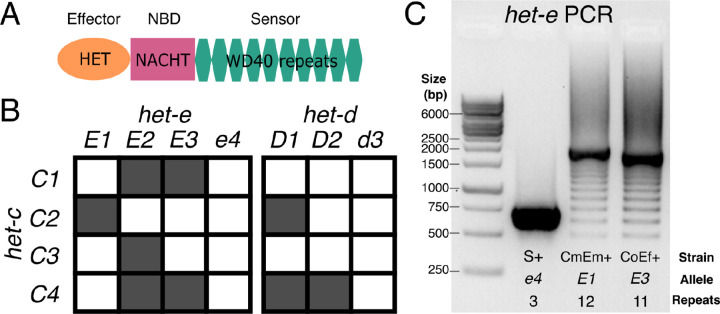
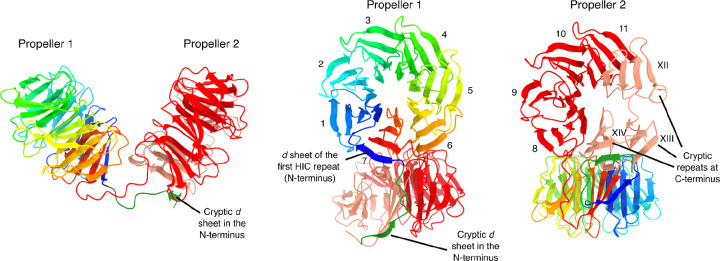
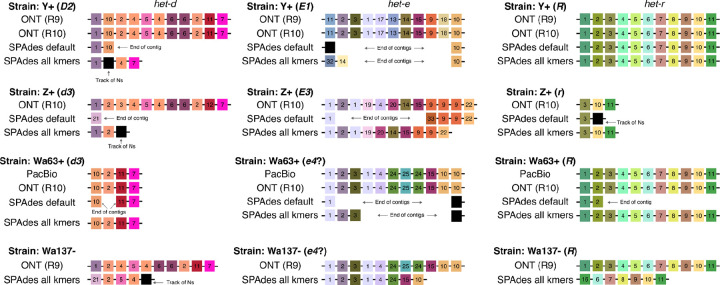
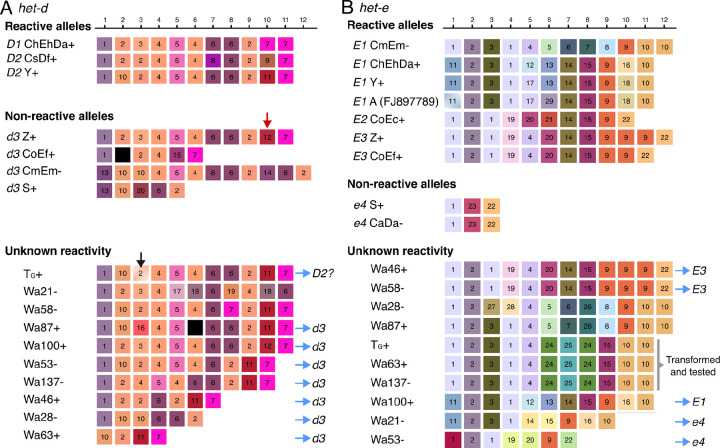
NOD-like receptors (NLRs) are intracellular immune receptors that detect pathogen-associated cues and trigger defense mechanisms, including regulated cell death. In filamentous fungi, some NLRs mediate heterokaryon incompatibility, a self/non-self recognition process that prevents the vegetative fusion of genetically distinct individuals, reducing the risk of parasitism. The and NLRs in are highly polymorphic incompatibility genes ( genes) whose products recognize different alleles of the gene via a sensor domain composed of WD40 repeats. These repeats display unusually high sequence identity maintained by concerted evolution. However, some sites within individual repeats are hypervariable and under diversifying selection. Despite extensive genetic studies, inconsistencies in the reported WD40 domain sequence have hindered functional and evolutionary analyses. Here we demonstrate that the WD40 domain can be accurately reconstructed from long-read sequencing (Oxford Nanopore and PacBio) data, but not from Illumina-based assemblies. Functional alleles are usually formed by 11 highly conserved repeats, with different repeat combinations underlying the same phenotypic and incompatibility reactions. Protein structure models suggest that their WD40 domain folds into two 7-blade β-propellers composed of the highly conserved repeats, as well as three cryptic divergent repeats at the C-terminus. We additionally show that one particular allele does not have an incompatibility reaction with common alleles, despite being 11-repeats long. Our findings provide a robust foundation for future research into the molecular mechanisms and evolutionary dynamics of NLRs, while also highlighting both the fragility and the flexibility of -propellers as immune sensor domains.
NOD样受体(NLRs)是细胞内免疫受体,可检测病原体相关信号并触发防御机制,包括程序性细胞死亡。在丝状真菌中,一些NLRs介导异核体不相容性,这是一种自我/非自我识别过程,可防止遗传上不同个体的营养体融合,降低寄生风险。中的和NLRs是高度多态的不相容基因(基因),其产物通过由WD40重复序列组成的传感器结构域识别基因的不同等位基因。这些重复序列通过协同进化保持异常高的序列同一性。然而,单个重复序列中的一些位点是高度可变的,并且处于多样化选择之下。尽管进行了广泛的遗传研究,但报道的WD40结构域序列的不一致性阻碍了功能和进化分析。在这里,我们证明WD40结构域可以从长读长测序(牛津纳米孔和PacBio)数据中准确重建,但不能从基于Illumina的组装中重建。功能等位基因通常由11个高度保守的重复序列形成,相同表型和不相容反应的基础是不同的重复序列组合。蛋白质结构模型表明,它们的WD40结构域折叠成两个由高度保守的重复序列组成的7叶β-螺旋桨,以及C末端的三个隐蔽的发散重复序列。我们还表明,尽管一个特定的等位基因有11个重复序列长,但它与常见的等位基因没有不相容反应。我们的发现为未来研究NLRs的分子机制和进化动力学提供了坚实的基础,同时也突出了β-螺旋桨作为免疫传感器结构域的脆弱性和灵活性。