Li Ruei-Hong, Chen Tai-Rui, Gilson Nicholas D, Brazaitis Marius, Cheng Yi-Ting, Wu Hui-Fang, Lee Ji-Hang, Chang Yu-Kai
Department of Physical Education and Sport Sciences, National Taiwan Normal University, 162, Section 1, Heping E. Road, Taipei, 106, Taiwan.
School of Human Movement and Nutrition Sciences, The University of Queensland, St Lucia, QLD, Australia.
Sports Med Open. 2025 Jan 27;11(1):12. doi: 10.1186/s40798-024-00809-2.
Concurrent exercise (CE), an emerging exercise modality characterized by sequential bouts of aerobic (AE) and resistance exercise (RE), has demonstrated acute benefits on executive functions (EFs) and neuroelectric P3 amplitude. However, the effect of acute CE on inhibitory control, a sub-component of EFs, and P3 amplitude remains inconclusive. Moreover, exploring the mechanisms underlying the effects of acute exercise on EFs contributes to scientific comprehension, with lactate recognized as a crucial candidate positively correlated with EFs. Therefore, this study aimed to determine the effects of acute CE on inhibitory control via behavioral and event-related potential approaches and to examine its potential mediational role on lactate.
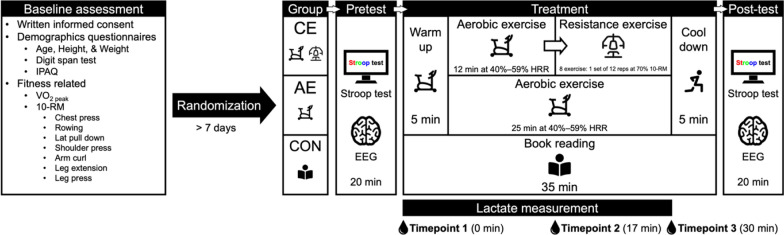
Seventy-eight adults (mean age = 22.95, SD = 1.75 years) were randomly assigned to either a CE, AE, or control (CON) group. Participants in the CE group engaged in 12-min of AE (40-59% of heart rate reserve [HRR]) coupled with 13-min of RE (1 set, with 75% of 10-repetition maximum, and 12 repetitions of 8 movements). The AE group participated in 25 min of AE (40-59% HRR). Prior to and following exercise onset, participants in both the CE and AE groups completed a 5-min warm-up and cool-down. Participants in the CON group read books for 35 min. Lactate concentrations were measured at timepoints of 0-, 17-, and 30-min relative to the treatment onset. Response time (RT) and accuracy in the Stroop test, as well as P3 amplitude, were assessed before and after the treatment.
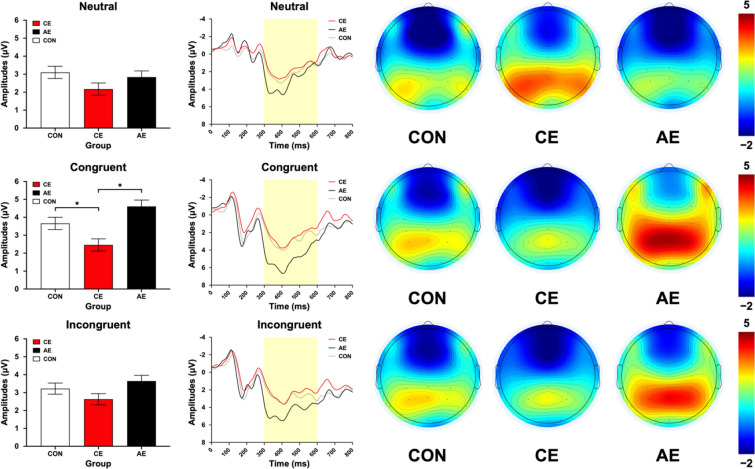
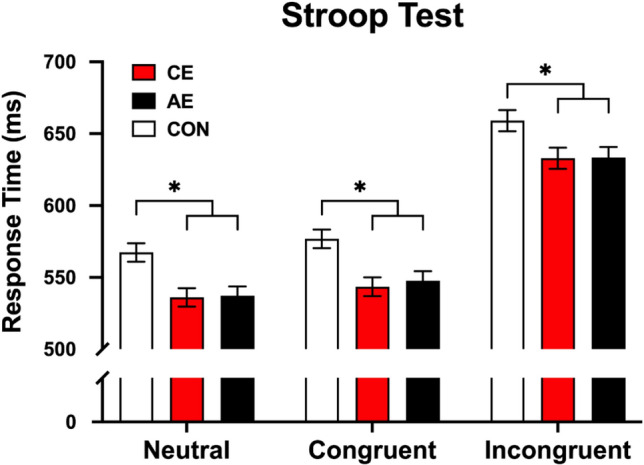
The results revealed that both the CE and AE groups had significantly shorter RTs compared to the CON group, with no significant differences in accuracy among groups. A decrease in P3 amplitude was observed for the CE group compared to the AE and CON groups. The mediating effects of lactate between acute exercise and inhibitory control were insignificant.
The findings suggest that both CE and AE improve inhibitory control and CE potentially enhances the efficient allocation of attention resources. The lack of a significant mediating effect of lactate warrants further investigation.
ClinicalTrials.gov, NCT06370286. Registered 12 April 2024-Retrospectively registered, https://clinicaltrials.gov/study/NCT06370286 .
同时进行的运动(CE)是一种新兴的运动方式,其特点是有氧(AE)运动和抗阻运动(RE)交替进行,已证明对执行功能(EFs)和神经电P3波幅有急性益处。然而,急性CE对抑制控制(EFs的一个子成分)和P3波幅的影响仍无定论。此外,探究急性运动对EFs影响的潜在机制有助于科学理解,乳酸被认为是与EFs呈正相关的关键因素。因此,本研究旨在通过行为学和事件相关电位方法确定急性CE对抑制控制的影响,并检验其对乳酸的潜在中介作用。
78名成年人(平均年龄 = 22.95,标准差 = 1.75岁)被随机分配到CE组、AE组或对照组(CON)。CE组参与者进行12分钟的AE运动(心率储备[HRR]的40 - 59%),并结合13分钟的RE运动(1组,10次重复最大值的75%,8个动作各重复12次)。AE组参与者进行25分钟的AE运动(40 - 59% HRR)。在运动开始前和运动后,CE组和AE组的参与者均完成5分钟的热身和放松。CON组参与者阅读35分钟的书籍。在相对于治疗开始的0分钟、17分钟和30分钟时间点测量乳酸浓度。在治疗前后评估Stroop测试中的反应时间(RT)和准确性以及P3波幅。
结果显示,与CON组相比,CE组和AE组的RT均显著缩短,各组之间准确性无显著差异。与AE组和CON组相比,CE组观察到P3波幅降低。乳酸在急性运动和抑制控制之间的中介作用不显著。
研究结果表明,CE和AE均能改善抑制控制,且CE可能增强注意力资源的有效分配。乳酸缺乏显著中介作用值得进一步研究。
ClinicalTrials.gov,NCT#06370286。2024年4月12日注册 - 追溯注册,https://clinicaltrials.gov/study/NCT06370286 。