Institute of Physical Education, Health and Leisure Studies, National Cheng Kung University, No. 1, University Road, Tainan, 701, Taiwan, ROC..
Institute of Experimental Endocrinology, Biomedical Research Center, Slovak Academy of Sciences, Dubravska cesta 9, 84505 Bratislava, Slovakia.
Neuroimage Clin. 2017 Oct 31;17:272-284. doi: 10.1016/j.nicl.2017.10.028. eCollection 2018.
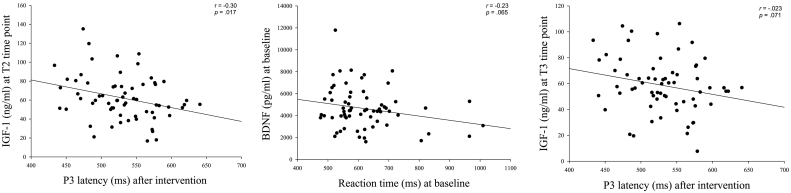
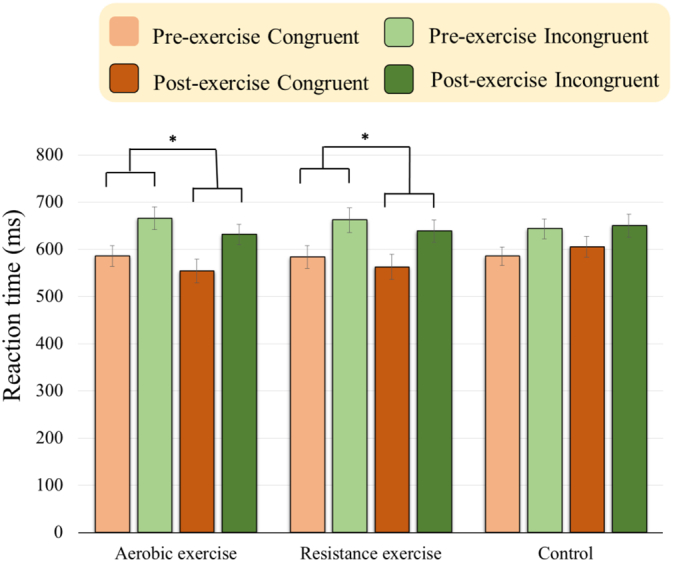
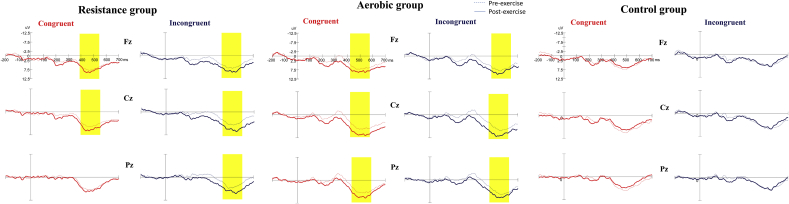
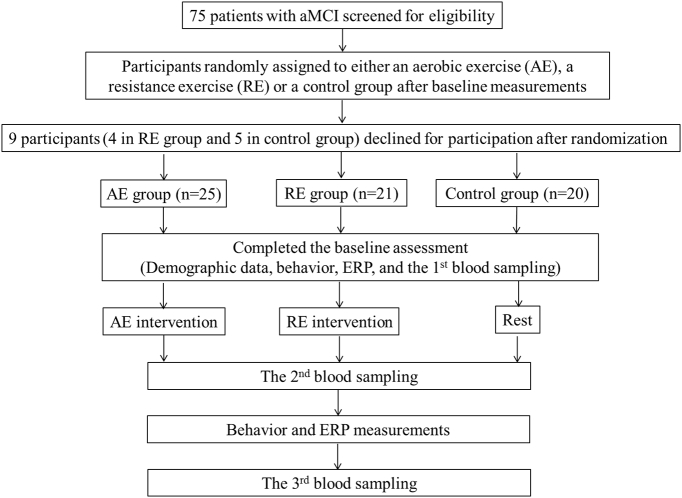
Although exercise is an effective way to decrease the risk of developing Alzheimer's disease, the biological basis for such benefits from the different exercise modes remains elusive. The present study thus aimed (i) to investigate the effects of acute aerobic or resistance exercise on neurocognitive performances and molecular markers when performing a cognitive task involving executive functioning in older adults with amnestic mild cognitive impairment (aMCI), and (ii) to explore relationships of acute exercise-induced neurocognitive changes with changes in circulating levels of neuroprotective growth factors (e.g., BDNF, IGF-1, VEGF, and FGF-2, collectively termed 'exerkines'), elicited by different acute exercise modes. Sixty-six older adults with aMCI were recruited and randomly assigned to an aerobic exercise (AE) group, a resistance exercise (RE) group, or a non-exercise-intervention (control) group. The behavioral [i.e., accuracy rate (AR) and reaction time (RT)] and electrophysiological [i.e., event-related potential (ERP) P3 latency and amplitude collected from the Fz, Cz, and Pz electrodes] indices were simultaneously measured when participants performed a Flanker task at baseline and after either an acute bout of 30 min of moderate-intensity AE, RE or a control period. Blood samples were taken at three time points, one at baseline (T1) and two after an acute exercise intervention (T2 and T3: before and after cognitive task test, respectively). The results showed that the acute AE and RE not only improved behavioral (i.e., RTs) performance but also increased the ERP P3 amplitudes in the older adults with aMCI. Serum FGF-2 levels did not change with acute aerobic or resistance exercise. However, an acute bout of aerobic exercise significantly increased serum levels of BDNF and IGF-1 and tended to increase serum levels of VEGF in elderly aMCI individuals. Acute resistance exercise increased only serum IGF-1 levels. However, the exercise-induced elevated levels of these molecular markers returned almost to baseline levels in T3 (about 20 min after acute exercise). In addition, changes in the levels of neurotrophic and angiogenic factors were not correlated with changes in RTs and P3 amplitudes. The present findings of changes in neuroprotective growth factors and neurocognitive performances through acute AE or RE suggest that molecular and neural prerequisites for exercise-dependent plasticity are preserved in elderly aMCI individuals. However, the distinct pattern of changes in circulating molecular biomarkers induced by two different exercise modes in aMCI elderly individuals and the potentially interactive mechanisms of the effects of BDNF, IGF-1, and VEGF on amyloid-β provide a basis for future long-term exercise intervention to investigate whether AE relative to RE might be more effective in prevention/treatment of an early stage neurodegenerative disease.
虽然运动是降低患阿尔茨海默病风险的有效方法,但不同运动模式带来的这些益处的生物学基础仍难以捉摸。因此,本研究旨在:(i)研究急性有氧或抗阻运动对执行功能认知任务中老年轻度认知障碍(aMCI)患者神经认知表现和分子标志物的影响;(ii)探讨急性运动引起的神经认知变化与不同急性运动模式引起的循环中神经保护生长因子(如 BDNF、IGF-1、VEGF 和 FGF-2,统称为“运动因子”)变化之间的关系。招募了 66 名患有 aMCI 的老年人,并将其随机分配到有氧运动(AE)组、抗阻运动(RE)组或非运动干预(对照组)组。当参与者在基线时和进行 30 分钟中等强度的急性 AE、RE 或对照期后,同时测量行为(即准确率(AR)和反应时间(RT))和电生理(即 Fz、Cz 和 Pz 电极上的事件相关电位(ERP)P3 潜伏期和振幅)指数。在三个时间点采集血样,一个在基线时(T1),两个在急性运动干预后(T2 和 T3:分别在认知任务测试之前和之后)。结果表明,急性 AE 和 RE 不仅改善了行为(即 RT)表现,还增加了 aMCI 老年人的 ERP P3 振幅。血清 FGF-2 水平不因急性有氧或抗阻运动而改变。然而,急性有氧运动显著增加了 BDNF 和 IGF-1 的血清水平,并倾向于增加老年 aMCI 个体血清中 VEGF 的水平。急性抗阻运动仅增加了 IGF-1 的血清水平。然而,这些分子标志物的运动诱导升高水平在 T3 几乎恢复到基线水平(急性运动后约 20 分钟)。此外,神经保护生长因子水平的变化与 RT 和 P3 振幅的变化无关。本研究通过急性 AE 或 RE 发现神经保护生长因子和神经认知表现的变化表明,运动依赖性可塑性的分子和神经前提在老年 aMCI 个体中得以保留。然而,两种不同运动模式在 aMCI 老年人中引起的循环分子生物标志物变化的不同模式以及 BDNF、IGF-1 和 VEGF 对淀粉样蛋白-β的影响的潜在相互作用机制为未来的长期运动干预提供了依据,以研究有氧运动相对于抗阻运动是否更能有效预防/治疗早期神经退行性疾病。