Robinson Andrew, Jiang David, Nkansah Abbey, Herrera Duran Juan S, Leung Jonathan, Laude Madeline, Craig John, Guo Leopold, Timmins Lucas, Cosgriff-Hernandez Elizabeth
Department of Biomedical Engineering, The University of Texas at Austin, Austin, Texas, 78712, USA.
Department of Biomedical Engineering, University of Utah, Salt Lake City, Utah, 84112, USA.
bioRxiv. 2025 Jan 21:2025.01.16.633374. doi: 10.1101/2025.01.16.633374.
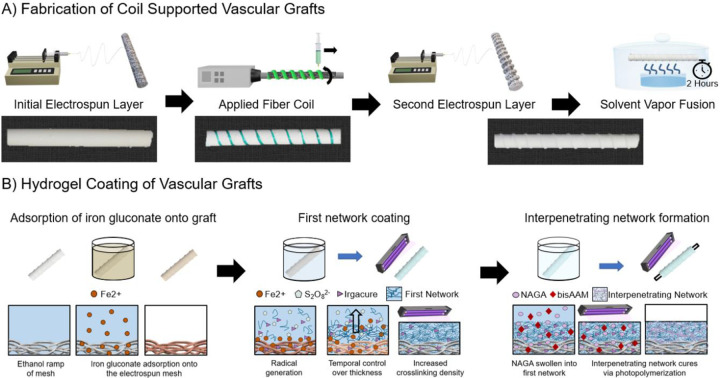
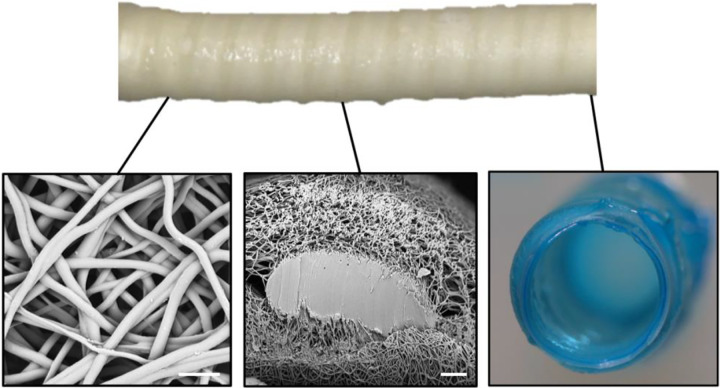
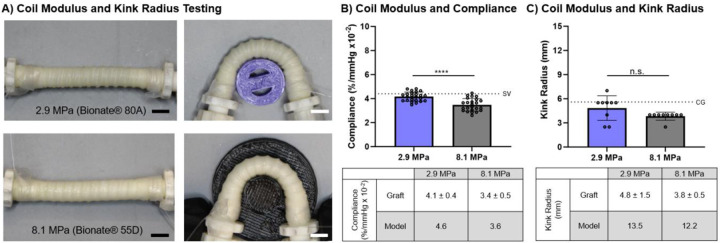
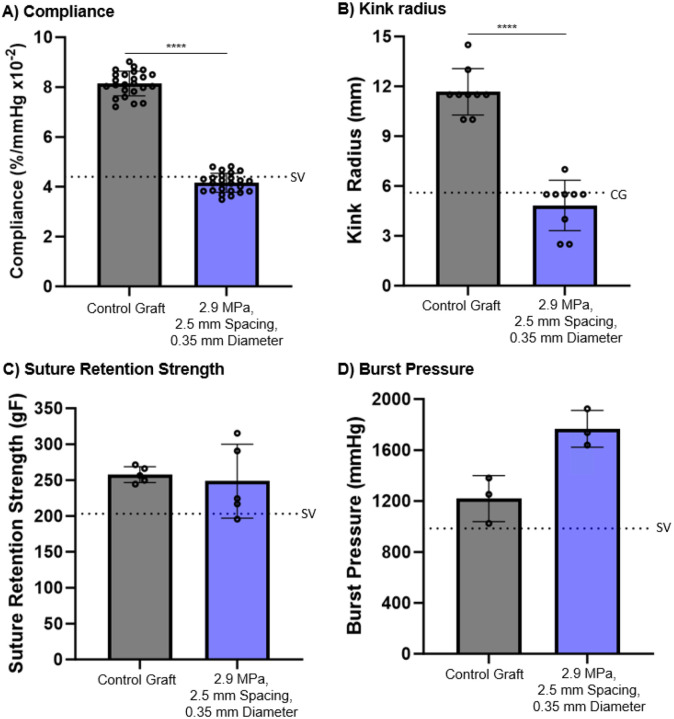
Small diameter vascular grafts require a complex balance of biomechanical properties to achieve target burst pressure, arterial compliance-matching, and kink resistance to prevent failure. Iterative design of our multilayer vascular was previously used to achieve high compliance while retaining the requisite burst pressure and suture retention strength for clinical use. To impart kink resistance, a custom 3D solution printer was used to add a polymeric coil to the electrospun polyurethane graft to support the graft during bending. The addition of this reinforcing coil increased kink resistance but reduced compliance. A matrix of grafts were fabricated and tested to establish key structure-property relationships between coil parameters (spacing, diameter, modulus) and biomechanical properties (compliance, kink radius). A successful graft design was identified with a compliance similar to saphenous vein grafts (4.1 ± 0.4 %/mmHgx10) while maintaining comparable kink resistance to grafts used currently in the clinic. To explore graft combinations that could increase graft compliance to match arterial values while retaining this kink resistance, we utilized finite element (FE) models of compliance and kink radius that simulated experimental testing. The FE-predicted graft compliance agreed well with experimental values. Although the kink model over-predicted the experimental kink radius values, key trends between graft parameters and kink resistance were reproduced. As an initial proof-of-concept, the validated models were then utilized to parse through a targeted graft design space. Although this initial parameter range tested did not yield a graft that improved upon the previous balance of graft properties, this combination of advanced manufacturing and computational framework paves the way for future model-driven design to further optimize graft performance.
小直径血管移植物需要在生物力学性能上达到复杂的平衡,以实现目标破裂压力、动脉顺应性匹配和抗扭结能力,从而防止移植物失效。我们之前对多层血管移植物进行迭代设计,以实现高顺应性,同时保留临床使用所需的破裂压力和缝线保留强度。为了赋予抗扭结能力,使用定制的3D溶液打印机在电纺聚氨酯移植物上添加聚合物线圈,以在弯曲过程中支撑移植物。这种增强线圈的添加增加了抗扭结能力,但降低了顺应性。制作并测试了一系列移植物,以建立线圈参数(间距、直径、模量)与生物力学性能(顺应性、扭结半径)之间的关键结构-性能关系。确定了一种成功的移植物设计,其顺应性与大隐静脉移植物相似(4.1±0.4%/mmHg×10),同时保持与目前临床使用的移植物相当的抗扭结能力。为了探索能够提高移植物顺应性以匹配动脉值同时保留这种抗扭结能力的移植物组合,我们利用了模拟实验测试的顺应性和扭结半径的有限元(FE)模型。有限元预测的移植物顺应性与实验值吻合良好。尽管扭结模型高估了实验扭结半径值,但再现了移植物参数与抗扭结能力之间的关键趋势。作为初步的概念验证,然后利用经过验证的模型在目标移植物设计空间中进行分析。尽管最初测试的这个参数范围没有产生一种在移植物性能的先前平衡基础上有所改进的移植物,但这种先进制造和计算框架的结合为未来基于模型的设计进一步优化移植物性能铺平了道路。