Hughes Damien, Mousa Abdelrazek H, Musumeci Chiara, Larsson Malte, Shameem Muhammad Anwar, Aydemir Umut, Schmiderer Ludwig, Larsson Jonas, Berggren Magnus, Ek Fredrik, Olsson Roger, Hjort Martin
Chemical Biology & Therapeutics, Department of Experimental Medical Science, Lund University, SE-221 84, Lund, Sweden.
Department of Chemistry and Molecular Biology, University of Gothenburg, SE-405 30, Gothenburg, Sweden.
Nano Lett. 2025 Feb 26;25(8):3059-3065. doi: 10.1021/acs.nanolett.4c05016. Epub 2025 Feb 13.
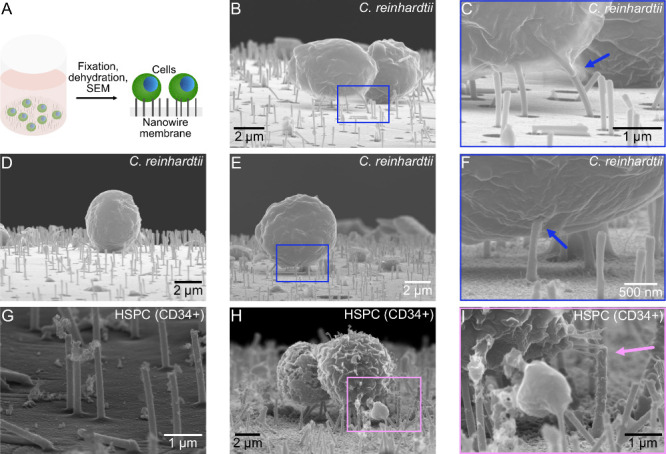
Free-standing nanowires can gain intracellular access without causing stress or apoptosis. Current approaches to generate nanowires focus on lithographic patterning and inorganic materials (Si, GaAs, AlO, etc.) while organic materials are less explored. Use of organic conductive polymers allows for the creation of soft mixed ion-electron conducting nanowires. Processing conductive polymers into nanowires is challenging due to the harsh chemicals and processing conditions used. Here, we demonstrate a lithography-free and scalable method to generate all-organic, water-stable nanowires composed of conductive polymers. A nanoporous membrane is filled with conductive polymer in solution, followed by a cross-linking step to make the polymer water stable. The surface of the membrane is anisotropically etched using a reactive ion etcher to reveal the polymer inside the pores, which extends from the membrane as nanowires. We interface the nanowires with model algal cells and human primary hematopoietic stem and progenitor cells.
独立的纳米线可以进入细胞内而不会引起应激或凋亡。目前制备纳米线的方法主要集中在光刻图案化和无机材料(硅、砷化镓、氧化铝等),而对有机材料的探索较少。使用有机导电聚合物可以制备出柔软的混合离子-电子传导纳米线。由于使用了苛刻的化学物质和加工条件,将导电聚合物加工成纳米线具有挑战性。在这里,我们展示了一种无光刻且可扩展的方法来制备由导电聚合物组成的全有机、水稳定纳米线。用溶液中的导电聚合物填充纳米多孔膜,然后进行交联步骤以使聚合物具有水稳定性。使用反应离子蚀刻器对膜表面进行各向异性蚀刻,以露出孔内的聚合物,聚合物从膜中延伸出来形成纳米线。我们将纳米线与模型藻类细胞以及人类原代造血干细胞和祖细胞进行连接。