Bakeer Walid, Gaafar Marwa, El-Gendy Ahmed O, El Badry M A, Alblwi Noaf Abdullah N, Selim Heba M R M, Alharbi Nada K, Bendary Mahmoud M
Department of Microbiology and Immunology, Faculty of Pharmacy, Beni-Suef University, Beni-Suef, Egypt.
Quality Control Specialist at Egyptian Drug Authority (EDA), Dokki, Egypt.
Medicine (Baltimore). 2024 Dec 27;103(52):e41051. doi: 10.1097/MD.0000000000041051.
Methicillin-Resistant Staphylococcus aureus (MRSA) is a global concern owing to the increasing prevalence of multidrug-resistant (MDR) strains. Vancomycin has been the primary treatment for MRSA; however, Vancomycin-resistant strains are being increasingly reported worldwide. Therefore, comparative studies are essential to support antimicrobial stewardship and improving clinical management. Ultimately, the findings from this study are expected to inform treatment strategies and guide public health interventions effectively.
This study investigated the prevalence, antimicrobial resistance, and virulence characteristics of Vancomycin-sensitive S. aureus (VSSA) and Vancomycin-resistant S. aureus (VRSA) within MRSA strains. By employing a combination of phenotypic methods, such as antimicrobial susceptibility testing, and genotypic techniques, including molecular typing and identification of virulence genes, we obtained comprehensive insights into VRSA and VSSA profiles.
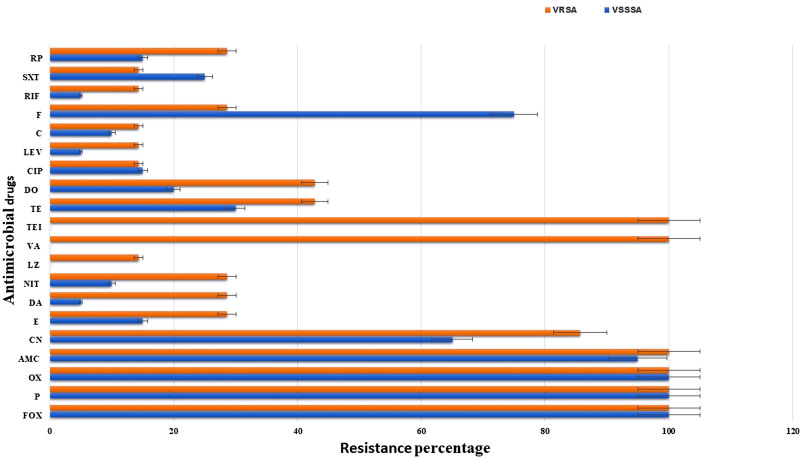
Of 250 clinical samples, 62 (24.8%) were S. aureus and 27 (43.5%) were identified as MRSA. All MRSA isolates exhibited MDR patterns. Most MRSA strains were VSSA (20/27, 74.1%), while 7 (25.9%) were VRSA. The VRSA isolates showed more antimicrobial resistance than VSSA isolates; however, the VRSA isolates had less virulence than VSSA isolates. Linezolid was the most effective treatment, with a 3.7% resistance rate. A higher percentage of biofilm-producing MRSA (96.3%) was confirmed by both phenotypic and genotypic methods. All isolates, except one VRSA, showed multi-virulence patterns (harbored more than 3 virulence genes). High diversity and low clonality (D-value = 0.99) were found in both VSSA and VRSA. Based on our correlation findings, the emergence of vancomycin resistance could modify the association between antimicrobial resistance and virulence, potentially affecting the pathogenic profile of these strains. The study also revealed complex interactions among host factors (including age and gender), sample origin, antimicrobial resistance, biofilm production, and virulence genes.
This study highlights the alarming spread of MRSA and VRSA, which show significant resistance and virulence.
耐甲氧西林金黄色葡萄球菌(MRSA)由于多重耐药(MDR)菌株的日益流行而成为全球关注的问题。万古霉素一直是治疗MRSA的主要药物;然而,全球范围内越来越多地报道了耐万古霉素菌株。因此,比较研究对于支持抗菌药物管理和改善临床管理至关重要。最终,本研究的结果有望为治疗策略提供信息并有效指导公共卫生干预措施。
本研究调查了MRSA菌株中对万古霉素敏感的金黄色葡萄球菌(VSSA)和耐万古霉素金黄色葡萄球菌(VRSA)的流行情况、抗菌药物耐药性和毒力特征。通过采用抗菌药物敏感性试验等表型方法与分子分型和毒力基因鉴定等基因技术相结合的方式,我们对VRSA和VSSA的特征有了全面的了解。
在250份临床样本中,62份(24.8%)为金黄色葡萄球菌,27份(43.5%)被鉴定为MRSA。所有MRSA分离株均呈现多重耐药模式。大多数MRSA菌株为VSSA(20/27,74.1%),而7份(约25.9%)为VRSA。VRSA分离株比VSSA分离株表现出更多的抗菌药物耐药性;然而,VRSA分离株的毒力低于VSSA分离株。利奈唑胺是最有效的治疗药物,耐药率为3.7%。通过表型和基因方法均证实了较高比例的产生物膜MRSA(96.3%)。除一份VRSA外,所有分离株均表现出多种毒力模式(携带超过3个毒力基因)。在VSSA和VRSA中均发现了高度多样性和低克隆性(D值 = 0.99)。根据我们的相关性研究结果,万古霉素耐药性的出现可能会改变抗菌药物耐药性与毒力之间的关联,潜在地影响这些菌株的致病特征。该研究还揭示了宿主因素(包括年龄和性别)、样本来源、抗菌药物耐药性、生物膜产生和毒力基因之间的复杂相互作用。
本研究突出了MRSA和VRSA令人担忧的传播情况,它们表现出显著的耐药性和毒力。