Zhao Mingyue, Gillani Ali Hassan, Hussain Hafiz Rashid, Arshad Hafsa, Arshed Muhammad, Fang Yu
Department of Pharmacy Administration and Clinical Pharmacy, School of Pharmacy, Xi'an Jiaotong University, Xi'an 710049, China.
Center for Drug Safety and Policy Research, Xian Jiaotong University, Xi'an 710049, China.
Antibiotics (Basel). 2025 Feb 11;14(2):175. doi: 10.3390/antibiotics14020175.
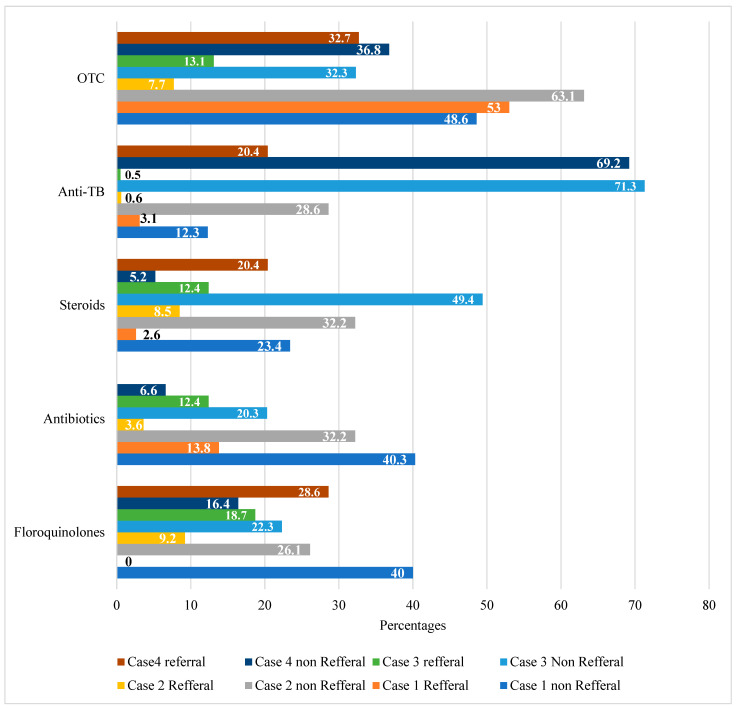
Pakistan is classified as a high-burden country for tuberculosis, and the prescription of antibiotics and fluoroquinolones complicates the detection and treatment of the disease. The existing literature primarily relies on knowledge questionnaires and prescription analyses, which focus on healthcare providers' knowledge rather than their actual clinical practices. Therefore, this study aimed to evaluate the quality of tuberculosis care using standardized patients. We conducted a cross-sectional study, recruiting consenting private healthcare practitioners in four cities in Punjab, Pakistan. Standardized patients were engaged from the general public to simulate four cases: two suspected tuberculosis cases (Case 1 and 2), one confirmed tuberculosis case (Case 3), and one suspected multidrug-resistant tuberculosis case (Case 4). The optimal management in Cases 1 and 2 was referral for sputum testing, chest X-ray, or referral to a public facility for directly observed treatment short-courses without dispensing antibiotics, fluoroquinolones, and steroids. In Case 3, treatment with four anti-TB medications was expected, while Case 4 should have prompted a drug-susceptibility test. Descriptive statistics using SPSS version 23 were employed to analyze disparities in referrals, ideal case management, antibiotic use, steroid administration, and the number of medications prescribed. From July 2022 to May 2023, 3321 standardized cases were presented to private healthcare practitioners. Overall, 39.4% of tuberculosis cases were managed optimally, with Case 3 showing the highest rate (56.7%) and Case 4 showing the lowest (19.8%). City-specific analysis revealed that Rawalpindi had the highest management rate (55.8%), while Sialkot had the lowest (30.6%). Antibiotics were most frequently prescribed in Case 1 and least prescribed in Case 4, with a similar pattern for fluoroquinolones. Anti-TB medications were also prescribed in naïve and suspected tuberculosis cases (8.3% in Case 1 and 10.8% in Case 2). The quality of tuberculosis management in actual practice is suboptimal among healthcare providers in Pakistan. Furthermore, the over-prescription of antibiotics, fluoroquinolones, and anti-TB drugs presents a significant risk for the development of drug-resistant tuberculosis.
巴基斯坦被列为结核病高负担国家,抗生素和氟喹诺酮类药物的处方使该疾病的检测和治疗变得复杂。现有文献主要依赖知识问卷和处方分析,侧重于医疗服务提供者的知识而非他们的实际临床实践。因此,本研究旨在使用标准化患者评估结核病护理质量。我们进行了一项横断面研究,在巴基斯坦旁遮普省的四个城市招募了同意参与的私人医疗从业者。从普通公众中招募标准化患者来模拟四个病例:两个疑似结核病例(病例1和病例2)、一个确诊结核病例(病例3)和一个疑似耐多药结核病例(病例4)。病例1和病例2的最佳管理方法是转诊进行痰检、胸部X光检查,或转诊至公共机构接受直接观察下的短程治疗,且不发放抗生素、氟喹诺酮类药物和类固醇。在病例3中,预计使用四种抗结核药物进行治疗,而病例4应促使进行药敏试验。使用SPSS 23版进行描述性统计,以分析转诊、理想病例管理、抗生素使用、类固醇给药和所开药物数量方面的差异。2022年7月至2023年5月,向私人医疗从业者呈现了3321个标准化病例。总体而言,39.4%的结核病例得到了最佳管理,其中病例3的比例最高(56.7%),病例4的比例最低(19.8%)。城市特定分析显示,拉瓦尔品第的管理率最高(55.8%),而锡亚尔科特的管理率最低(30.6%)。抗生素在病例1中最常被处方,在病例4中最少被处方,氟喹诺酮类药物的情况类似。在初治和疑似结核病例中也开具了抗结核药物(病例1中为8.3%,病例2中为10.8%)。在巴基斯坦,医疗服务提供者实际的结核病管理质量欠佳。此外,抗生素、氟喹诺酮类药物和抗结核药物的过度处方对耐药结核病的发展构成了重大风险。