Vu Thanh Cong, Gooding J Justin, Kah Melanie
NanoSoils Bio Pty Ltd, Sydney, NSW, Australia.
School of Chemistry, University of New South Wales, Sydney, NSW, Australia.
Nat Commun. 2025 Mar 7;16(1):2306. doi: 10.1038/s41467-025-57650-8.
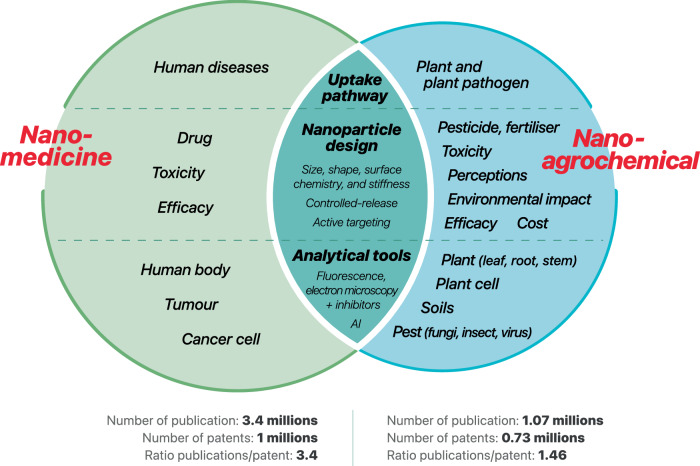
Sharing concepts and knowledge between medical and agricultural fields can promote the development of improved nano-enabled technologies. A central idea behind drug delivery systems is that the active substances are encapsulated in nanoparticles (nano-medicines) to protect the drugs from premature degradation and allow them to be transported to the target site within the body. After three decades of development, nano-medicines are now used in many practical applications, including clinical oncology, infectious disease, cosmetics, and vaccines. Nano-agrochemicals are increasingly considered to tackle challenges associated with food production, sustainability and food security. Despite obvious differences between nano-medicines and nano-agrochemicals in terms of uptake mechanisms, target and environmental and economic constraints, the principles behind nanoparticle design share many similarities. This article hopes to share experiences and lessons learnt from nano-medicines that will help design more effective and safer nano-agrochemicals.
医学和农业领域之间分享概念和知识能够促进先进纳米技术的发展。药物递送系统背后的一个核心观点是,活性物质被包裹在纳米颗粒(纳米药物)中,以保护药物不被过早降解,并使其能够被运输到体内的靶位点。经过三十年的发展,纳米药物如今已应用于许多实际领域,包括临床肿瘤学、传染病、化妆品和疫苗。纳米农用化学品越来越多地被视为应对与粮食生产、可持续性和粮食安全相关挑战的手段。尽管纳米药物和纳米农用化学品在摄取机制、靶标以及环境和经济限制方面存在明显差异,但纳米颗粒设计背后的原理有许多相似之处。本文希望分享从纳米药物中汲取的经验教训,这将有助于设计出更有效、更安全的纳米农用化学品。