Leung Ho Man Colman, Gong Chengyue, Geiser Luke, Fivekiller Emily E, Bui Nam, Vu Tam, Prioleau Temiloluwa, Forlenza Gregory P, Liu Qiang, Zhou Xia
Department of Computer Science, Columbia University, New York, NY, 10027, USA.
Department of Computer Science, University of Texas at Austin, Austin, TX, 78712, USA.
Sci Rep. 2025 Mar 14;15(1):8877. doi: 10.1038/s41598-025-92515-6.
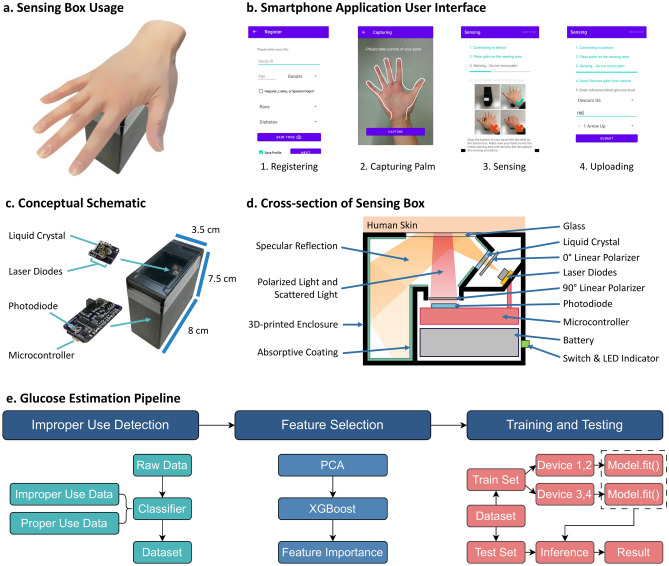
Diabetes affects millions in the US, causing elevated blood glucose levels that could lead to complications like kidney failure and heart disease. Recent development of continuous glucose monitors has enabled a minimally invasive option, but the discomfort and social factors highlight the need for noninvasive alternatives in diabetes management. We propose a portable noninvasive glucose sensing system based on the glucose's optical activity property which rotates linearly polarized light depending on its concentration level. To enable a portable form factor, a light trap mechanism is used to capture unwanted specular reflection from the palm and the enclosure itself. We fabricate four sensing prototypes and conduct a 363-day multi-session clinical evaluation in real-world settings. 30 participants are provided with a prototype for a 5-day home monitoring study, collecting on average 8 data points per day. We identify the error caused by differences between the sensing boxes and the participants' improper usage. We utilize a machine learning pipeline together with Bayesian Ridge Regressor models and multiple-step data processing techniques to deal with the noisy data. Over 95% of the predictions fall within Zone A (clinically accurate) or B (clinically acceptable) of the Consensus Error Grid with a 0.24 mean absolute relative differences.
糖尿病影响着美国数百万人,导致血糖水平升高,进而可能引发肾衰竭和心脏病等并发症。连续血糖监测仪的最新发展提供了一种微创选择,但不适和社会因素凸显了糖尿病管理中对无创替代方案的需求。我们提出了一种基于葡萄糖光学活性特性的便携式无创血糖传感系统,该特性会根据葡萄糖浓度水平使线偏振光发生旋转。为实现便携式外形尺寸,采用了一种光阱机制来捕获来自手掌和外壳本身的不必要镜面反射。我们制作了四个传感原型,并在实际环境中进行了为期363天的多阶段临床评估。30名参与者被提供一个原型进行为期5天的家庭监测研究,平均每天收集8个数据点。我们识别出传感盒差异和参与者使用不当所导致的误差。我们利用机器学习管道以及贝叶斯岭回归模型和多步数据处理技术来处理噪声数据。超过95%的预测落在共识误差网格的A区(临床准确)或B区(临床可接受)内,平均绝对相对差异为0.24。