Benca Emir, van Knegsel Kenneth P, Pestel Maximilian, Zderic Ivan, Caspar Jan, Hirtler Lena, Strassl Andreas, Gehweiler Dominic, Zehetmayer Sonja, Gueorguiev Boyko, Widhalm Harald, Windhager Reinhard, Varga Peter
Department of Orthopedics and Trauma Surgery, Medical University of Vienna, Währinger Gürtel 18- 20, Vienna, 1090, Austria.
AO Research Institute Davos, Clavadelerstrasse 8, Davos, 7270, Switzerland.
Arch Orthop Trauma Surg. 2025 Mar 22;145(1):207. doi: 10.1007/s00402-025-05805-z.
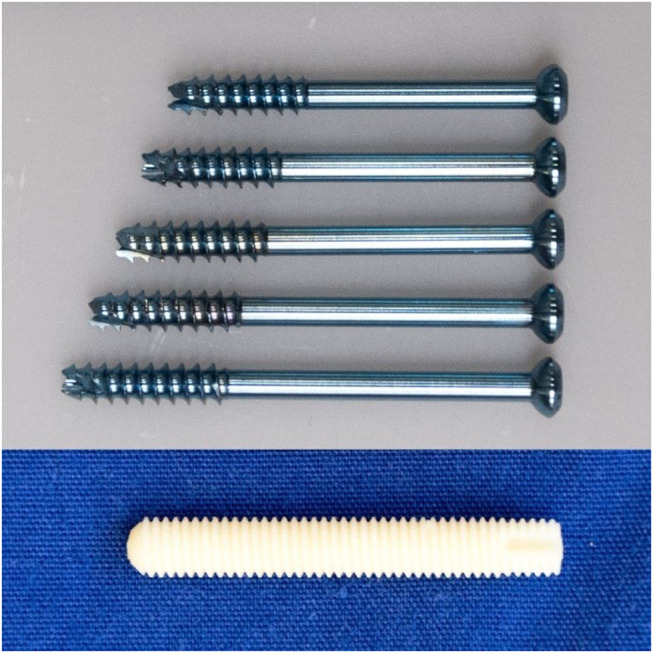
Fractures of the odontoid process are associated with high non-union rates, challenging treatment, and high incidence of screw-related complications. The aim of this study was to compare the biomechanical competence of a single biointegrative bone allograft screw versus two conventional cannulated screws for odontoid fracture fixation.
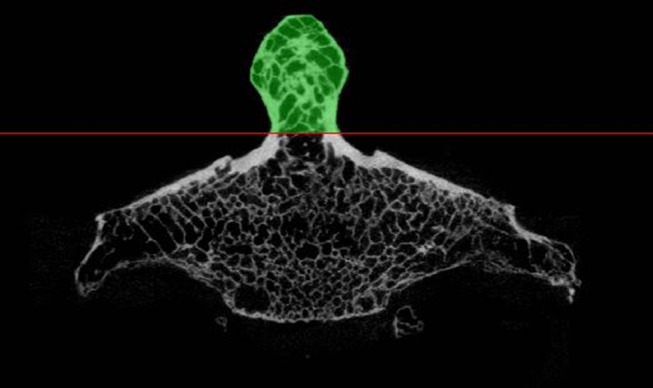
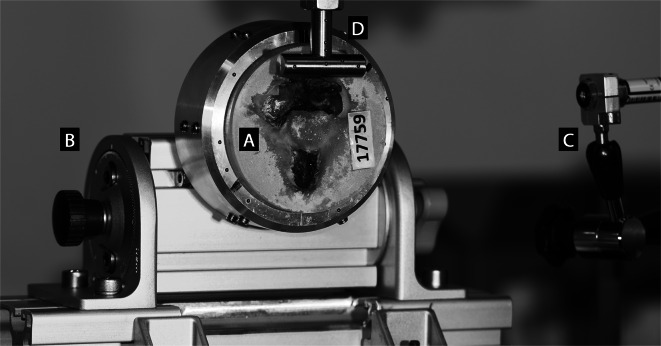
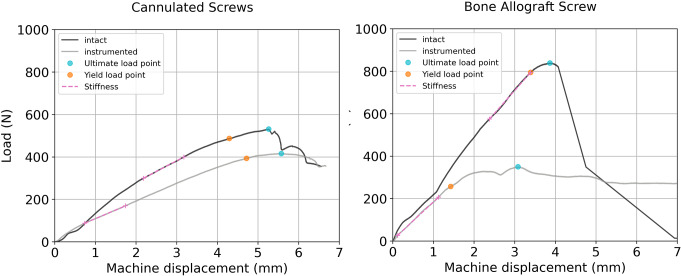
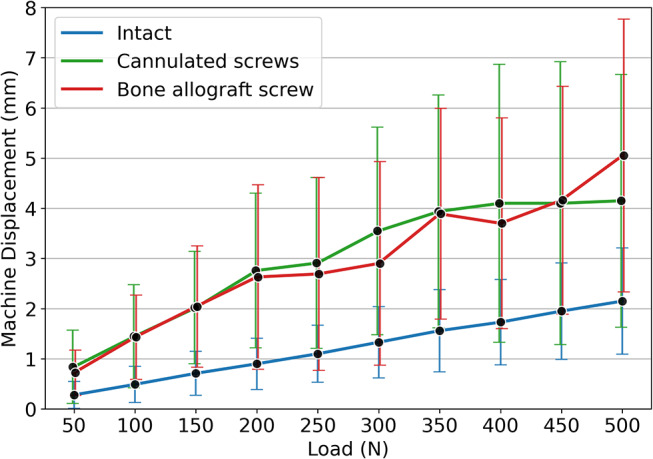
The odontoid process of intact C2 vertebral specimens was subjected to quasi-static loading until fracture. Specimens with an Anderson and d'Alonzo type II or III fracture (n = 47) were fixated with either two conventional cannulated screws or with a single bone allograft screw. The constructs were biomechanically tested to failure in the same fashion as in their intact state. Stiffness, yield, and ultimate load were evaluated. The results were adjusted by age, sex, volumetric bone mineral density (vBMD), and the cross-sectional area ratio of cortical bone to total bone measured at the junction of the odontoid process with the vertebral body (Ct.Ar/Tt.Ar).
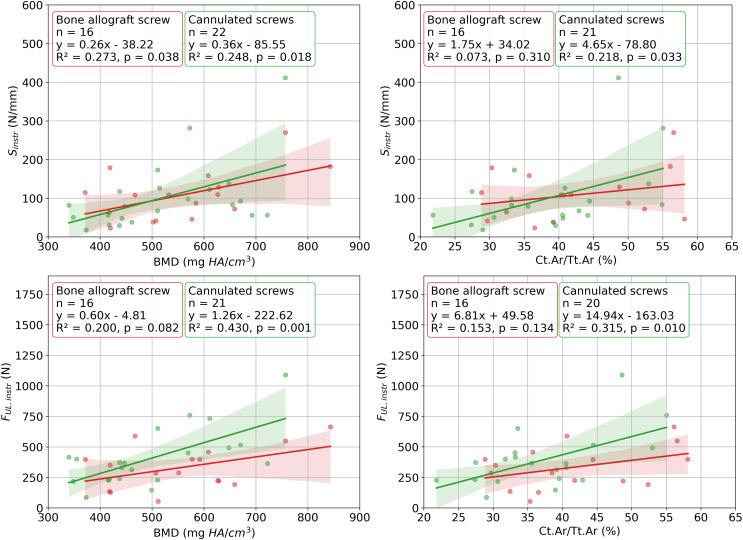
Stiffness, yield and ultimate load were restored in the cannulated screws group by 44 ± 10%, 46 ± 7%, and 46 ± 5% and in the bone allograft group by 50 ± 12%, 30 ± 9%, and 34 ± 6% (mean ± SE). There were no significant differences between the groups regarding the three mechanical outcomes (0.104 ≤ p ≤ 0.223). Positive significant relation was found between vBMD and stiffness in each group (0.248 ≤ R²≤0.273, 0.018 ≤ p ≤ 0.038), as well as between Ct.Ar/Tt.Ar and stiffness (R²=0.218, p = 0.033), vBMD and ultimate load (R²=0.430, p = 0.001) and ultimate loadand vBMD (R²=0.315, p = 0.010) in the cannulated screws group.
The primary stability of odontoid fracture fixation is determined mainly by the quality of the local bone and independent of the fixation technique. From the biomechanical perspective, the lower mean values for the yield and ultimate load restored in the bone allograft group compared to the cannulated screws group should be compensated by lower peak load during the patient's rehabilitation process.
齿突骨折与高不愈合率、具有挑战性的治疗以及螺钉相关并发症的高发生率相关。本研究的目的是比较单根生物整合同种异体骨移植螺钉与两根传统空心螺钉用于齿突骨折固定的生物力学性能。
对完整的C2椎体标本的齿突进行准静态加载直至骨折。将Anderson和d’Alonzo II型或III型骨折的标本(n = 47)用两根传统空心螺钉或单根同种异体骨移植螺钉固定。对这些结构进行生物力学测试直至失效,测试方式与它们处于完整状态时相同。评估刚度、屈服强度和极限载荷。结果根据年龄、性别、体积骨密度(vBMD)以及在齿突与椎体交界处测量的皮质骨与总骨的横截面积比(Ct.Ar/Tt.Ar)进行调整。
空心螺钉组的刚度、屈服强度和极限载荷分别恢复了44±10%、46±7%和46±5%,同种异体骨移植组分别恢复了50±12%、30±9%和34±6%(平均值±标准误)。两组在这三项力学指标上无显著差异(0.104≤p≤0.223)。在每组中,vBMD与刚度之间存在显著正相关(0.248≤R²≤0.273,0.018≤p≤0.038),在空心螺钉组中,Ct.Ar/Tt.Ar与刚度之间(R² = 0.218,p = 0.033)、vBMD与极限载荷之间(R² = 0.430,p = 0.001)以及极限载荷与vBMD之间(R² = 0.315,p = 0.010)也存在显著正相关。
齿突骨折固定的初始稳定性主要由局部骨质量决定,与固定技术无关。从生物力学角度来看,同种异体骨移植组与空心螺钉组相比,恢复的屈服强度和极限载荷平均值较低,这应在患者康复过程中由较低的峰值载荷来弥补。