• 文献检索
  • 文档翻译
  • 深度研究
  • 学术资讯
  • Suppr Zotero 插件Zotero 插件
  • 邀请有礼
  • 套餐&价格
  • 历史记录
应用&插件
Suppr Zotero 插件Zotero 插件浏览器插件Mac 客户端Windows 客户端微信小程序
定价
高级版会员购买积分包购买API积分包
服务
文献检索文档翻译深度研究API 文档MCP 服务
关于我们
关于 Suppr公司介绍联系我们用户协议隐私条款
关注我们

Suppr 超能文献

核心技术专利:CN118964589B侵权必究
粤ICP备2023148730 号-1Suppr @ 2026

文献检索

告别复杂PubMed语法,用中文像聊天一样搜索,搜遍4000万医学文献。AI智能推荐,让科研检索更轻松。

立即免费搜索

文件翻译

保留排版,准确专业,支持PDF/Word/PPT等文件格式,支持 12+语言互译。

免费翻译文档

深度研究

AI帮你快速写综述,25分钟生成高质量综述,智能提取关键信息,辅助科研写作。

立即免费体验

助听器购买的社会预测因素:耻辱感、社交网络构成、社会支持和孤独感重要吗?

Social Predictors of Hearing Aid Purchase: Do Stigma, Social Network Composition, Social Support, and Loneliness Matter?

作者信息

Singh Gurjit, Goy Huiwen, Wright-Whyte Kay, Chasteen Alison L, Pichora-Fuller M Kathleen

机构信息

Sonova Canada, Kitchener, Ontario, Canada.

Department of Psychology, Toronto Metropolitan University, Toronto, Ontario, Canada.

出版信息

Ear Hear. 2025;46(5):1149-1163. doi: 10.1097/AUD.0000000000001656. Epub 2025 Mar 28.

DOI:10.1097/AUD.0000000000001656
PMID:40148265
原文链接:https://pmc.ncbi.nlm.nih.gov/articles/PMC12352571/
Abstract

OBJECTIVES

The purpose of this study was to evaluate the extent to which four different social factors (stigma, social network composition, social support, and loneliness) predict the purchase of hearing aids in a sample of older adults with impaired hearing who had not previously tried hearing aids and visited a hearing care clinic for the first time.

DESIGN

Data collection took place across 130 different hearing care clinics (Connect Hearing) in Canada. A total of 4630 participants were recruited for the study from notices in the waiting rooms of the clinics or by advertising in local newspapers. The final sample consisted of 753 adults (mean age = 69.2 years; SD = 9.0; 57.4% male) who were all recommended to try hearing aids. Clinical records were tracked for a minimum of 3 months and a maximum of 15 months after the appointment to determine if they obtained hearing aids. Participants completed a 56-item questionnaire before their appointment and then experienced standard care at the clinic (i.e., hearing evaluation, hearing rehabilitation if desired, etc.). Key factors assessed by the questionnaire included stigma related to age, stigma related to hearing aids, social network composition, perceived levels of social support, loneliness, self-reported hearing disability, and demographic information.

RESULTS

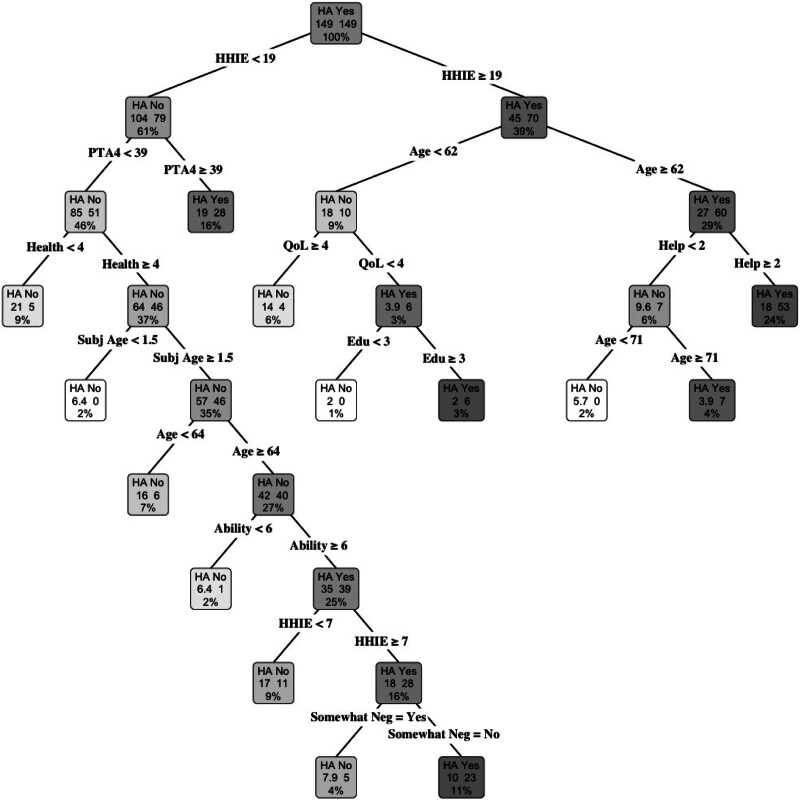
Data were analyzed using two methods, a penalized logistic regression and a classification tree analysis, to identify statistical predictors and meaningful clinical cutoff scores, respectively. Both models found that hearing aid adoption was best predicted by being older and having greater self-reported hearing disability. Hearing aid uptake was also predicted by social factors, but these predictors were less robust than age and self-reported hearing disability. Participants were more likely to adopt hearing aids if they reported less hearing aid stigma and had a social network that included at least 1 person with a suspected hearing loss. Loneliness and social support did not predict hearing aid adoption. Some model-specific variables also emerged.

CONCLUSIONS

Using a prospective research design, the study provides novel quantitative evidence of the role of different social factors regarding the uptake of hearing aids. The research findings may be used to better identify individuals more and less likely to obtain hearing aids, inform hearing rehabilitation, and motivate the use of interventions designed to lessen the impact of stigma on hearing rehabilitation.

摘要

目的

本研究的目的是评估四种不同的社会因素(耻辱感、社会网络构成、社会支持和孤独感)在未曾尝试过助听器且首次前往听力保健诊所的听力受损老年人样本中,对购买助听器的预测程度。

设计

数据收集在加拿大的130家不同的听力保健诊所(Connect Hearing)进行。通过诊所候诊室的公告或在当地报纸上刊登广告,共招募了4630名参与者参与该研究。最终样本由753名成年人组成(平均年龄 = 69.2岁;标准差 = 9.0;男性占57.4%),他们均被建议尝试使用助听器。在预约后至少跟踪临床记录3个月,最多跟踪15个月,以确定他们是否购买了助听器。参与者在预约前完成了一份56项的问卷,然后在诊所接受标准护理(即听力评估、如有需要进行听力康复等)。问卷评估的关键因素包括与年龄相关的耻辱感、与助听器相关的耻辱感、社会网络构成、感知的社会支持水平、孤独感、自我报告的听力残疾以及人口统计学信息。

结果

使用两种方法对数据进行分析,即惩罚逻辑回归和分类树分析,分别用于识别统计预测因素和有意义的临床临界分数。两个模型均发现,年龄较大和自我报告的听力残疾程度较高最能预测助听器的采用情况。社会因素也能预测助听器的使用情况,但这些预测因素不如年龄和自我报告的听力残疾那么有力。如果参与者报告的助听器耻辱感较低且其社会网络中至少有1人疑似听力损失,那么他们更有可能采用助听器。孤独感和社会支持并不能预测助听器的采用情况。还出现了一些特定于模型的变量。

结论

该研究采用前瞻性研究设计,提供了关于不同社会因素在助听器采用方面作用的新的定量证据。研究结果可用于更好地识别更有可能和不太可能获得助听器的个体,为听力康复提供信息,并推动使用旨在减轻耻辱感对听力康复影响的干预措施。
https://cdn.ncbi.nlm.nih.gov/pmc/blobs/deb6/12352571/3806de76873b/aud-46-1149-g002.jpg
https://cdn.ncbi.nlm.nih.gov/pmc/blobs/deb6/12352571/de6495960d63/aud-46-1149-g001.jpg
https://cdn.ncbi.nlm.nih.gov/pmc/blobs/deb6/12352571/3806de76873b/aud-46-1149-g002.jpg
https://cdn.ncbi.nlm.nih.gov/pmc/blobs/deb6/12352571/de6495960d63/aud-46-1149-g001.jpg
https://cdn.ncbi.nlm.nih.gov/pmc/blobs/deb6/12352571/3806de76873b/aud-46-1149-g002.jpg

相似文献

1
Social Predictors of Hearing Aid Purchase: Do Stigma, Social Network Composition, Social Support, and Loneliness Matter?助听器购买的社会预测因素:耻辱感、社交网络构成、社会支持和孤独感重要吗?
Ear Hear. 2025;46(5):1149-1163. doi: 10.1097/AUD.0000000000001656. Epub 2025 Mar 28.
2
Prescription of Controlled Substances: Benefits and Risks管制药品的处方:益处与风险
3
Interventions to improve hearing aid use in adult auditory rehabilitation.改善成人听觉康复中助听器使用情况的干预措施。
Cochrane Database Syst Rev. 2014 Jul 12(7):CD010342. doi: 10.1002/14651858.CD010342.pub2.
4
Interventions to improve hearing aid use in adult auditory rehabilitation.改善成人听觉康复中助听器使用情况的干预措施。
Cochrane Database Syst Rev. 2016 Aug 18;2016(8):CD010342. doi: 10.1002/14651858.CD010342.pub3.
5
A New Measure of Quantified Social Health Is Associated With Levels of Discomfort, Capability, and Mental and General Health Among Patients Seeking Musculoskeletal Specialty Care.一种新的量化社会健康指标与寻求肌肉骨骼专科护理的患者的不适程度、能力以及心理和总体健康水平相关。
Clin Orthop Relat Res. 2025 Apr 1;483(4):647-663. doi: 10.1097/CORR.0000000000003394. Epub 2025 Feb 5.
6
Bilateral versus unilateral hearing aids for bilateral hearing impairment in adults.成人双侧听力障碍使用双侧助听器与单侧助听器的比较。
Cochrane Database Syst Rev. 2017 Dec 19;12(12):CD012665. doi: 10.1002/14651858.CD012665.pub2.
7
Investigation and analysis of mental health status of the older adult in western rural areas.西部农村地区老年人心理健康状况的调查与分析
Front Public Health. 2025 Jul 16;13:1612600. doi: 10.3389/fpubh.2025.1612600. eCollection 2025.
8
Signs and symptoms to determine if a patient presenting in primary care or hospital outpatient settings has COVID-19.在基层医疗机构或医院门诊环境中,如果患者出现以下症状和体征,可判断其是否患有 COVID-19。
Cochrane Database Syst Rev. 2022 May 20;5(5):CD013665. doi: 10.1002/14651858.CD013665.pub3.
9
Reading aids for adults with low vision.针对视力低下成年人的阅读辅助工具。
Cochrane Database Syst Rev. 2018 Apr 17;4(4):CD003303. doi: 10.1002/14651858.CD003303.pub4.
10
Falls prevention interventions for community-dwelling older adults: systematic review and meta-analysis of benefits, harms, and patient values and preferences.社区居住的老年人跌倒预防干预措施:系统评价和荟萃分析的益处、危害以及患者的价值观和偏好。
Syst Rev. 2024 Nov 26;13(1):289. doi: 10.1186/s13643-024-02681-3.

本文引用的文献

1
Toward Alleviating the Stigma of Hearing Aids: A Review.减轻助听器污名化:综述
Audiol Res. 2024 Dec 4;14(6):1058-1074. doi: 10.3390/audiolres14060087.
2
Using Ecological Momentary Analysis to explore stigma experiences in the real world for adults with acquired hearing loss.运用生态瞬时评估法探究成年后天性听力损失患者在现实世界中的耻辱感经历。
Int J Audiol. 2025 Apr;64(sup1):S28-S38. doi: 10.1080/14992027.2024.2418970. Epub 2024 Nov 4.
3
How do adults with hearing loss, family members, and hearing care professionals respond to the stigma of hearing loss and hearing aids?
听力损失的成年人、其家庭成员以及听力保健专业人员如何应对听力损失和助听器带来的耻辱感?
Int J Audiol. 2024 Oct 17:1-8. doi: 10.1080/14992027.2024.2406885.
4
Preliminary Validation of Experienced Ageism Measures With Four Populations in the United States.美国四个群体中经验年龄歧视量表的初步验证。
Ear Hear. 2024;45(Suppl 1):62S-69S. doi: 10.1097/AUD.0000000000001475. Epub 2024 Sep 19.
5
Preliminary Validation of Hearing Device-Related Stigma Measures in Four United States Populations.四种美国人群中听力设备相关污名量表的初步验证。
Ear Hear. 2024;45(Suppl 1):53S-61S. doi: 10.1097/AUD.0000000000001539. Epub 2024 Sep 19.
6
Development of Measures for d/Deaf and Hard of Hearing Stigma: Introduction to the Special Supplement on Stigma Measurement Tools.聋人/重听污名化措施的制定:关于污名化测量工具的特刊介绍。
Ear Hear. 2024;45(Suppl 1):4S-16S. doi: 10.1097/AUD.0000000000001543. Epub 2024 Sep 19.
7
The experience of stigma related to hearing loss and hearing aids: perspectives of adults with hearing loss, their families, and hearing care professionals.与听力损失及助听器相关的耻辱感体验:听力损失成年人、其家人及听力保健专业人员的观点
Int J Audiol. 2024 Jun 2:1-8. doi: 10.1080/14992027.2024.2353862.
8
Predicting Individual Hearing-Aid Preference From Self-Reported Listening Experiences in Daily Life.预测个体对助听器的偏好:基于日常生活中的自我报告听力体验。
Ear Hear. 2024;45(5):1313-1325. doi: 10.1097/AUD.0000000000001520. Epub 2024 May 24.
9
Relationships Between Speech, Spatial and Qualities of Hearing Short Form SSQ12 Item Scores and their Use in Guiding Rehabilitation for Cochlear Implant Recipients.言语、空间和听力简短问卷 SSQ12 项目得分之间的关系及其在指导人工耳蜗植入者康复中的应用。
Trends Hear. 2024 Jan-Dec;28:23312165231224643. doi: 10.1177/23312165231224643.
10
To tell or not to tell? Exploring the social process of stigma for adults with hearing loss and their families: introduction to the special issue.告知还是不告知?探索成年听力损失者及其家庭的耻辱感社会过程:特刊引言
Int J Audiol. 2023 Dec 28:1-11. doi: 10.1080/14992027.2023.2293651.