Pulido López María Guadalupe, Garduño Roberto González, Penago Gerardo Jiménez, Hernández Glafiro Torres, Vera Maritza Zaragoza, Ríos Hilario Josué Jonathan, Zambrano Velasco María Guadalupe
Unidad Regional Universitaria Sursureste. Universidad Autónoma Chapingo. Teapa, Tabasco, Mexico.
Campus Montecillo. Colegio de Postgraduados. Montecillo, Estado de Mexico, Mexico.
Open Vet J. 2025 Feb;15(2):871-884. doi: 10.5455/OVJ.2025.v15.i2.36. Epub 2025 Feb 28.
The selection of sheep with high genetic resistance to gastrointestinal nematodes is a sustainable alternative for parasite control.
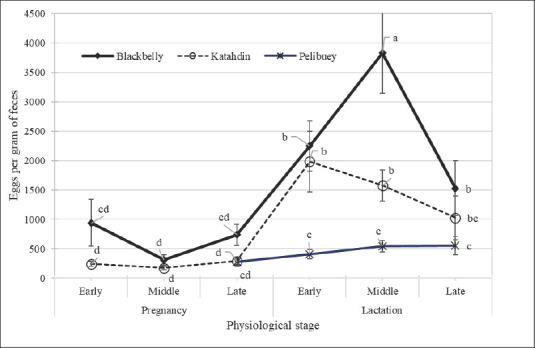
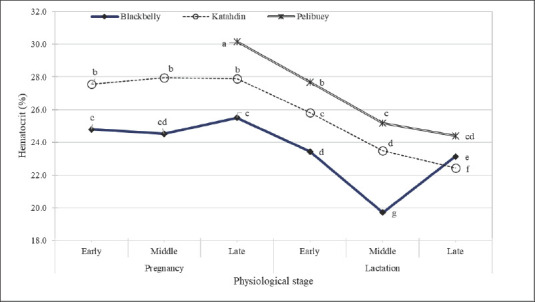
This study was performed to categorize three breeds of hair sheep according to their resistance to gastrointestinal nematodes during the peripartum period using hematocrit (HCT) and to compare these results with categorizations derived from the nematode eggs per gram of feces (EPG).
Parasitological records from two studies involving 46 Katahdin × Pelibuey and 25 Blackbelly ewes were used, along with information from pregnancy (week 22) to lactation (week 13) of a flock of 31 Pelibuey ewes. All ewes of the three breeds were naturally infected by grazing. The ewes were categorized as resistant, intermediate, or susceptible in each breed and by physiological stage (gestation or lactation) using the EPG ± three standard errors. We also categorized ewes based on their HCT ± one standard deviation.
During pregnancy, resistant ewes were those with less than 257, 148, and 96 EPG for the Blackbelly, Katahdin, and Pelibuey breeds, respectively, while in lactation, resistant ewes had less than 1,587, 912, and 310 EPG, respectively. In the classification by HCT, Blackbelly ewes had values lower than 31.0%; therefore, only intermediate (HCT of 24.4%-31.0%) and susceptible ewes (HCT < 24.4%) were identified. Among the Katahdin, the resistant ewes had only 149 EPGs recorded during lactation, thereby making the classification by lactation-HTC (94 EPG) comparable to the classification by EPG. In Pelibuey ewes, classification by HCT during early lactation (week 1-4) allowed the selection of resistant ewes with higher EPG (379 EPG) compared with the EPG classification (80 EPG), but intermediate and resistant ewes had similar EPG.
Classification by HCT and nematode eggs per gram of feces allows the selection of ewes with resistance to gastrointestinal nematodes at the beginning of lactation.
选择对胃肠道线虫具有高遗传抗性的绵羊是寄生虫控制的一种可持续替代方法。
本研究旨在利用血细胞比容(HCT)对三种毛用绵羊品种在围产期对胃肠道线虫的抗性进行分类,并将这些结果与每克粪便中线虫卵(EPG)得出的分类结果进行比较。
使用了两项研究的寄生虫学记录,其中一项涉及46只卡他丁×佩利布埃杂交羊和25只黑腹母羊,另一项来自31只佩利布埃母羊群体从怀孕(第22周)到哺乳(第13周)的信息。三个品种的所有母羊均通过放牧自然感染。根据EPG±三个标准误,将每个品种以及生理阶段(妊娠或哺乳)的母羊分为抗性、中间型或易感型。我们还根据HCT±一个标准差对母羊进行分类。
在怀孕期间,黑腹、卡他丁和佩利布埃品种的抗性母羊分别是EPG低于257、148和96的母羊,而在哺乳期,抗性母羊的EPG分别低于1587、912和310。在按HCT分类中,黑腹母羊的值低于31.0%;因此,仅鉴定出中间型(HCT为24.4%-31.0%)和易感母羊(HCT<24.4%)。在卡他丁品种中,抗性母羊在哺乳期仅记录到149个EPG,因此哺乳期血细胞比容(HTC)(94个EPG)分类与EPG分类相当。在佩利布埃母羊中,与EPG分类(80个EPG)相比,在哺乳早期(第1-4周)按HCT分类能够选出EPG较高(379个EPG)的抗性母羊,但中间型和抗性母羊的EPG相似。
通过HCT和每克粪便中的线虫卵进行分类,能够在哺乳期开始时选择出对胃肠道线虫具有抗性的母羊。