Monalisha P, Ameziane Maria, Spasojevic Irena, Pellicer Eva, Mansell Rhodri, Menéndez Enric, van Dijken Sebastiaan, Sort Jordi
Departament de Física Universitat Autònoma de Barcelona Cerdanyola del Vallès 08193 Bellaterra Spain.
NanoSpin Department of Applied Physics Aalto University School of Science FI-00076 Aalto Finland.
Small Sci. 2024 Jul 4;4(10):2400133. doi: 10.1002/smsc.202400133. eCollection 2024 Oct.
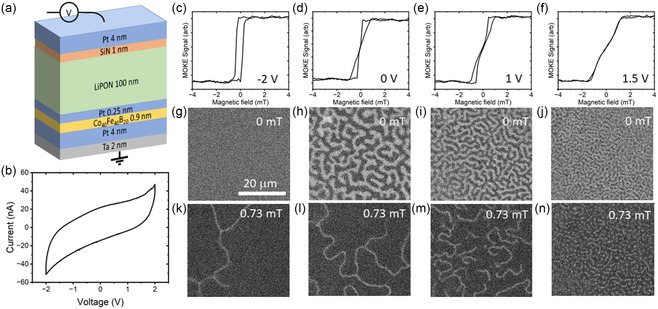
With the advent of Big Data, traditional digital computing is struggling to cope with intricate tasks related to data classification or pattern recognition. To mitigate this limitation, software-based neural networks are implemented, but they are run in conventional computers whose operation principle (with separate memory and data-processing units) is highly inefficient compared to the human brain. Brain-inspired in-memory computing is achieved through a wide variety of methods, for example, artificial synapses, spiking neural networks, or reservoir computing. However, most of these methods use materials (e.g., memristor arrays, spintronics, phase change memories) operated with electric currents, resulting in significant Joule heating effect. Tuning magnetic properties by voltage-driven ion motion (i.e., magnetoionics) has recently emerged as an alternative energy-efficient approach to emulate functionalities of biological synapses: potentiation/depression, multilevel storage, or transitions from short-term to long-term plasticity. In this perspective, the use of magnetoionics in neuromorphic applications is critically reviewed, with emphasis on modulating synaptic weight through: 1) control of magnetization by voltage-induced ion retrieval/insertion; and 2) control of magnetic stripe domains and skyrmions in gated magnetic thin films adjacent to solid-state ionic supercapacitors. The potential prospects in this emerging research area together with a forward-looking discussion on future opportunities are provided.
随着大数据时代的到来,传统数字计算在处理与数据分类或模式识别相关的复杂任务时面临困境。为了缓解这一限制,人们采用了基于软件的神经网络,但它们运行在传统计算机上,其操作原理(具有独立的内存和数据处理单元)与人类大脑相比效率极低。受大脑启发的内存计算通过多种方法实现,例如人工突触、脉冲神经网络或水库计算。然而,这些方法大多使用由电流驱动的材料(如忆阻器阵列、自旋电子学、相变存储器),会产生显著的焦耳热效应。通过电压驱动离子运动来调节磁性能(即磁离子学)最近已成为一种替代的节能方法,用于模拟生物突触的功能:增强/抑制、多级存储或从短期可塑性到长期可塑性的转变。从这个角度出发,本文对磁离子学在神经形态应用中的使用进行了批判性综述,重点在于通过以下方式调节突触权重:1)通过电压诱导离子提取/插入来控制磁化;2)控制与固态离子超级电容器相邻的门控磁性薄膜中的磁条畴和斯格明子。本文还介绍了这一新兴研究领域的潜在前景,并对未来机会进行了前瞻性讨论。