da Costa Romay Coragem, Cunha Francisca Guerra, Abreu Raquel, Pereira Gonçalo, Geraldes Catarina, Cunha Eva, Chambel Lélia, Oliveira Manuela
CIISA-Centre for Interdisciplinary Research in Animal Health, Faculty of Veterinary Medicine, University of Lisbon, Avenida da Universidade Técnica, 1300-477 Lisboa, Portugal.
Associate Laboratory for Animal and Veterinary Sciences (AL4AnimalS), 1300-477 Lisboa, Portugal.
Animals (Basel). 2025 Apr 4;15(7):1043. doi: 10.3390/ani15071043.
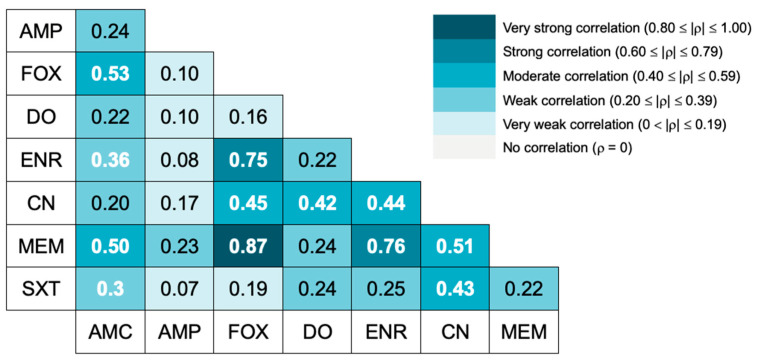
Staphylococci are prevalent in dogs' microbiota, with commensal strains being able to exhibit resistance and virulence traits, complicating secondary infection management. As antimicrobial resistance is a global threat, particularly in middle-income countries like Angola, surveillance of resistant bacteria is crucial. We analyzed the prevalence, antimicrobial resistance, and virulence profiles of staphylococci from dogs in Angola. Isolates were identified using VITEK 2 Compact (bioMérieux© SA, Marcy l'Etoile, France), and their genetic diversity was assessed via PCR fingerprinting. Isolates' susceptibility to relevant antimicrobials was determined by disk diffusion, and their virulence profiles were evaluated using plaque assays. The relationship between antibiotic resistance and animal-related factors was also assessed by statistical analysis. Isolates were identified as (former , 38%), (30%), (13%), (former , 7%), (former , 5%), (2%), and spp. (5%). Of these, 86% were resistant to at least one of the antimicrobials tested, and 30% were classified as multidrug-resistant, being more common in females, dogs with clinical signs of disease, and vaccinated animals. Moreover, 93% of the isolates were able to produce biofilm, 46% could produce lecithinase and gelatinase, and 23% could produce hemolysins. Companion dogs from Angola can carry resistant staphylococci able to express several virulence factors, potentially representing a One Health risk.
葡萄球菌在犬类微生物群中普遍存在,共生菌株能够表现出耐药性和毒力特征,使继发感染的管理变得复杂。由于抗菌药物耐药性是一个全球性威胁,尤其是在安哥拉等中等收入国家,对抗耐药菌进行监测至关重要。我们分析了安哥拉犬类葡萄球菌的流行情况、抗菌药物耐药性和毒力特征。使用VITEK 2 Compact(法国生物梅里埃公司,马西莱图瓦勒)鉴定分离株,并通过PCR指纹图谱评估其遗传多样性。通过纸片扩散法测定分离株对相关抗菌药物的敏感性,并使用噬斑试验评估其毒力特征。还通过统计分析评估了抗生素耐药性与动物相关因素之间的关系。分离株被鉴定为金黄色葡萄球菌(原金黄色葡萄球菌,38%)、中间葡萄球菌(30%)、溶血葡萄球菌(13%)、表皮葡萄球菌(原沃氏葡萄球菌,7%)、头状葡萄球菌(原科氏葡萄球菌,5%)、模仿葡萄球菌(2%)和葡萄球菌属其他种(5%)。其中,86%对至少一种测试抗菌药物耐药,30%被归类为多重耐药,在雌性犬、有疾病临床症状的犬和接种过疫苗的动物中更为常见。此外,93%的分离株能够产生生物膜,46%能够产生卵磷脂酶和明胶酶,23%能够产生溶血素。来自安哥拉的宠物犬可能携带能够表达多种毒力因子的耐药葡萄球菌,这可能构成“同一健康”风险。