Tunyong Witawat, Arsheewa Weewan, Santajit Sirijan, Kong-Ngoen Thida, Pumirat Pornpan, Sookrung Nitat, Chaicumpa Wanpen, Indrawattana Nitaya
Department of Microbiology and Immunology, Faculty of Tropical Medicine, Mahidol University, Bangkok, 10400, Thailand.
Department of Microbiology, Phrapokklao Hospital, Chanthaburi, 22000, Thailand.
Infect Drug Resist. 2021 Aug 29;14:3485-3494. doi: 10.2147/IDR.S328521. eCollection 2021.
The global spread of carbapenem-resistant Enterobacterales (CRE) inflicts a severe threat to human health. The CRE infections have resulted in an increased mortality rate in hospitals and other health-care settings worldwide. In this study, the antibiotic-resistance pattern and prevalence of carbapenemase-encoding genes among CRE isolated from patients of one hospital in Thailand were investigated.
By using conventional biochemical tests, we identified and isolated all species of Enterobacterales from the clinical samples kept at Prapokklao Hospital, Chanthaburi, Thailand, which were collected during 2016-2017. Multidrug-resistant (MDR) bacteria were determined by disc diffusion method and minimum inhibitory concentration (MIC) test strips. Carbapenemase genes were detected by PCR and confirmed by Sanger sequencing.
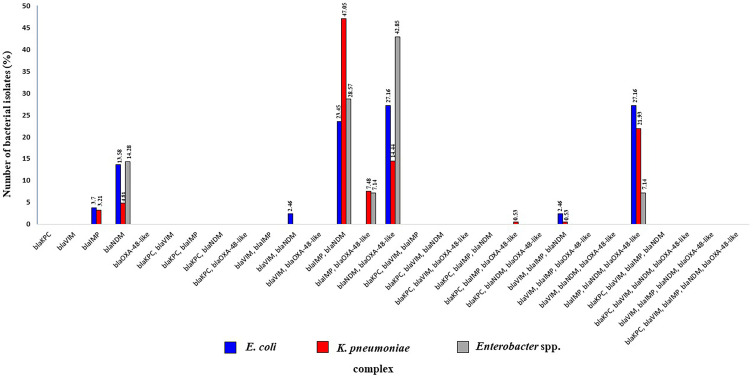
complex, , and spp. were isolated from the specimens. Of 9,564 isolated Enterobacterales, 282 were multidrug-resistance (MDR). The MIC test strips revealed that the MDR CRE were resistant to ertapenem (92.9%) and meropenem (81.3%). All these isolates carried carbapenemase-coding genes, including (90%) and (71%), the two most commonly found genes among CRE strains. There were 39.2% of the isolates that carried a combination of - and 22.6% carried combined - - genes.
This study demonstrates a significantly high prevalence of CRE isolates with the MDR phenotypes. A minority of the isolates carried a single carbapenem-resistant gene, while the majority harbored multiple genes in combination. Regular monitoring of MDR CRE and characterization of their drug resistance are important for guiding treatment, intervention and control of the CRE spread and outbreak in a health-care setting.
耐碳青霉烯类肠杆菌科细菌(CRE)在全球范围内的传播对人类健康构成严重威胁。CRE感染导致全球医院及其他医疗环境中的死亡率上升。在本研究中,对从泰国一家医院的患者中分离出的CRE的耐药模式及碳青霉烯酶编码基因的流行情况进行了调查。
通过常规生化试验,我们从泰国尖竹汶府Prapokklao医院保存的2016 - 2017年期间采集的临床样本中鉴定并分离出所有肠杆菌科细菌物种。采用纸片扩散法和最低抑菌浓度(MIC)试验条测定多重耐药(MDR)细菌。通过PCR检测碳青霉烯酶基因,并经桑格测序确认。
从标本中分离出了 菌属、 菌属和 菌属。在9564株分离出的肠杆菌科细菌中,282株为多重耐药菌(MDR)。MIC试验条显示,MDR CRE对厄他培南(92.9%)和美罗培南(81.3%)耐药。所有这些分离株均携带碳青霉烯酶编码基因,包括 基因(90%)和 基因(71%),这是CRE菌株中最常见的两个基因。39.2%的分离株携带 - 基因组合,22.6%携带 - - 基因组合。
本研究表明,具有MDR表型的CRE分离株的流行率显著较高。少数分离株携带单个耐碳青霉烯基因,而大多数则携带多个组合基因。定期监测MDR CRE及其耐药特征对于指导医疗环境中CRE传播和暴发的治疗、干预及控制至关重要。