Barrau-Martinez Blanca, Termes-Escalé Mireia, Valenzuela-Alcaraz Brenda, Llorach Rafael, Farran-Codina Andreu, Tor-Roca Alba, Gratacós Eduard, Crispi Fatima, Urpi-Sarda Mireia
Departament de Nutrició, Ciències de l'Alimentació i Gastronomia, Facultat de Farmàcia i Ciències de l'Alimentació, Campus de l'Alimentació de Torribera, Universitat de Barcelona (UB), 08921 Santa Coloma de Gramenet, Spain.
Institut de Recerca en Nutrició i Seguretat Alimentària (INSA-UB), Campus de l'Alimentació de Torribera, Universitat de Barcelona (UB), 08921 Santa Coloma de Gramenet, Spain.
Nutrients. 2025 Mar 28;17(7):1189. doi: 10.3390/nu17071189.
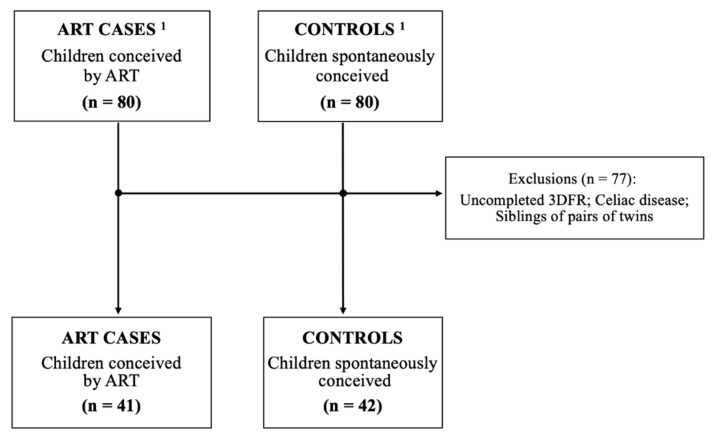
: Research on the relationship between nutritional characteristics and their impact on cardiovascular remodeling in children conceived by assisted reproductive technology (ART) is limited. We aimed to explore the influence of postnatal nutrition on vascular wall thickness in children conceived through ART, comparing them with a naturally conceived control group. : A prospective observational cohort of 3-year-old children (n = 83) was analyzed, including 41 conceived ART and 42 spontaneously conceived. The carotid maximum intima-media thickness (max-cIMT), a strong predictor of myocardial infarction, was measured and dietary intake was assessed through 3-day food records. Dietary data were compared between groups, and the relationship between nutritional intake and max-cIMT were explored. In the ART group, the k-means clustering method identified distinct dietary patterns. : ART children showed significantly higher max-cIMT values, as well as increased dietary intake of saturated fatty acids (SFA), total proteins, and animal proteins compared to those spontaneously conceived. Three cluster groups were identified based on dietary intake in the ART group; those ART children whose dietary pattern closely resembled the control group exhibited lower max-cIMT values. : Our findings suggest that ART children exhibited a distinct dietary pattern characterized by higher consumption of total and animal proteins and SFA, compared to those conceived naturally. Further research is required to unravel the interindividual differences among individuals conceived through ART, enabling the formulation of precise nutritional recommendations for personalized nutrition and preventive medicine.
关于辅助生殖技术(ART)受孕儿童的营养特征及其对心血管重塑影响之间关系的研究有限。我们旨在探讨出生后营养对通过ART受孕儿童血管壁厚度的影响,并将他们与自然受孕的对照组进行比较。
对一组3岁儿童(n = 83)进行前瞻性观察队列分析,其中包括41名通过ART受孕的儿童和42名自然受孕的儿童。测量了颈动脉最大内膜中层厚度(max-cIMT),这是心肌梗死的一个强有力预测指标,并通过3天的食物记录评估饮食摄入量。比较了两组之间的饮食数据,并探讨了营养摄入与max-cIMT之间的关系。在ART组中,采用k均值聚类方法确定了不同的饮食模式。
与自然受孕的儿童相比,ART受孕儿童的max-cIMT值显著更高,饱和脂肪酸(SFA)、总蛋白和动物蛋白的饮食摄入量也有所增加。根据ART组的饮食摄入量确定了三个聚类组;那些饮食模式与对照组密切相似的ART受孕儿童表现出较低的max-cIMT值。
我们的研究结果表明,与自然受孕的儿童相比,ART受孕儿童呈现出一种独特的饮食模式,其特点是总蛋白、动物蛋白和SFA的摄入量较高。需要进一步研究以揭示通过ART受孕个体之间的个体差异,从而能够制定精确的营养建议,用于个性化营养和预防医学。