
通过高通量技术推进辐射诱导突变体筛选:拟南芥突变体筛选的初步评估
Advancing radiation-induced mutant screening through high-throughput technology: a preliminary evaluation of mutant screening in Arabidopsis thaliana.
作者信息
Li Zhe, Mu Jinhu, Du Yan, Liu Xiao, Yu Lixia, Ding Jianing, Long Jing, Chen Jingmin, Zhou Libin
机构信息
Biophysics Group, Biomedical Center, Institute of Modern Physics, Chinese Academy of Sciences, Lanzhou, 730000, China.
University of Chinese Academy of Sciences, Beijing, 100049, China.
出版信息
Plant Methods. 2025 Apr 15;21(1):50. doi: 10.1186/s13007-025-01367-8.
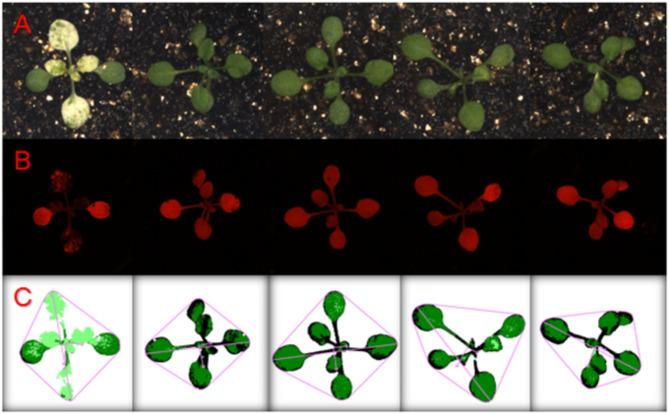
Identifying mutant traits is essential for improving crop yield, quality, and stress resistance in plant breeding. Historically, the efficiency of breeding has been constrained by throughput and accuracy. Recent significant advancements have been made through the development of automated, high-accuracy, and high-throughput equipment. However, challenges remain in the post-processing of large-scale image data and its practical application and evaluation in breeding. This study presents a comparative analysis of human and machine recognition, with validation of a randomly selected mutant at the physiological level performed on wild-type Arabidopsis thaliana and a candidate mutant of the M generation, which was generated through mutagenesis with heavy ion beams (HIBs) and Co-γ radiation. The mutant populations were subjected to image acquisition and automated screening using the High-throughput Plant Imaging System (HTPIS), generating approximately 10 GB of data (4,635 image datasets). We performed Principal Components Analysis (PCA), scatter matrix clustering, and Logistic Growth Curve (LGC) analyses, and compared these results with those obtained from traditional manual screening based on human visual assessment, and randomly selected #197 candidate mutants for validation in terms of growth and development, chlorophyll fluorescence, and subcellular structure. Our findings demonstrate that as the confidence interval level increases from 75 to 99.9%, the accuracy of machine-based mutant identification decreases from 1 to 0.446, while the false positive rate decreases from 0.817 to 0.118, and the false negative rate increases from 0 to 0.554. Nevertheless, machine-based screening remains more accurate and efficient than human assessment. This study evaluated and validated the efficiency (greater than 80%) of high-throughput techniques for screening mutants in complex populations of radiation-induced progeny, and presented a graphical data processing procedure for high-throughput screening of mutants, providing a basis for breeding techniques utilizing HIBs and γ-ray radiation, and offering innovative approaches and methodologies for radiation-induced breeding in the context of high-throughput big data.
识别突变性状对于提高植物育种中的作物产量、品质和抗逆性至关重要。从历史上看,育种效率一直受到通量和准确性的限制。最近,通过开发自动化、高精度和高通量设备取得了重大进展。然而,在大规模图像数据的后处理及其在育种中的实际应用和评估方面仍然存在挑战。本研究对人工识别和机器识别进行了比较分析,并在野生型拟南芥和通过重离子束(HIB)诱变和Co-γ辐射产生的M代候选突变体上,在生理水平对随机选择的突变体进行了验证。使用高通量植物成像系统(HTPIS)对突变群体进行图像采集和自动筛选,生成了约10GB的数据(4635个图像数据集)。我们进行了主成分分析(PCA)、散点矩阵聚类和逻辑生长曲线(LGC)分析,并将这些结果与基于人工视觉评估的传统手动筛选结果进行比较,随机选择了197个候选突变体进行生长发育、叶绿素荧光和亚细胞结构方面的验证。我们的研究结果表明,随着置信区间水平从75%提高到99.9%,基于机器的突变体识别准确率从1降至0.446,而假阳性率从0.817降至0.118,假阴性率从0增至0.554。尽管如此,基于机器的筛选仍然比人工评估更准确、更高效。本研究评估并验证了高通量技术在复杂的辐射诱导后代群体中筛选突变体的效率(大于80%),并提出了一种用于高通量筛选突变体的图形数据处理程序,为利用HIB和γ射线辐射的育种技术提供了依据,并为高通量大数据背景下的辐射诱导育种提供了创新方法和手段。



 Zotero 插件