Shvetsov Nikita, Sildnes Anders, Tafavvoghi Masoud, Busund Lill-Tove Rasmussen, Dalen Stig Manfred, Møllersen Kajsa, Bongo Lars Ailo, Kilvær Thomas Karsten
Department of Computer Science, UiT The Arctic University of Norway, Tromsø, Norway.
Department of Community Medicine, UiT The Arctic University of Norway, Tromsø, Norway.
J Pathol Inform. 2025 Mar 12;17:100437. doi: 10.1016/j.jpi.2025.100437. eCollection 2025 Apr.
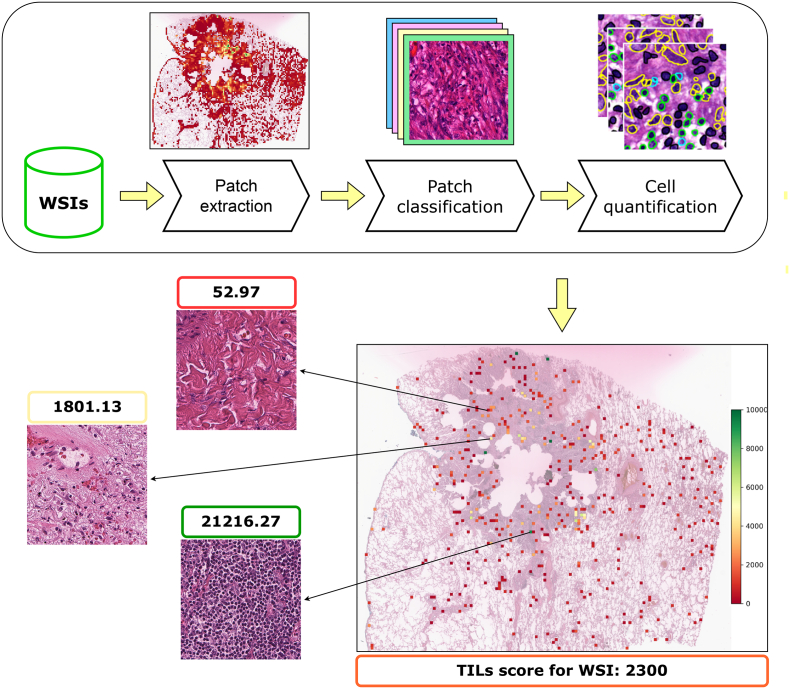
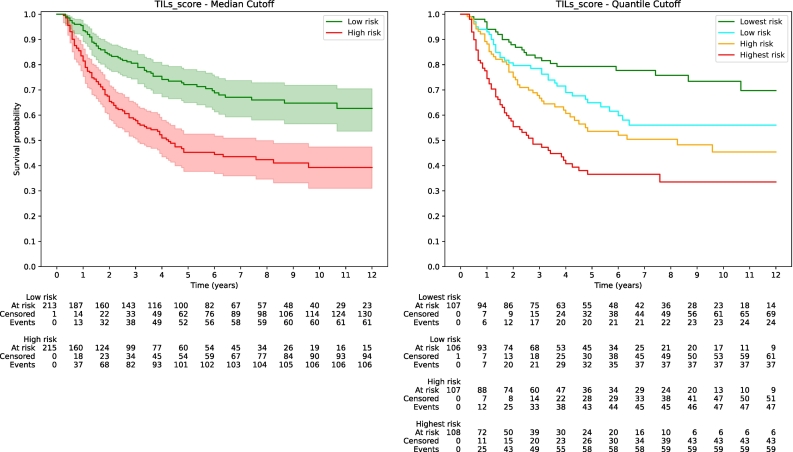
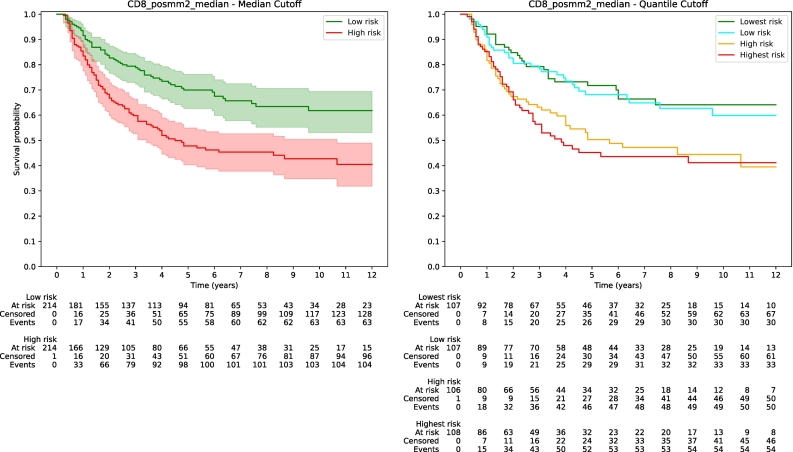
The prognostic relevance of tumor-infiltrating lymphocytes (TILs) in non-small cell Lung cancer (NSCLC) is well-established. However, manual TIL quantification in hematoxylin and eosin (H&E) whole slide images (WSIs) is laborious and prone to variability. To address this, we aim to develop and validate an automated computational pipeline for the quantification of TILs in WSIs of NSCLC. Such a solution in computational pathology can accelerate TIL evaluation, thereby standardizing the prognostication process and facilitating personalized treatment strategies. We develop an end-to-end automated pipeline for TIL estimation in Lung cancer WSIs by integrating a patch extraction approach based on hematoxylin component filtering with a machine learning-based patch classification and cell quantification method using the HoVer-Net model architecture. Additionally, we employ randomized patch sampling to further reduce the processed patch amount. We evaluate the effectiveness of the patch sampling procedure, the pipeline's ability to identify informative patches and computational efficiency, and the clinical value of produced scores using patient survival data. Our pipeline demonstrates the ability to selectively process informative patches, achieving a balance between computational efficiency and prognostic integrity. The pipeline filtering excludes approximately 70% of all patch candidates. Further, only 5% of eligible patches are necessary to retain the pipeline's prognostic accuracy (c-index = 0.65), resulting in a linear reduction of the total computational time compared to the filtered patch subset analysis. The pipeline's TILs score has a strong association with patient survival and outperforms traditional CD8 immunohistochemical scoring (c-index = 0.59). Kaplan-Meier analysis further substantiates the TILs score's prognostic value. This study introduces an automated pipeline for TIL evaluation in Lung cancer WSIs, providing a prognostic tool with potential to improve personalized treatment in NSCLC. The pipeline's computational advances, particularly in reducing processing time, and clinical relevance demonstrate a step forward in computational pathology.
肿瘤浸润淋巴细胞(TILs)在非小细胞肺癌(NSCLC)中的预后相关性已得到充分证实。然而,在苏木精和伊红(H&E)全切片图像(WSIs)中手动定量TILs既费力又容易出现变异性。为了解决这个问题,我们旨在开发并验证一种用于NSCLC的WSIs中TILs定量的自动化计算流程。计算病理学中的这样一种解决方案可以加速TIL评估,从而使预后过程标准化并促进个性化治疗策略。我们通过将基于苏木精成分过滤的补丁提取方法与使用HoVer-Net模型架构的基于机器学习的补丁分类和细胞定量方法相结合,开发了一种用于肺癌WSIs中TIL估计的端到端自动化流程。此外,我们采用随机补丁采样来进一步减少处理的补丁数量。我们评估了补丁采样程序的有效性、该流程识别信息丰富补丁的能力和计算效率,以及使用患者生存数据产生的分数的临床价值。我们的流程展示了选择性处理信息丰富补丁的能力,在计算效率和预后完整性之间取得了平衡。流程过滤排除了所有补丁候选物的约70%。此外,仅需5%的合格补丁就能保持流程的预后准确性(c指数 = 0.65),与过滤后的补丁子集分析相比,总计算时间呈线性减少。该流程的TILs分数与患者生存密切相关,并且优于传统的CD8免疫组织化学评分(c指数 = 0.59)。Kaplan-Meier分析进一步证实了TILs分数的预后价值。本研究介绍了一种用于肺癌WSIs中TIL评估的自动化流程,提供了一种有可能改善NSCLC个性化治疗的预后工具。该流程的计算进展,特别是在减少处理时间方面,以及临床相关性表明了计算病理学向前迈进了一步。