Ganie Shahid Mohammad, Pramanik Pijush Kanti Dutta, Zhao Zhongming
AI Research Centre, Department of Analytics, Woxsen University, Hyderabad, Telangana, 502345, India.
School of Computer Science and Engineering, Galgotias University, Greater Noida, Uttar Pradesh, 203201, India.
Sci Rep. 2025 Apr 22;15(1):13912. doi: 10.1038/s41598-025-97547-6.
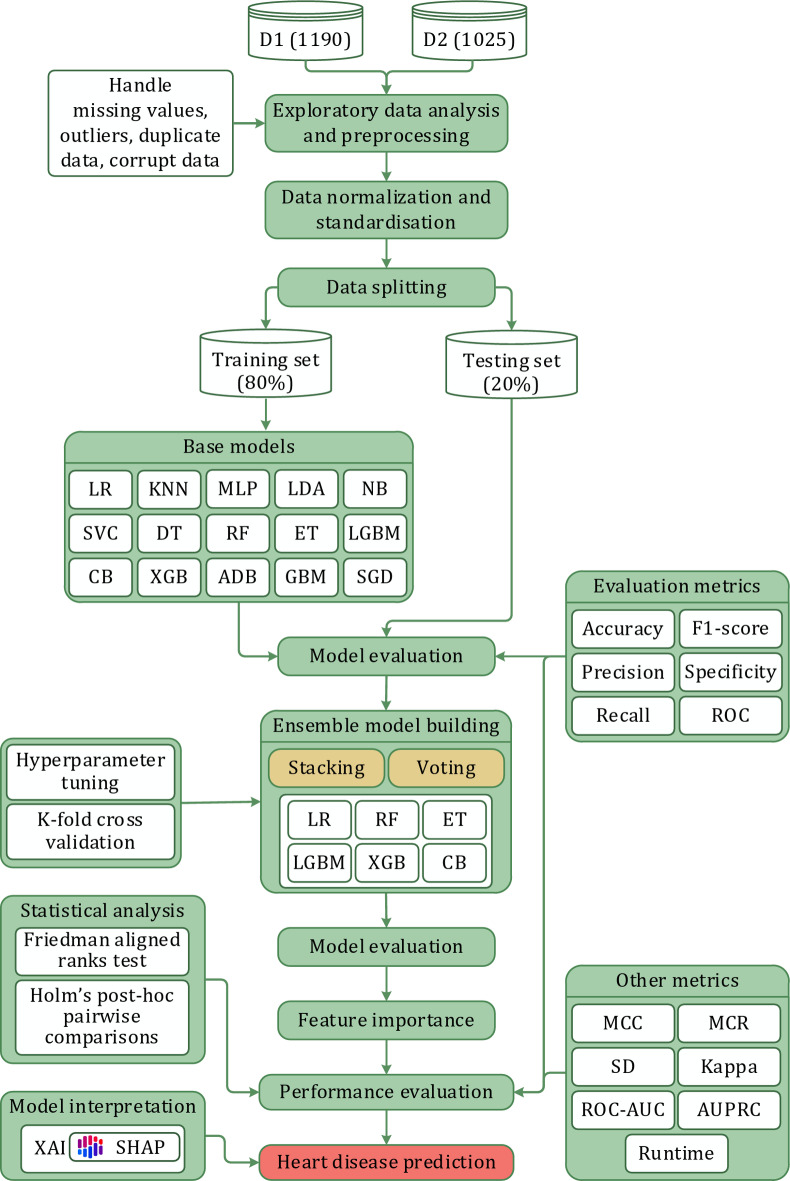
Heart disease is one of the leading causes of death worldwide. Predicting and detecting heart disease early is crucial, as it allows medical professionals to take appropriate and necessary actions at earlier stages. Healthcare professionals can diagnose cardiac conditions more accurately by applying machine learning technology. This study aimed to enhance heart disease prediction using stacking and voting ensemble methods. Fifteen base models were trained on two different heart disease datasets. After evaluating various combinations, six base models were pipelined to develop ensemble models employing a meta-model (stacking) and a majority vote (voting). The performance of the stacking and voting models was compared to that of the individual base models. To ensure the robustness of the performance evaluation, we conducted a statistical analysis using the Friedman aligned ranks test and Holm post-hoc pairwise comparisons. The results indicated that the developed ensemble models, particularly stacking, consistently outperformed the other models, achieving higher accuracy and improved predictive outcomes. This rigorous statistical validation emphasised the reliability of the proposed methods. Furthermore, we incorporated explainable AI (XAI) through SHAP analysis to interpret the model predictions, providing transparency and insight into how individual features influence heart disease prediction. These findings suggest that combining the predictions of multiple models through stacking or voting may enhance the performance of heart disease prediction and serve as a valuable tool in clinical decision-making.
心脏病是全球主要死因之一。早期预测和检测心脏病至关重要,因为这能让医疗专业人员在更早阶段采取适当且必要的行动。医疗保健专业人员通过应用机器学习技术可以更准确地诊断心脏疾病。本研究旨在使用堆叠和投票集成方法来增强心脏病预测。在两个不同的心脏病数据集上训练了15个基础模型。在评估了各种组合之后,将6个基础模型进行流水线操作,以开发采用元模型(堆叠)和多数投票(投票)的集成模型。将堆叠和投票模型的性能与单个基础模型的性能进行了比较。为确保性能评估的稳健性,我们使用弗里德曼对齐秩检验和霍尔姆事后成对比较进行了统计分析。结果表明,所开发的集成模型,尤其是堆叠模型,始终优于其他模型,实现了更高的准确率和更好的预测结果。这种严格的统计验证强调了所提出方法的可靠性。此外,我们通过SHAP分析纳入了可解释人工智能(XAI)来解释模型预测,为个体特征如何影响心脏病预测提供透明度和见解。这些发现表明,通过堆叠或投票组合多个模型的预测可能会提高心脏病预测的性能,并成为临床决策中的一个有价值的工具。