Maden Tuba, Ergen Halil İbrahim, Pancar Zarife, Buglione Antonio, Padulo Johnny, Migliaccio Gian Mario, Russo Luca
Department of Physiotherapy and Rehabilitation, Faculty of Health Sciences, Gaziantep University, 27050 Gaziantep, Turkey.
Department of Physical Education and Sport, Faculty Sport Science, Gaziantep University, 27310 Gaziantep, Turkey.
Medicina (Kaunas). 2025 Apr 4;61(4):668. doi: 10.3390/medicina61040668.
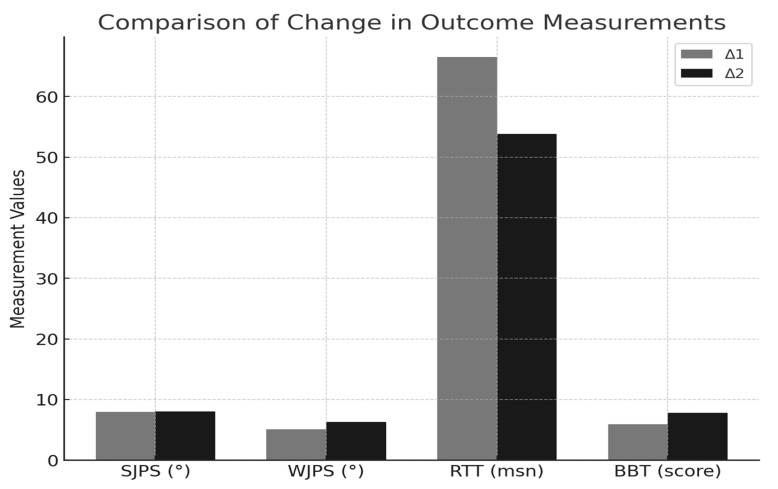
: Although virtual reality (VR) has been shown to be effective in rehabilitation through motor learning principles, its impact on upper extremity function, particularly in the context of console use, remains unclear. : This study aimed to investigate the effects of VR-based task-oriented movement on the upper extremity of healthy individuals. A total of 26 healthy individuals performed task-oriented movements in both real and virtual environments in a randomized order. All participants completed a single session of task-oriented movements using a VR Goggle system in a virtual setting. Physiotherapists designed immersive VR-based experiences and 3D screen-based exergames for this study. Upper extremity function was assessed using several measures: joint position sense (JPS) of the wrist and shoulder was evaluated using a universal goniometer, reaction time was measured via a mobile application, and gross manual dexterity was assessed using the box-and-block test (BBT). Evaluations were conducted before and after the interventions. : The results showed that JPS remained similar between conditions, while BBT performance improved in both groups. However, the reaction time increased significantly only after VR intervention ( < 0.05). No significant period or carryover effects were observed across the parameters. These findings suggest that VR-based task-oriented training positively influences reaction time and supports hand function. Moreover, VR systems that simulate joint position sense similar to real-world conditions may be beneficial for individuals with musculoskeletal motor deficits. : These results highlight the potential for integrating VR technology into rehabilitation programs for patients with neurological or orthopedic impairments, providing a novel tool for enhancing upper extremity function and injury prevention strategies.
虽然虚拟现实(VR)已被证明通过运动学习原理在康复中有效,但其对上肢功能的影响,特别是在使用控制台的情况下,仍不明确。本研究旨在调查基于VR的任务导向运动对健康个体上肢的影响。共有26名健康个体以随机顺序在真实和虚拟环境中进行任务导向运动。所有参与者在虚拟环境中使用VR护目镜系统完成了一轮任务导向运动。物理治疗师为该研究设计了基于沉浸式VR的体验和基于3D屏幕的运动游戏。使用多种测量方法评估上肢功能:使用通用测角仪评估手腕和肩部的关节位置觉(JPS),通过移动应用程序测量反应时间,并使用箱块测试(BBT)评估总体手动灵巧性。在干预前后进行评估。结果表明,不同条件下JPS保持相似,而两组的BBT表现均有所改善。然而,仅在VR干预后反应时间显著增加(<0.05)。在各参数中未观察到显著的时期或遗留效应。这些发现表明,基于VR的任务导向训练对反应时间有积极影响并支持手部功能。此外,模拟与现实世界条件相似的关节位置觉的VR系统可能对患有肌肉骨骼运动缺陷的个体有益。这些结果突出了将VR技术整合到神经或骨科损伤患者康复计划中的潜力,为增强上肢功能和预防损伤策略提供了一种新工具。