Polo-Montalvo Alberto, Gómez-Cerezo Natividad, Cicuéndez Mónica, González Blanca, Izquierdo-Barba Isabel, Arcos Daniel
Departamento Química en Ciencias Farmacéuticas, Facultad de Farmacia, Universidad Complutense de Madrid, Plaza Ramón y Cajal s/n, 28040 Madrid, Spain.
Instituto de Investigación Sanitaria del Hospital Clínico San Carlos (IdISSC), 28040 Madrid, Spain.
Pharmaceutics. 2025 Apr 15;17(4):519. doi: 10.3390/pharmaceutics17040519.
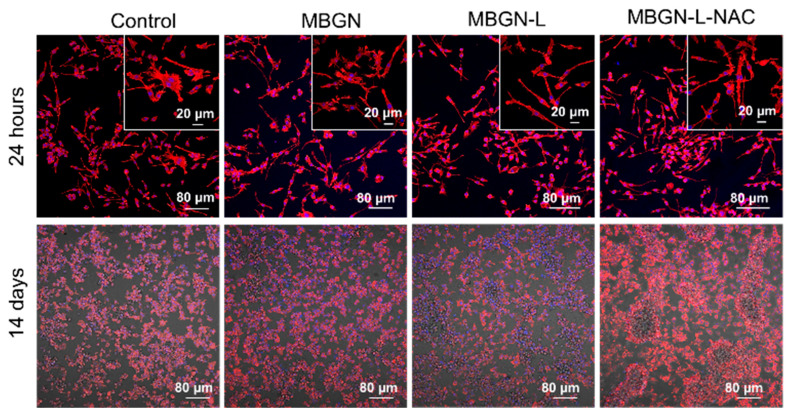
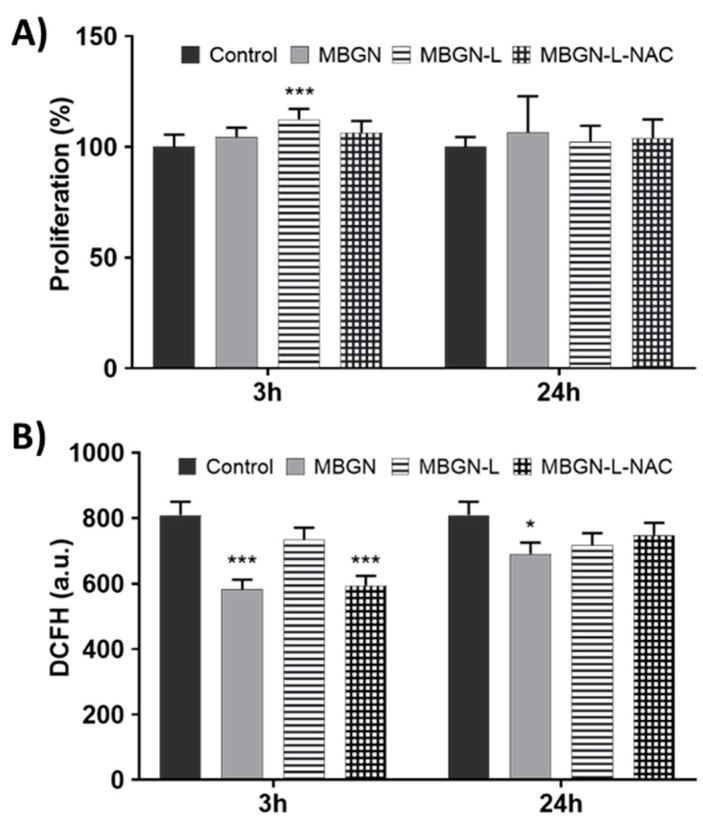
: Bone infection is one of the most prevalent complications in orthopedic surgery. This pathology is mostly due to bacterial pathogens, among which stands out. The formation of a bacterial biofilm makes systemic treatment with antibiotics ineffective. Herein we propose a nanosystem composed of mesoporous bioactive glass nanoparticles (MBGN) loaded with levofloxacin and functionalized with N-acetylcysteine (NAC), aiming to offer an alternative to current treatments. These nanoparticles would present antibacterial activity able to disintegrate the biofilm and regenerate the peri-implantar osseous tissue. : MBGN of composition 82.5 SiO-17.5 CaO have been synthesized, loaded with levofloxacin, and functionalized with NAC (MBGN-L-NAC). The antimicrobial activity against mature biofilms and bioactivity of the nanosystem have been evaluated, as well as its biocompatibility and ability to promote murine pre-osteoblastic MC3T3-E1 differentiation. : MBGNs exhibited high surface areas and radial mesoporosity, allowing up to 23.1% (% ) of levofloxacin loading. NAC was covalently bound keeping the mucolytic thiol group, SH, available. NAC and levofloxacin combination enhances the activity against by disrupting mature biofilm integrity. This nanosystem was biocompatible with pre-osteoblasts, enhanced their differentiation towards a mature osteoblast phenotype, and promoted bio-mimetic mineralization under in vitro conditions. MBGN-L-NAC nanoparticles induced greater osteogenic response of osteoprogenitor cells through increased alkaline phosphatase expression, increased mineralization, and stimulation of pre-osteoblast nodule formation. : MBGN-L-NAC exhibits a more efficient antibacterial activity due to the biofilm disaggregation exerted by NAC, which also contributes to enhance the osteoinductive properties of MBGNs, providing a potential alternative to conventional strategies for the management of bone infections.
骨感染是骨科手术中最常见的并发症之一。这种病理状况主要归因于细菌病原体,其中[具体细菌未提及]尤为突出。细菌生物膜的形成使得抗生素的全身治疗无效。在此,我们提出一种由负载左氧氟沙星并经N - 乙酰半胱氨酸(NAC)功能化的介孔生物活性玻璃纳米颗粒(MBGN)组成的纳米系统,旨在为当前治疗提供一种替代方案。这些纳米颗粒将呈现出能够分解生物膜并使种植体周围骨组织再生的抗菌活性。
已合成了组成为82.5 SiO - 17.5 CaO的MBGN,负载左氧氟沙星,并经NAC功能化(MBGN - L - NAC)。评估了该纳米系统对成熟生物膜的抗菌活性和生物活性,以及其生物相容性和促进小鼠前成骨细胞MC3T3 - E1分化的能力。
MBGN表现出高比表面积和径向介孔率,左氧氟沙星的负载量高达23.1%(重量百分比)。NAC通过共价键结合,使溶粘蛋白的巯基(SH)保持可用。NAC和左氧氟沙星的组合通过破坏成熟生物膜的完整性增强了对[具体细菌未提及]的活性。该纳米系统与前成骨细胞具有生物相容性,增强了它们向成熟成骨细胞表型的分化,并在体外条件下促进了仿生矿化。MBGN - L - NAC纳米颗粒通过增加碱性磷酸酶表达、增加矿化和刺激前成骨细胞结节形成,诱导了骨祖细胞更强的成骨反应。
MBGN - L - NAC由于NAC对生物膜的分解作用而表现出更有效的抗菌活性,这也有助于增强MBGN的骨诱导特性,为骨感染的管理提供了一种替代传统策略的潜在方案。