Chotchindakun Kittipat, Pekkoh Jeeraporn, Ruangsuriya Jetsada, Zheng Kai, Unalan Irem, Boccaccini Aldo R
Department of Biology, Faculty of Science, Chiang Mai University, Chiang Mai 50200, Thailand.
Research Center of Microbial Diversity and Sustainable Utilization, Faculty of Science, Chiang Mai University, Chiang Mai 50200, Thailand.
Polymers (Basel). 2021 May 29;13(11):1794. doi: 10.3390/polym13111794.
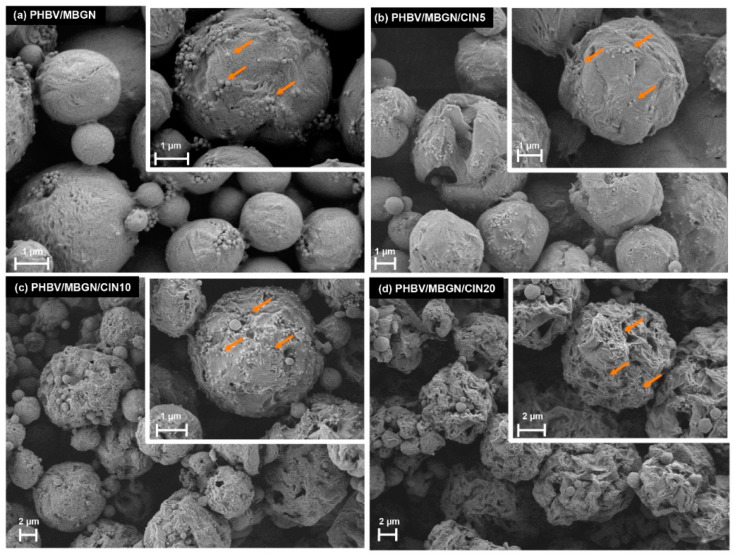
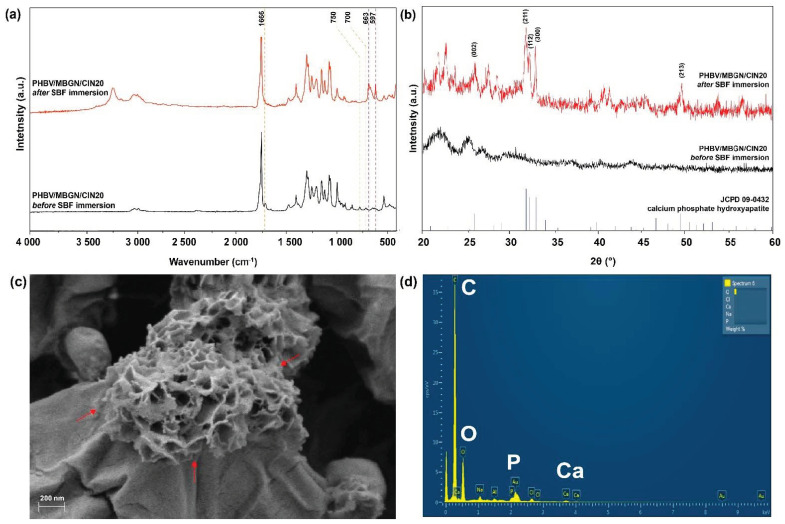
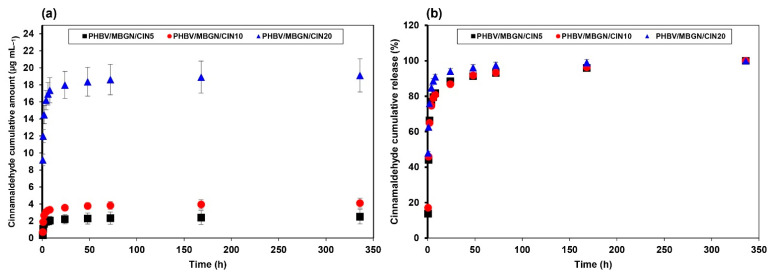
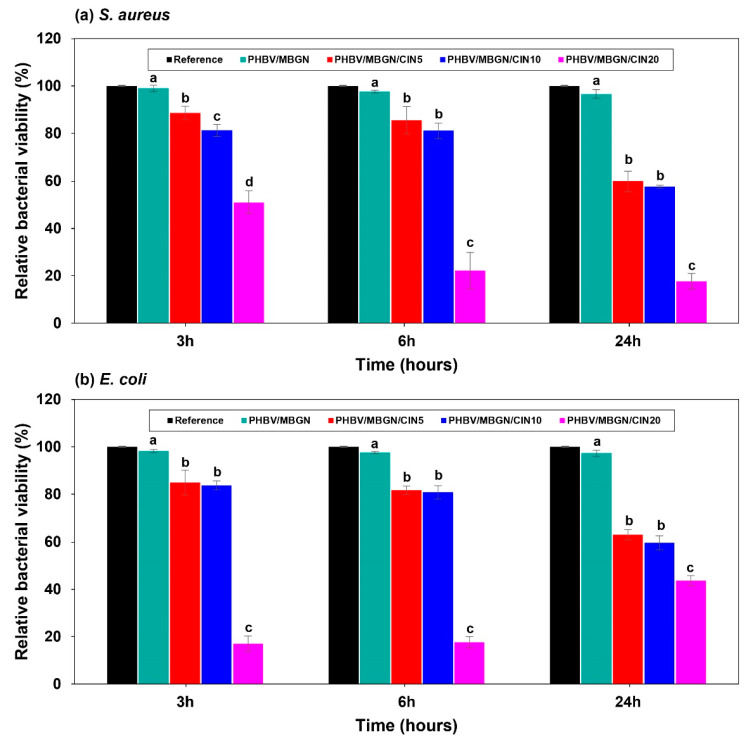
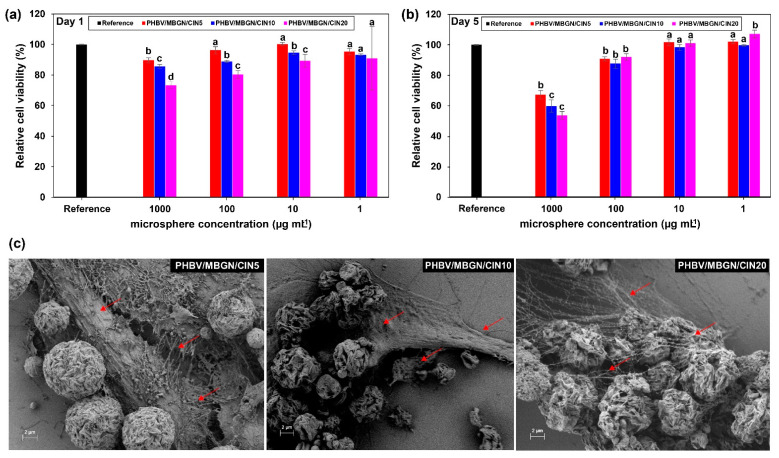
Polyhydroxybutyrate-co-hydroxyvalerate (PHBV) is considered a suitable polymer for drug delivery systems and bone tissue engineering due to its biocompatibility and biodegradability. However, the lack of bioactivity and antibacterial activity hinders its biomedical applications. In this study, mesoporous bioactive glass nanoparticles (MBGN) were incorporated into PHBV to enhance its bioactivity, while cinnamaldehyde (CIN) was loaded in MBGN to introduce antimicrobial activity. The blank (PHBV/MBGN) and the CIN-loaded microspheres (PHBV/MBGN/CIN5, PHBV/MBGN/CIN10, and PHBV/MBGN/CIN20) were fabricated by emulsion solvent extraction/evaporation method. The average particle size and zeta potential of all samples were investigated, as well as the morphology of all samples evaluated by scanning electron microscopy. PHBV/MBGN/CIN5, PHBV/MBGN/CIN10, and PHBV/MBGN/CIN20 significantly exhibited antibacterial activity against and in the first 3 h, while CIN releasing behavior was observed up to 7 d. Human osteosarcoma cell (MG-63) proliferation and attachment were noticed after 24 h cell culture, demonstrating no adverse effects due to the presence of microspheres. Additionally, the rapid formation of hydroxyapatite on the composite microspheres after immersion in simulated body fluid (SBF) during 7 d revealed the bioactivity of the composite microspheres. Our findings indicate that this system represents an alternative model for an antibacterial biomaterial for potential applications in bone tissue engineering.
聚羟基丁酸酯-共-羟基戊酸酯(PHBV)因其生物相容性和生物可降解性,被认为是药物递送系统和骨组织工程的合适聚合物。然而,其缺乏生物活性和抗菌活性阻碍了它在生物医学领域的应用。在本研究中,将介孔生物活性玻璃纳米颗粒(MBGN)掺入PHBV以增强其生物活性,同时将肉桂醛(CIN)负载于MBGN中以引入抗菌活性。通过乳液溶剂萃取/蒸发法制备了空白微球(PHBV/MBGN)和负载CIN的微球(PHBV/MBGN/CIN5、PHBV/MBGN/CIN10和PHBV/MBGN/CIN20)。研究了所有样品的平均粒径和zeta电位,并通过扫描电子显微镜评估了所有样品的形态。PHBV/MBGN/CIN5、PHBV/MBGN/CIN10和PHBV/MBGN/CIN20在前3小时对[具体菌种1]和[具体菌种2]均表现出显著的抗菌活性,同时观察到CIN的释放行为持续了7天。细胞培养24小时后,观察到人类骨肉瘤细胞(MG-63)增殖并附着,表明微球的存在没有产生不良影响。此外,复合微球在模拟体液(SBF)中浸泡7天后,迅速形成羟基磷灰石,揭示了复合微球的生物活性。我们的研究结果表明,该系统代表了一种用于骨组织工程潜在应用的抗菌生物材料的替代模型。