Mulqueeney James M, Ezard Thomas H G, Goswami Anjali
School for Ocean & Earth Science, National Oceanography Centre Southampton, University of Southampton Waterfront Campus, Southampton, UK.
Department of Life Sciences, Natural History Museum, London, UK.
BMC Ecol Evol. 2025 Apr 27;25(1):38. doi: 10.1186/s12862-025-02377-9.
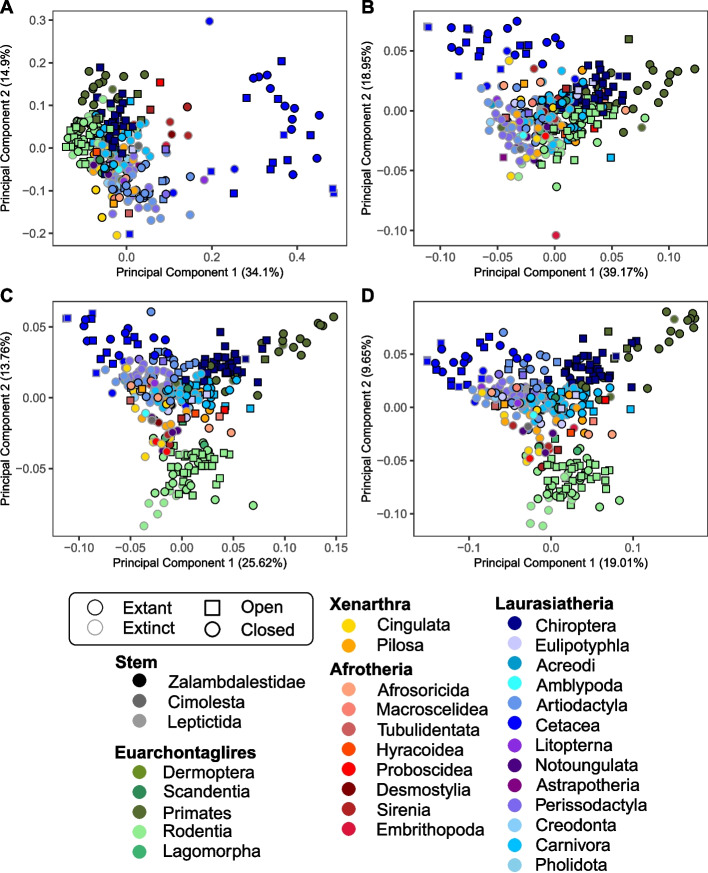
The study of phenotypic evolution has been transformed in recent decades by methods allowing precise quantification of anatomical shape, in particular 3D geometric morphometrics. While this effectiveness of geometric morphometrics has been demonstrated by thousands of studies, it generally requires manual or semi-automated landmarking, which is time-consuming, susceptible to operator bias, and limits comparisons across morphologically disparate taxa. Emerging automated methods, particularly landmark-free techniques, offer potential solutions, but these approaches have thus far been primarily applied to closely related forms. In this study, we explore the utility of automated, landmark-free approaches for macroevolutionary analyses. We compare an application of Large Deformation Diffeomorphic Metric Mapping (LDDMM) known as Deterministic Atlas Analysis (DAA) with a high-density geometric morphometric approach, using a dataset of 322 mammals spanning 180 families. Initially, challenges arose from using mixed modalities (computed tomography (CT) and surface scans), which we addressed by standardising the data by using Poisson surface reconstruction that creates watertight, closed surfaces for all specimens. After standardisation, we observed a significant improvement in the correspondence between patterns of shape variation measured using manual landmarking and DAA, although differences emerged, especially for Primates and Cetacea. We further evaluated the downstream effects of these differences on macroevolutionary analyses, finding that both methods produced comparable but varying estimates of phylogenetic signal, morphological disparity and evolutionary rates. Our findings highlight the potential of landmark-free approaches like DAA for large scale studies across disparate taxa, owing to their enhanced efficiency. However, they also reveal several challenges that should be addressed before these methods can be widely adopted. In this context, we outline these issues, propose solutions based on existing literature, and identify potential avenues for further research. We argue that by incorporating these improvements, the application of landmark-free analyses could be expanded, thereby enhancing the scope of morphometric studies and enabling the analysis of larger and more diverse datasets.
近几十年来,通过能够精确量化解剖形状的方法,特别是三维几何形态测量学,表型进化的研究发生了变革。虽然几何形态测量学的这种有效性已在数千项研究中得到证明,但它通常需要手动或半自动地标定位,这既耗时,又容易受到操作者偏差的影响,还限制了对形态差异较大的分类群进行比较。新兴的自动化方法,特别是无地标技术,提供了潜在的解决方案,但迄今为止,这些方法主要应用于亲缘关系密切的形态。在本研究中,我们探索自动化、无地标方法在宏观进化分析中的效用。我们将一种称为确定性图谱分析(DAA)的大变形微分同胚度量映射(LDDMM)应用与一种高密度几何形态测量方法进行比较,使用了一个包含180个科的322种哺乳动物的数据集。最初,使用混合模态(计算机断层扫描(CT)和表面扫描)带来了挑战,我们通过使用泊松表面重建对数据进行标准化来解决这个问题,该方法为所有标本创建了水密、封闭的表面。标准化后,我们观察到使用手动地标定位和DAA测量的形状变化模式之间的对应性有了显著改善,尽管也出现了差异,特别是对于灵长类动物和鲸目动物。我们进一步评估了这些差异对宏观进化分析的下游影响,发现两种方法产生了可比但不同的系统发育信号、形态差异和进化速率估计。我们的研究结果突出了像DAA这样的无地标方法在跨不同分类群的大规模研究中的潜力,这得益于它们更高的效率。然而,它们也揭示了在这些方法能够被广泛采用之前需要解决的几个挑战。在此背景下,我们概述了这些问题,根据现有文献提出了解决方案,并确定了进一步研究的潜在途径。我们认为,通过纳入这些改进,无地标分析的应用可以得到扩展,从而扩大形态测量研究的范围,并能够分析更大、更多样化的数据集。