Wei Zhengang, Liu Hongli, Zhang Jicheng, Chen Yan, Chang Lixia, Cheng Huiyu, Bai Xue, Wang Xiaohua, Li Su
Shandong Provincial Hospital Affiliated to Shandong First Medical University, Jinan, China.
Department of Information Technology, Affiliated Hospital of Zunyi Medical University, Zunyi, China.
Digit Health. 2025 Apr 10;11:20552076251332987. doi: 10.1177/20552076251332987. eCollection 2025 Jan-Dec.
Adequate digital competence is crucial for clinical nurses to effectively adapt to the evolving digital technologies in their practice. Currently, there is a lack of a brief assessment tool in China that comprehensively measures the digital competence of nurses in clinical practice across the dimensions of knowledge, skills, and attitudes. Therefore, this study aims to translate the Digital Competence Questionnaire (DCQ) into Chinese and evaluate its psychometric properties.
Following Brislin's translation model, the DCQ was translated and back-translated, and cultural adaptation and revisions of the Chinese version were conducted through expert consultations and a pilot survey. A cross-sectional study was carried out from July to October 2024 to conduct a methodological investigation on the translation and validation of the DCQ.
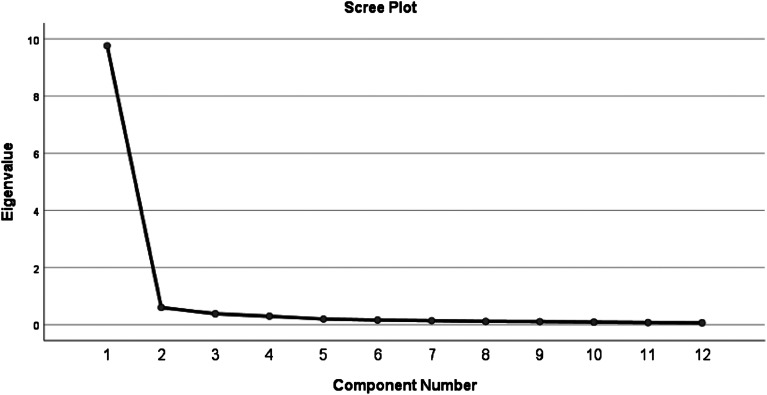
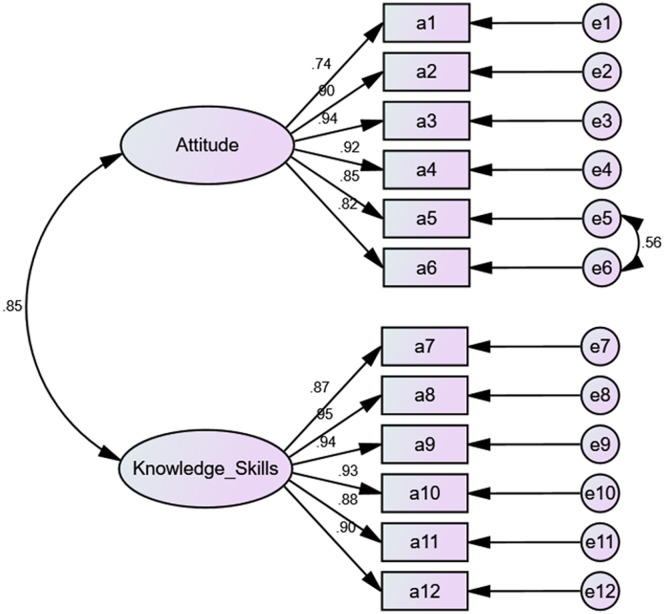
The Chinese version of the DCQ includes two dimensions-attitude and knowledge & skills-with a total of 12 items. The overall Cronbach's value for the questionnaire is 0.970, while Cronbach's for the individual dimensions ranges from 0.921 to 0.945. The split-half reliability of the entire scale is 0.912, and the test-retest reliability is 0.846. Confirmatory factor analysis supported the hypothesized first-order two-factor model, with all fit indices demonstrating satisfactory values and remaining within acceptable levels.
The Chinese version of the DCQ has been successfully introduced in China, demonstrating strong psychometric properties. It can be used in healthcare settings as a tool to assess the digital competence of nurses, providing a basis for developing subsequent digital technology training programs and targeted interventions.
具备足够的数字能力对于临床护士有效适应其实践中不断发展的数字技术至关重要。目前,中国缺乏一种能全面从知识、技能和态度维度衡量临床实践中护士数字能力的简短评估工具。因此,本研究旨在将数字能力问卷(DCQ)翻译成中文并评估其心理测量特性。
按照布里斯林的翻译模型对DCQ进行翻译和回译,并通过专家咨询和预调查对中文版进行文化调适和修订。于2024年7月至10月开展横断面研究,对DCQ的翻译和验证进行方法学调查。
DCQ中文版包括态度和知识与技能两个维度,共12个条目。问卷的总体克朗巴哈系数为0.970,各维度的克朗巴哈系数在0.921至0.945之间。整个量表的分半信度为0.912,重测信度为0.846。验证性因素分析支持假设的一阶双因素模型,所有拟合指数均显示出令人满意的值且保持在可接受水平内。
DCQ中文版已在中国成功引入,显示出强大的心理测量特性。它可在医疗环境中用作评估护士数字能力的工具,为制定后续数字技术培训计划和针对性干预措施提供依据。