
基于脑电图的癫痫发作检测的混合信号神经形态处理器上的事件驱动神经网络。
Event driven neural network on a mixed signal neuromorphic processor for EEG based epileptic seizure detection.
作者信息
Bartels Jim, Gallou Olympia, Ito Hiroyuki, Cook Matthew, Sarnthein Johannes, Indiveri Giacomo, Ghosh Saptarshi
机构信息
Institute of Neuroinformatics, University of Zurich and ETH Zurich, Zurich, Switzerland.
Nano Sensing Unit, Tokyo Institute of Technology, Yokohama, 226-8503, Japan.
出版信息
Sci Rep. 2025 May 7;15(1):15965. doi: 10.1038/s41598-025-99272-6.
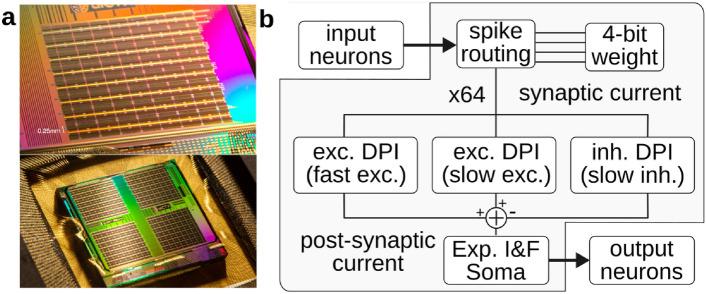
Long-term monitoring of biomedical signals is essential for the modern clinical management of neurological conditions such as epilepsy. However, developing wearable systems that are able to monitor, analyze, and detect epileptic seizures with long-lasting operation times using current technologies is still an open challenge. Brain-inspired spiking neural networks (SNNs) represent a promising signal processing and computing framework as they can be deployed on ultra-low power neuromorphic computing systems, for this purpose. Here, we introduce a novel SNN architecture, co-designed and validated on a mixed-signal neuromorphic chip, that shows potential for always-on monitoring of epileptic activity. We demonstrate how the hardware implementation of this SNN captures the phenomenon of partial synchronization within neural activity during seizure periods. We assess the network using a full-custom asynchronous mixed-signal neuromorphic platform, processing analog signals in real-time from an Electroencephalographic (EEG) seizure dataset. The neuromorphic chip comprises an analog front-end (AFE) signal conditioning stage and an asynchronous delta modulation (ADM) circuit directly integrated on the same die, which can produce the stream of spikes as input to the SNN, directly from the analog EEG signals. We show a linear classifier in a post processing stage that is sufficient to reliably classify and detect seizures, from the local features extracted by the SNN, indicating the feasibility of full on-chip seizure monitoring in the future. This research marks a significant advancement toward developing embedded intelligent "wear and forget" units for resource-constrained environments. These units could autonomously detect and log relevant EEG events of interest in out-of-hospital environments, offering new possibilities for patient care and management of neurological disorders.
对生物医学信号进行长期监测对于癫痫等神经系统疾病的现代临床管理至关重要。然而,利用现有技术开发能够长时间运行以监测、分析和检测癫痫发作的可穿戴系统仍然是一个悬而未决的挑战。受大脑启发的脉冲神经网络(SNN)代表了一个很有前景的信号处理和计算框架,因为它们可以部署在超低功耗的神经形态计算系统上用于此目的。在此,我们介绍一种新颖的SNN架构,它是在混合信号神经形态芯片上共同设计和验证的,显示出对癫痫活动进行持续监测的潜力。我们展示了这种SNN的硬件实现如何捕捉癫痫发作期间神经活动中的部分同步现象。我们使用一个全定制的异步混合信号神经形态平台对该网络进行评估,实时处理来自脑电图(EEG)癫痫发作数据集的模拟信号。该神经形态芯片包括一个模拟前端(AFE)信号调理阶段和一个直接集成在同一芯片上的异步增量调制(ADM)电路,它可以直接从模拟EEG信号产生脉冲流作为SNN的输入。我们在一个后处理阶段展示了一个线性分类器,它足以从SNN提取的局部特征中可靠地分类和检测癫痫发作,这表明未来全片上癫痫发作监测的可行性。这项研究朝着为资源受限环境开发嵌入式智能“穿戴即忘”单元迈出了重要一步。这些单元可以在院外环境中自主检测并记录相关的感兴趣EEG事件,为患者护理和神经系统疾病管理提供了新的可能性。


 Zotero 插件