
青少年篮球正式训练和比赛期间的内外负荷、身体能力及技术技能:首发球员与轮换球员的比较
Internal and External Loads during Formal Training and Competition, Physical Capacities, and Technical Skills in Youth Basketball: A Comparison between Starters and Rotation Players.
作者信息
Gonçalves Gonçalo, Neta Paulo, Ribeiro João, Guimarães Eduardo
机构信息
Centre of Research, Education, Innovation and Intervention in Sport (CIFI2D), Faculty of Sport, University of Porto, Porto, Portugal.
Department of Physical Education and Sports Sciences, University of Maia, Maia, Portugal.
出版信息
J Hum Kinet. 2025 Apr 30;96(Spec Issue):53-67. doi: 10.5114/jhk/201159. eCollection 2025 Feb.
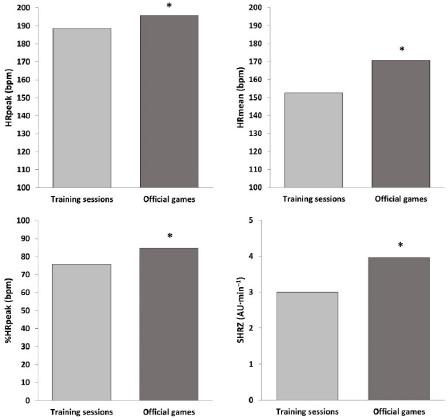
This preliminary study had two aims: (i) to compare the internal and external loads between training sessions and official games in youth basketball players; (ii) to investigate the effects of the playing role on physical capacities, basketball skills, and internal and external loads accumulated during training and competition. Thirteen under-16 male basketball players, aged 15.30 ± 0.88 years, were followed over 10 consecutive weeks and assigned into two groups according to their playing role: starters and rotation players. Prior to the 10-week monitoring period, players' training experience, basic anthropometrics, physical capacities, and basketball skills were assessed. Then, internal and external loads were monitored in formal training and official competition. Data were analyzed using non-parametric techniques. Players attained significantly higher values in most measures of internal and external loads during official games (r = 0.82 to 0.88, p < 0.01). Starters outperformed rotation players in the 20-m sprint (r = 0.61, p < 0.05), the lane agility drill (r = 0.77, p < 0.01), and the control dribble (r = 0.73, p < 0.01). They also reached a lower HR in practice (r = 0.65, p < 0.05), but a higher %HR (r = -0.61, p < 0.05) and greater scores in the summated-heart-rate-zones model (r = -0.61, p < 0.05) as well as the dynamic stress load during official games (r = -0.57, p < 0.05). The findings highlight that young basketball players apparently do not train as intensely as they play. Moreover, it was during competition that starting players experienced higher internal and external loads. It is recommended that basketball coaches regularly monitor loads in both formal training and competition to closely match game demands when planning their practices. Finally, it is suggested that future research includes larger sample sizes to provide a more comprehensive understanding of both internal and external loads in youth basketball.
这项初步研究有两个目的
(i)比较青少年篮球运动员训练课与正式比赛之间的内部和外部负荷;(ii)调查比赛角色对身体能力、篮球技术以及训练和比赛期间积累的内部和外部负荷的影响。13名16岁以下的男性篮球运动员,年龄为15.30±0.88岁,连续10周被跟踪,并根据他们的比赛角色分为两组:首发球员和轮换球员。在为期10周的监测期之前,对球员的训练经历、基本人体测量学、身体能力和篮球技术进行了评估。然后,在正式训练和正式比赛中监测内部和外部负荷。使用非参数技术分析数据。在正式比赛期间,球员在大多数内部和外部负荷指标上获得了显著更高的值(r = 0.82至0.88,p < 0.01)。首发球员在20米短跑(r = 0.61,p < 0.05)、场地敏捷性训练(r = 0.77,p < 0.01)和控球运球(r = 0.73,p < 0.01)方面的表现优于轮换球员。他们在训练中的心率也较低(r = 0.65,p < 0.05),但在正式比赛中的心率百分比更高(r = -0.61,p < 0.05),在累计心率区模型中的得分更高(r = -0.61,p < 0.05),以及在正式比赛中的动态应激负荷更高(r = -0.57,p < 0.05)。研究结果突出表明,年轻篮球运动员的训练强度显然不如比赛强度。此外,正是在比赛期间,首发球员经历了更高的内部和外部负荷。建议篮球教练在正式训练和比赛中定期监测负荷,以便在规划训练时紧密匹配比赛需求。最后,建议未来的研究纳入更大的样本量,以更全面地了解青少年篮球的内部和外部负荷。


 Zotero 插件