Shirsat Shubhangi D, Li Chunyi, Liu Zhipeng, Achal Varenyam, Habimana Olivier
Biotechnology and Food Engineering Program, Guangdong Technion-Israel Institute of Technology, Shantou, 515063, China.
Environmental Engineering Program, Guangdong Technion-Israel Institute of Technology, Shantou, 515063, China.
Sci Rep. 2025 Jun 3;15(1):19460. doi: 10.1038/s41598-025-03962-0.
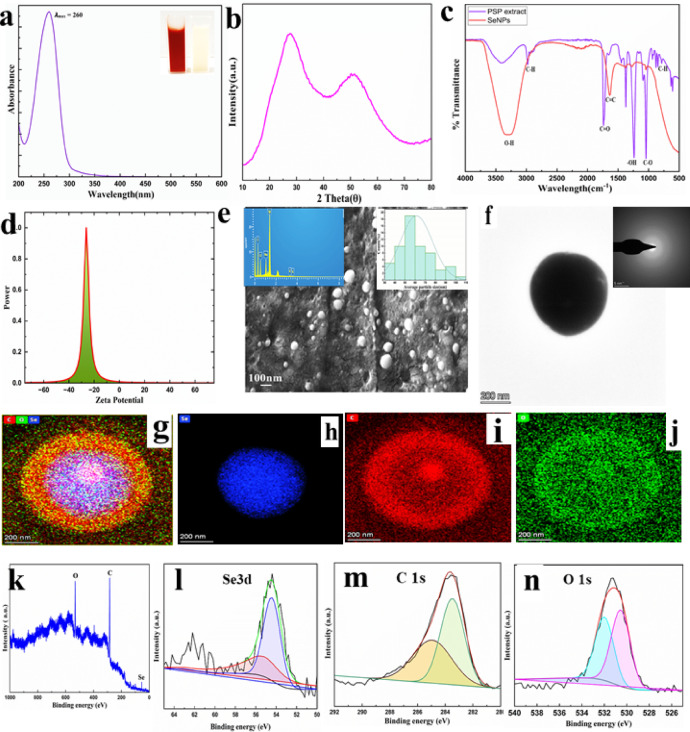
The advancement of neuroprotective pharmacological agents to proficiently avert amyloid-β (Aβ) clustering persists as a significant obstacle in Alzheimer's disease (AD) management. This analysis focuses on the inhibitory characteristics related to amyloid formation of selenium nanoparticles (SeNPs) enveloped in 5-caffeoylquinic acid (CQA), which are biosynthesized using violet sweet potato (PSP) extract. Engineered SeNPs revealed an absorption peak at 260 nm, were spherical and non-crystalline (50-60 nm), and had a zeta potential measured at 24.3 ± 2.1 mV. The antioxidant traits of SeNPs were showcased (IC = 8.01 ± 1.21 µg/mL), by obstructing AChE (IC = 3.70 ± 0.02 µg/mL) and BChE (IC = 72 ± 0.5 µg/mL), while also diminishing Aβ fibrillation, thereby emphasizing their function in the modulation of amyloid clustering. Molecular dynamics simulations elucidated that CQA-SeNPs preferentially associate with hydrophobic residues (e.g., Leu34 and Phe19) of the Aβ peptide, obstructing β-sheet formation. These findings suggest that CQA-SeNPs interfere with Aβ aggregation, offering a potential therapeutic strategy for AD.
开发能够有效防止淀粉样蛋白-β(Aβ)聚集的神经保护药理剂仍然是阿尔茨海默病(AD)治疗中的一个重大障碍。本分析聚焦于用紫甘薯(PSP)提取物生物合成的、包裹在5-咖啡酰奎尼酸(CQA)中的硒纳米颗粒(SeNPs)与淀粉样蛋白形成相关的抑制特性。工程化的SeNPs在260nm处有一个吸收峰,呈球形且无定形(50-60nm),其zeta电位为24.3±2.1mV。SeNPs的抗氧化特性得到了展示(IC = 8.01±1.21µg/mL),通过抑制乙酰胆碱酯酶(AChE,IC = 3.70±0.02µg/mL)和丁酰胆碱酯酶(BChE,IC = 72±0.5µg/mL),同时还减少了Aβ纤维形成,从而强调了它们在调节淀粉样蛋白聚集方面的作用。分子动力学模拟表明,CQA-SeNPs优先与Aβ肽的疏水残基(如Leu34和Phe19)结合,阻碍β-折叠的形成。这些发现表明,CQA-SeNPs可干扰Aβ聚集,为AD提供了一种潜在的治疗策略。