
人乳头瘤病毒疫苗接种、筛查差异与宫颈癌负担的变化态势:全球趋势、不平等现象及政策影响分析
HPV vaccination, screening disparities, and the shifting landscape of cervical cancer burden: a global analysis of trends, inequalities, and policy implications.
作者信息
Zhang Yingxin, Fan Zhe, Wang Jiankang, Guan Bing, Zhou Fengyi, Tang Zihan, Wu Wentao, Huang Aimin
机构信息
Department of Breast and Thyroid Surgery, Henan Provincial Chest Hospital, (Chest Hospital of Zhengzhou University), Zhengzhou, 450052, China.
The First Clinical Medical College of Zhengzhou University, Zhengzhou, 450052, China.
出版信息
BMC Womens Health. 2025 Jun 8;25(1):285. doi: 10.1186/s12905-025-03841-w.
SYNOPSIS
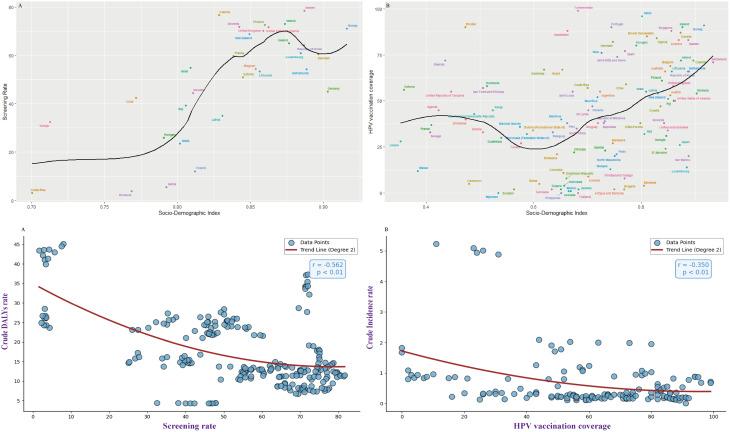
Health inequalities intensified, burden shifting to low-resource regions despite preventive advancements. HPV and screening rates diverged by SDI, highlighting coverage gaps. Screening and vaccination inversely linked to disease burden, underscoring critical efficacy. Innovative modeling exposed disparities, advocating SDI-stratified interventions.
OBJECTIVE
This study analyzes global and regional cervical cancer trends (1990-2021) across different Socio-Demographic Index (SDI) levels, highlighting health inequalities, assessing the impact of HPV vaccination and screening, and modeling future trends. The findings aim to inform targeted prevention policies, reduce regional disparities, and promote global health equity.
METHODS
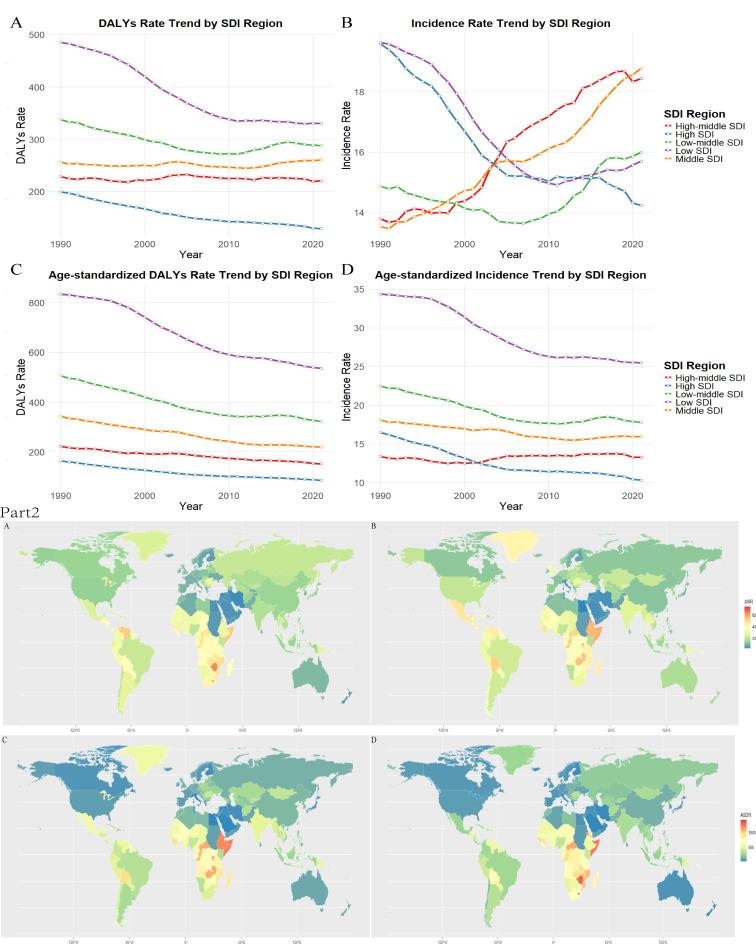
Data were sourced from the Global Burden of Disease study 2021(GBD 2021), OECD, and WHO. The focus was on incidence and disability-adjusted life years (DALYs) of cervical cancer. Time trends were analyzed by SDI regions, alongside health inequality assessments. Correlation analyses examined links between screening rates, HPV vaccination coverage, and disease burden.
RESULTS
From 1990 to 2021, global age-standardized incidence rate and age-standardized DALYs rates declined significantly, with estimated annual percentage changes (EAPC) of -0.54% (95% CI: -0.63 to -0.44) and - 1.27% (95% CI: -1.36 to -1.18). However, significant differences exist in specific patterns of change across SDI regions: exhibited an upward incidence trajectory. From 1990 to 2021, the burden of cervical cancer disease shifted from developed to less developed regions. Correlation analysis showed negative associations between screening rates and DALYs (r = -0.56, p < 0.01) and between vaccination coverage and incidence (r = -0.35, p < 0.01).
CONCLUSION
Although the global cervical cancer burden has decreased, significant regional disparities remain. Future policies should focus on tailored interventions, with low-resource regions strengthening healthcare infrastructure and implementing minimum effective preventive measures, while high-SDI regions shift to precision public health approaches. Policymakers must also incorporate culturally sensitive health education to address social barriers, challenge misconceptions, and empower communities, ultimately reducing preventable cervical cancer morbidity.
摘要
尽管在预防方面取得了进展,但健康不平等现象加剧,负担正向资源匮乏地区转移。人乳头瘤病毒(HPV)和筛查率因社会人口指数(SDI)而异,凸显了覆盖差距。筛查和疫苗接种与疾病负担呈负相关,突出了关键疗效。创新模型揭示了差异,倡导按SDI分层干预。
目的
本研究分析了不同社会人口指数(SDI)水平下全球和区域宫颈癌趋势(1990 - 2021年),突出健康不平等现象,评估HPV疫苗接种和筛查的影响,并对未来趋势进行建模。研究结果旨在为有针对性的预防政策提供信息,减少区域差异,促进全球健康公平。
方法
数据来源于《2021年全球疾病负担研究》(GBD 2021)、经合组织和世界卫生组织。重点关注宫颈癌的发病率和伤残调整生命年(DALYs)。按SDI区域分析时间趋势,并进行健康不平等评估。相关性分析检验了筛查率、HPV疫苗接种覆盖率与疾病负担之间的联系。
结果
1990年至2021年,全球年龄标准化发病率和年龄标准化DALYs率显著下降,估计年百分比变化(EAPC)分别为-0.54%(95%置信区间:-0.63至-0.44)和-1.27%(95%置信区间:-1.36至-1.18)。然而,SDI区域在具体变化模式上存在显著差异:发病率呈上升趋势。1990年至2021年,宫颈癌疾病负担从发达地区转移到欠发达地区。相关性分析显示筛查率与DALYs之间呈负相关(r = -0.56,p < 0.01),疫苗接种覆盖率与发病率之间呈负相关(r = -0.35,p < 0.01)。
结论
尽管全球宫颈癌负担有所下降,但区域差异仍然显著。未来政策应侧重于量身定制的干预措施,资源匮乏地区加强医疗基础设施建设并实施最低限度有效的预防措施,而高SDI地区转向精准公共卫生方法。政策制定者还必须纳入具有文化敏感性的健康教育,以消除社会障碍、挑战误解并增强社区能力,最终降低可预防的宫颈癌发病率。


 Zotero 插件