de Morais Thais Gouvea, Sánchez Uzcátegui Yetsenia Del Valle, de Sena Chubert Bernardo Castro, Furtado Rodrigo Ribeiro, Silveira Fernando Tobias, da Silva Edilene Oliveira, Vasconcelos Dos Santos Thiago
Programa de Pós Graduação em Biologia de Agentes Infecciosos e Parasitários, Instituto de Ciências Biológicas, Universidade Federal do Pará, Belém, Pará, Brazil.
Seção de Parasitologia, Instituto Evandro Chagas, Ananindeua, Pará, Brazil.
Parasit Vectors. 2025 Jun 9;18(1):216. doi: 10.1186/s13071-025-06860-6.
Knowledge of sand fly-Leishmania attachment determinants is pivotal for providing evidence on vector status. Considering the Amazonian transmission context of Trichophoromyia spp.-L. (Viannia) lainsoni, the present study aimed to assess in vitro interactions and detect gut glycoconjugates associated with this vector-parasite association.
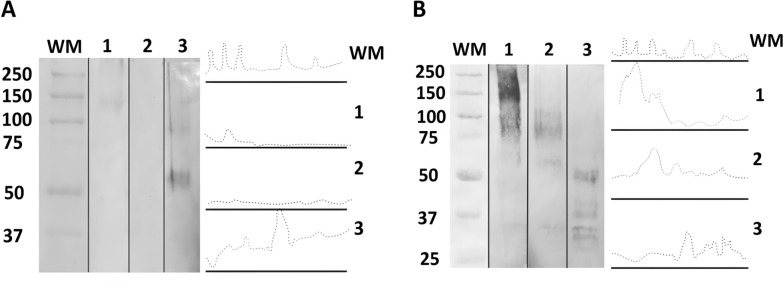
Field-caught Trichophoromyia brachipyga and Trichophoromyia ubiquitalis were tested. Lutzomyia longipalpis reared in the laboratory was used as a control. The intestines were obtained by dissection, and the species were confirmed by morphology. Interactions for each sand fly-Leishmania association were individually performed via an in vitro incubation system. N-acetyl-D-glucosamine (GlcNAc), galactose-(β 1,3)-GalNAc (Gal/GalNAc), and N-acetyl-D-galactosamine (GalNAc) glycoconjugates of Trichophoromyia spp. were analyzed by Western blotting using corresponding peroxidase-conjugated lectins.
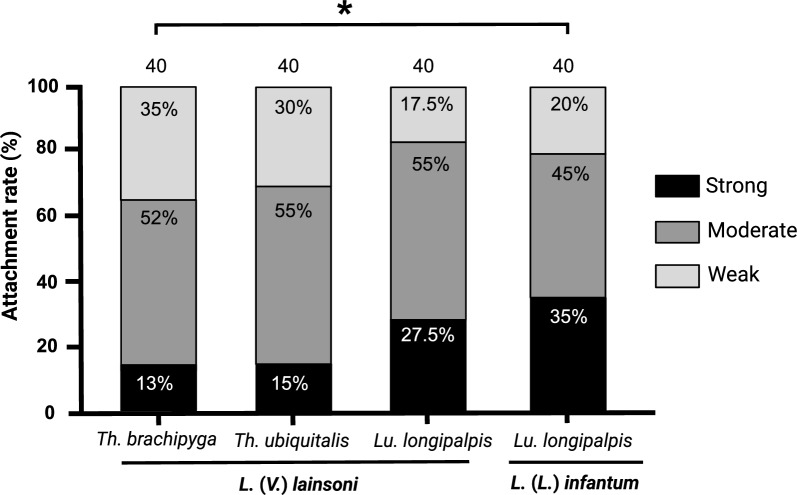
No difference was found between Th. ubiquitalis and Lu. longipalpis attachment with L. (V.) lainsoni, and Lu. longipalpis with Leishmania (Leishmania) infantum (control). However, Th. brachipyga-L. (V.) lainsoni attachment was weaker than that of the control. Trichophoromyia spp. were negative for residues of GlcNAc terminally exposed. Trichophoromyia ubiquitalis was positive for GalNAc and Gal/GalNAc, whereas Th. brachipyga presented only residues of GalNac terminally exposed.
The present study suggests that Trichophoromyia spp. sand flies, particularly Th. brachipyga, are susceptible to L. (V.) lainsoni, based on the observed vector-parasite attachment profiles and detection of GalNAc in their midguts. This supports early field data suggesting the vector status of these sand fly species.
了解白蛉与利什曼原虫的附着决定因素对于提供关于媒介地位的证据至关重要。考虑到亚马逊地区毛蠓属 - 赖氏利什曼原虫(Viannia亚属)的传播背景,本研究旨在评估体外相互作用并检测与这种媒介 - 寄生虫关联相关的肠道糖缀合物。
对野外捕获的短臂毛蠓和泛在毛蠓进行检测。以实验室饲养的长须白蛉作为对照。通过解剖获取肠道,并通过形态学确认物种。每种白蛉 - 利什曼原虫组合的相互作用通过体外培养系统单独进行。使用相应的过氧化物酶偶联凝集素通过蛋白质免疫印迹法分析毛蠓属的N - 乙酰 - D - 葡萄糖胺(GlcNAc)、半乳糖 -(β1,3)- N - 乙酰半乳糖胺(Gal/GalNAc)和N - 乙酰 - D - 半乳糖胺(GalNAc)糖缀合物。
泛在毛蠓和长须白蛉与赖氏利什曼原虫(Viannia亚属)的附着情况,以及长须白蛉与婴儿利什曼原虫(Leishmania亚属)(对照)的附着情况之间未发现差异。然而,短臂毛蠓与赖氏利什曼原虫(Viannia亚属)的附着比对照弱。毛蠓属未检测到末端暴露的GlcNAc残基。泛在毛蠓的GalNAc和Gal/GalNAc呈阳性,而短臂毛蠓仅检测到末端暴露的GalNac残基。
基于观察到的媒介 - 寄生虫附着情况以及在它们中肠中检测到GalNAc,本研究表明毛蠓属白蛉,特别是短臂毛蠓,对赖氏利什曼原虫(Viannia亚属)易感。这支持了早期野外数据表明这些白蛉物种的媒介地位。