
药物基因组学在儿科护理中的临床影响:从临床外显子组测序中提取的见解
Clinical impact of pharmacogenomics in pediatric care: insights extracted from clinical exome sequencing.
作者信息
Maggo Simran, Pan Yachen, Ostrow Dejerianne, Nguyen Jenny Q, Biegel Jaclyn A, Deardorff Matthew A, Gai Xiaowu
机构信息
Bernard J. Dunn School of Pharmacy, Shenandoah University, Winchester, VA, United States.
Center for Personalized Medicine, Department of Pathology and Laboratory Medicine, Children's Hospital Los Angeles, Los Angeles, CA, United States.
出版信息
Front Genet. 2025 May 29;16:1574325. doi: 10.3389/fgene.2025.1574325. eCollection 2025.
INTRODUCTION
Pharmacogenomic (PGx) testing improves drug efficacy and reduces risk of toxicity for commonly prescribed medications, with most pharmacogenomic studies largely focused on individuals of European descent to date. The impact of pharmacogenomic testing in a racially diverse population is still emerging, especially for Admixed American patients.
METHODS
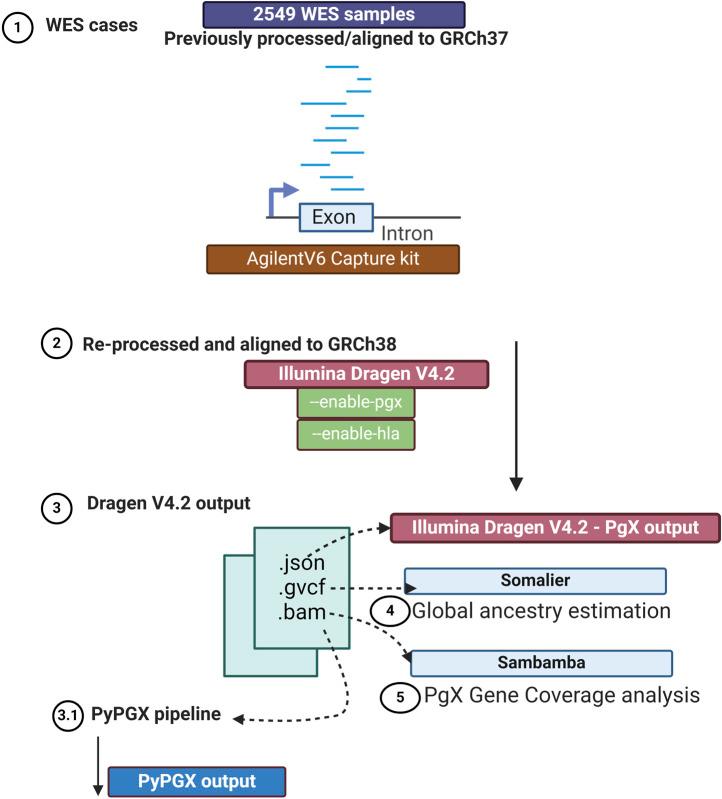
In this study, we assessed the frequency of actionable PGx variants by analyzing anonymized exome sequencing data of a racially diverse cohort of 1777 pediatric patients, collected for routine clinical genetic diagnosis at Children's Hospital Los Angeles (CHLA). Utilizing exome data, we used the Illumina DRAGEN germline pipeline v4.2, to determine the predicted phenotypes of 25 pharmacogenes including and , including CPIC Level A genes and genes recommended for PGx testing by the U.S. Food and Drug Administration. To assess cross-platform consistency, we compared our results to those generated by PyPGx, a pharmacogenomic genotyping tool developed by the same author as Stargazer. As the distribution of PGx alleles is ancestry specific, we estimated genetic ancestry bioinformatically using the Somalier tool.
RESULTS
Genetic ancestry analysis demonstrated that 62% of our cohort was Admixed American, followed by 23% European, 8% East Asian, 5% African American, and 2% South East Asian. Actionability analysis showed that: 1) 93% of all exome cases had at least one actionable PGx phenotype, 2) one in five cases (22%) had at least three actionable PGx phenotypes, and 3) CYP2B6 (54%) and CYP2D6 (33%) had the highest number of actionable phenotypes. Further analysis revealed notable differences, including higher rates of poor metabolizers for CYP2B6 and variations in CYP2D6 metabolizer statuses, in PGx phenotypes compared to previously collated frequencies in the PharmGKB database, especially within the Admixed American population.
DISCUSSION
In conclusion, our study reinforces the importance of PGx testing, underscores the diversity of PGx variation in ancestral backgrounds, and supports the clinical utility of preemptive PGx testing using exome or genome sequencing approaches.
引言
药物基因组学(PGx)检测可提高常用药物的疗效并降低毒性风险,迄今为止,大多数药物基因组学研究主要集中在欧洲血统的个体上。药物基因组学检测在种族多样化人群中的影响仍在显现,尤其是对于混血美国患者。
方法
在本研究中,我们通过分析1777名儿科患者的种族多样化队列的匿名外显子测序数据来评估可操作的PGx变异的频率,这些数据是在洛杉矶儿童医院(CHLA)为常规临床基因诊断收集的。利用外显子数据,我们使用Illumina DRAGEN种系分析流程v4.2来确定25种药物基因的预测表型,包括 和 ,包括CPIC A级基因以及美国食品药品监督管理局推荐用于PGx检测的基因。为了评估跨平台一致性,我们将我们的结果与PyPGx生成的结果进行了比较,PyPGx是由与Stargazer同一作者开发的药物基因组学基因分型工具。由于PGx等位基因的分布具有祖先特异性,我们使用Somalier工具通过生物信息学方法估计遗传祖先。
结果
遗传祖先分析表明,我们队列中的62%是混血美国人,其次是23%的欧洲人、8%的东亚人、5%的非裔美国人和2%的东南亚人。可操作性分析表明:1)所有外显子病例中有93%至少有一种可操作的PGx表型,2)五分之一的病例(22%)至少有三种可操作的PGx表型,3)CYP2B6(54%)和CYP2D6(33%)具有可操作表型的数量最多。进一步分析揭示了显著差异,包括与PharmGKB数据库中先前整理的频率相比,PGx表型中CYP2B负代谢者的比例更高以及CYP2D6代谢者状态的变化,特别是在混血美国人群体中。
讨论
总之,我们的研究强化了PGx检测的重要性,强调了PGx变异在祖先背景中的多样性,并支持使用外显子或基因组测序方法进行前瞻性PGx检测的临床实用性。




 Zotero 插件