Zhang Yuhan, Wang Cenzhu, Ruan Tingyan, Liang Shuai, Jiang Huning, Wu Xi, Hou Rui, Fan Hanfang, Wang Huiyu, Ding Junli, Xu Junying
The Affiliated Wuxi People's Hospital of Nanjing Medical University, Wuxi People's Hospital, Wuxi Medical Center, Nanjing Medical University.
Int J Med Sci. 2025 May 16;22(11):2596-2608. doi: 10.7150/ijms.111723. eCollection 2025.
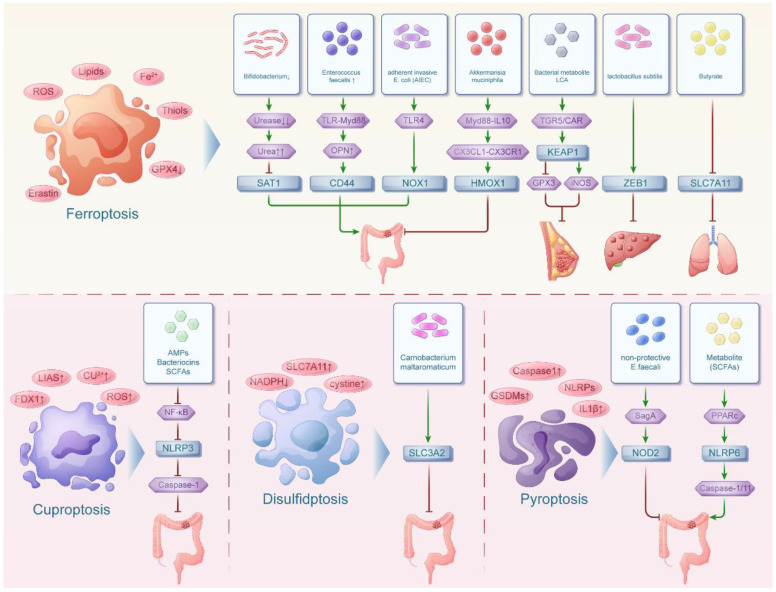
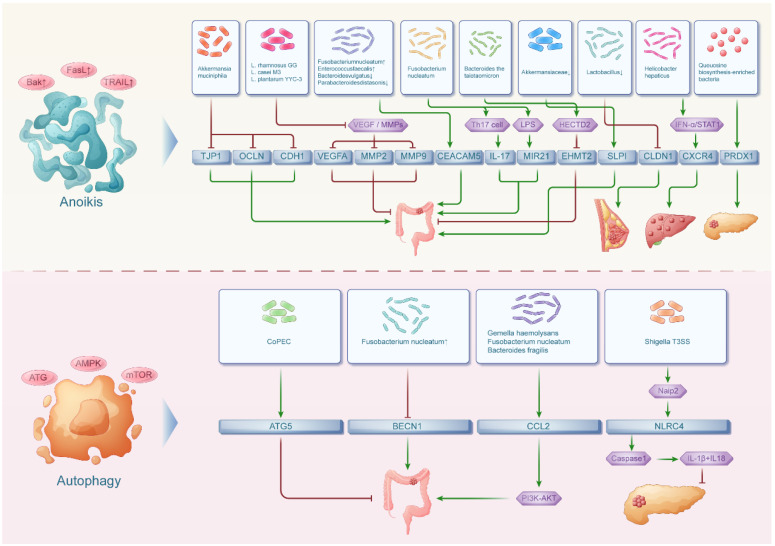
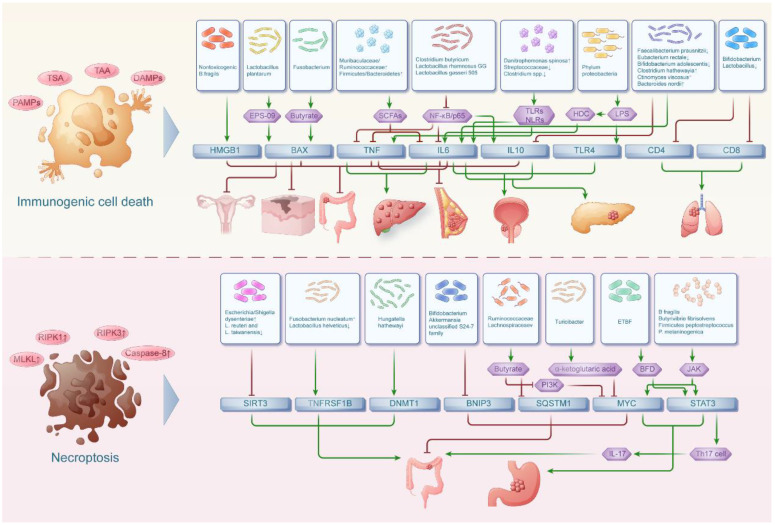
The human intestinal floras play an important role in human microecosystem, accounting for more than 1,500 species and consisting of beneficial, harmful and neutral bacteria, which take part in regulating the progression of various malignant tumors. Meanwhile, the cell death is a physiological process maintaining biological development and internal environmental homeostasis, including cuproptosis, ferroptosis, disulfidptosis, immunogenic cell death, necroptosis, anoikis, autophagy, pyroptosis and so on. A variety of cell deaths and their related genes have been reported to regulate many malignant tumors. In recent years, there has been increasing interest in understanding the interaction network between intestinal flora and cell death in microecosystem of various malignant tumors. However, this interaction network is still not fully understood and requires further investigation. Therefore, the aim of this study is to explore the potential mechanism network between intestinal flora and cell death in pan-cancers, with the hope that this research could bring a novel insight for the prevention and treatment of tumors.
人类肠道菌群在人体微生态系统中发挥着重要作用,由1500多种细菌组成,包括有益菌、有害菌和中性菌,参与调节各种恶性肿瘤的进展。同时,细胞死亡是维持生物发育和内环境稳态的生理过程,包括铜死亡、铁死亡、二硫键死亡、免疫原性细胞死亡、坏死性凋亡、失巢凋亡、自噬、焦亡等。据报道,多种细胞死亡及其相关基因可调节许多恶性肿瘤。近年来,人们越来越关注了解各种恶性肿瘤微生态系统中肠道菌群与细胞死亡之间的相互作用网络。然而,这种相互作用网络仍未完全了解,需要进一步研究。因此,本研究的目的是探索泛癌中肠道菌群与细胞死亡之间的潜在机制网络,希望这项研究能为肿瘤的预防和治疗带来新的见解。